Meta-Analysis
. 2017 Jul 1;43(4):788-800.
doi: 10.1093/schbul/sbw146.

Heritability of Neuropsychological Measures in Schizophrenia and Nonpsychiatric Populations: A Systematic Review and Meta-analysis

Affiliations
Meta-Analysis

Heritability of Neuropsychological Measures in Schizophrenia and Nonpsychiatric Populations: A Systematic Review and Meta-analysis

Gabriëlla A M Blokland et al. Schizophr Bull. .

Abstract

Schizophrenia is characterized by neuropsychological deficits across many cognitive domains. Cognitive phenotypes with high heritability and genetic overlap with schizophrenia liability can help elucidate the mechanisms leading from genes to psychopathology. We performed a meta-analysis of 170 published twin and family heritability studies of >800 000 nonpsychiatric and schizophrenia subjects to accurately estimate heritability across many neuropsychological tests and cognitive domains. The proportion of total variance of each phenotype due to additive genetic effects (A), shared environment (C), and unshared environment and error (E), was calculated by averaging A, C, and E estimates across studies and weighting by sample size. Heritability ranged across phenotypes, likely due to differences in genetic and environmental effects, with the highest heritability for General Cognitive Ability (32%-67%), Verbal Ability (43%-72%), Visuospatial Ability (20%-80%), and Attention/Processing Speed (28%-74%), while the lowest heritability was observed for Executive Function (20%-40%). These results confirm that many cognitive phenotypes are under strong genetic influences. Heritability estimates were comparable in nonpsychiatric and schizophrenia samples, suggesting that environmental factors and illness-related moderators (eg, medication) do not substantially decrease heritability in schizophrenia samples, and that genetic studies in schizophrenia samples are informative for elucidating the genetic basis of cognitive deficits. Substantial genetic overlap between cognitive phenotypes and schizophrenia liability (average rg = -.58) in twin studies supports partially shared genetic etiology. It will be important to conduct comparative studies in well-powered samples to determine whether the same or different genes and genetic variants influence cognition in schizophrenia patients and the general population.

Keywords: cognition; endophenotypes; heritability; meta-analysis; neuropsychology; twin study.


Figures

Fig. 1.
Fig. 1.
Variance component estimates for cognitive phenotypes based on meta-analysis of nonpsychiatric twin studies. Percentage variance explained by A (Additive genetic influences), C (Common environment), and E (Unique environment and Error) for individual test variables (plain font) and cognitive domains (bold font). Error bars and numbers in parentheses indicate 95% CIs. The sample size for a given cognitive domain differs from the summed sample size for test variables within that domain because inclusion criteria differ (supplementary methods).
Fig. 2.
Fig. 2.
Variance component estimates for cognitive phenotypes based on meta-analysis of nonpsychiatric family studies. Percentage variance explained by A + C (Additive genetic + Common environment influences) and E (Unique environment and Error) for individual test variables (plain font) and cognitive domains (bold font). A and C are combined because they cannot be disentangled in the family design. Error bars and numbers in parentheses indicate 95% CIs. The sample size for a given cognitive domain differs from the summed sample size for test variables within that domain because inclusion criteria differ (supplementary methods).
Fig. 3.
Fig. 3.
Variance component estimates for cognitive phenotypes based on meta-analysis of schizophrenia family studies. Percentage variance explained by A + C (Additive genetic + Common environment influences) and E (Unique environment and Error) for individual test variables (plain font) and cognitive domains (bold font). A and C are combined because they cannot be disentangled in the family design. Error bars and numbers in parentheses indicate 95% CIs. The sample size for a given cognitive domain differs from the summed sample size for test variables within that domain because inclusion criteria differ (supplementary methods).
Fig. 4.
Fig. 4.
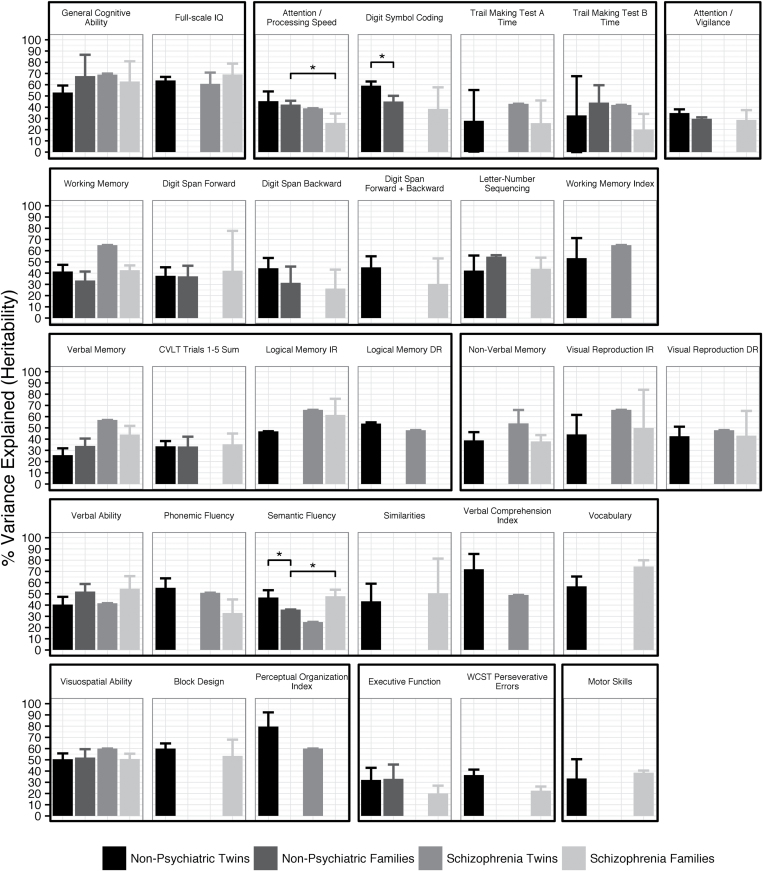
Heritability of cognitive phenotypes across study designs. Phenotypic variance explained was determined by meta-analysis for nonpsychiatric twin, nonpsychiatric family, and schizophrenia family studies, or from the original study estimates for schizophrenia twin studies. Cognitive domains (bold) and test variables (plain) meta-analyzed in the nonpsychiatric twin and at least one other study design are shown. Error bars indicate 95% CIs. *P < .05 (Bonferroni-corrected). WCST = Wisconsin Card Sorting Test; CVLT = California Verbal Learning Test; IR, DR = Immediate, Delayed Recall.
Fig. 5.
Fig. 5.
Genetic overlap between cognitive phenotypes and schizophrenia liability based on twin data. Cross-twin cross-trait (CT–CT) correlations for cognition in co-twin 1 and schizophrenia liability in co-twin 2 for MZ pairs (rMZCT–CT) and DZ pairs (rDZCT–CT). rph is the total phenotypic correlation between the cognitive phenotype and schizophrenia liability, of which rph-a is the amount due to additive genetic influences. rg is the genetic correlation between the cognitive phenotype and schizophrenia liability. All correlations are negative (ie, poor cognition associated with high liability) but are shown as positive values for plotting consistency. Data are maximum likelihood estimates reported in references. Study reference numbers are shown in parentheses. CT–CT correlations were only reported for studies Toulopoulou et al and Toulopoulou et al. FIQ and WMS subtests were analyzed in multiple studies; only data from studies reporting CT–CT correlations are shown. See supplementary table 8 for all reported data. FIQ = Full-Scale Intelligence Quotient; IR, DR = Immediate, Delayed Recall; WAIS = Wechsler Adult Intelligence Scale; WMS = Wechsler Memory Scale.

References

    1. Fioravanti M, Bianchi V, Cinti ME. Cognitive deficits in schizophrenia: an updated metanalysis of the scientific evidence. BMC Psychiatry. 2012;12:64. - PMC - PubMed
    1. Heinrichs RW, Zakzanis KK. Neurocognitive deficit in schizophrenia: a quantitative review of the evidence. Neuropsychology. 1998;12:426–445. - PubMed
    1. O’Carroll R. Cognitive impairment in schizophrenia. Adv Psychiatr Treat. 2000;6:161–168.
    1. Mesholam-Gately RI, Giuliano AJ, Goff KP, Faraone SV, Seidman LJ. Neurocognition in first-episode schizophrenia: a meta-analytic review. Neuropsychology. 2009;23:315–336. - PubMed
    1. Fusar-Poli P, Deste G, Smieskova R, et al. Cognitive functioning in prodromal psychosis: a meta-analysis. Arch Gen Psychiatry. 2012;69:562–571. - PubMed