


Hallucinations: A Systematic Review of Points of Similarity and Difference Across Diagnostic Classes
- PMID: 27872259
- PMCID: PMC5216859
- DOI: 10.1093/schbul/sbw132
Hallucinations: A Systematic Review of Points of Similarity and Difference Across Diagnostic Classes
Abstract
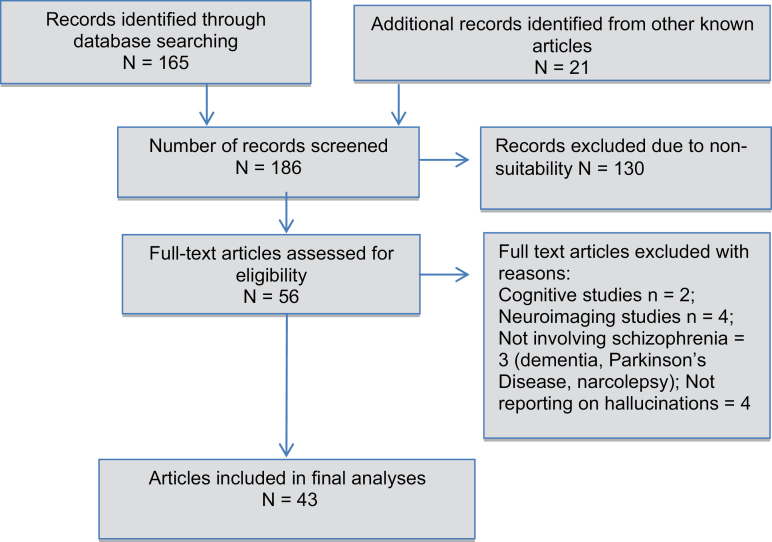
Hallucinations constitute one of the 5 symptom domains of psychotic disorders in DSM-5, suggesting diagnostic significance for that group of disorders. Although specific featural properties of hallucinations (negative voices, talking in the third person, and location in external space) are no longer highlighted in DSM, there is likely a residual assumption that hallucinations in schizophrenia can be identified based on these candidate features. We investigated whether certain featural properties of hallucinations are specifically indicative of schizophrenia by conducting a systematic review of studies showing direct comparisons of the featural and clinical characteristics of (auditory and visual) hallucinations among 2 or more population groups (one of which included schizophrenia). A total of 43 articles were reviewed, which included hallucinations in 4 major groups (nonclinical groups, drug- and alcohol-related conditions, medical and neurological conditions, and psychiatric disorders). The results showed that no single hallucination feature or characteristic uniquely indicated a diagnosis of schizophrenia, with the sole exception of an age of onset in late adolescence. Among the 21 features of hallucinations in schizophrenia considered here, 95% were shared with other psychiatric disorders, 85% with medical/neurological conditions, 66% with drugs and alcohol conditions, and 52% with the nonclinical groups. Additional differences rendered the nonclinical groups somewhat distinctive from clinical disorders. Overall, when considering hallucinations, it is inadvisable to give weight to the presence of any featural properties alone in making a schizophrenia diagnosis. It is more important to focus instead on the co-occurrence of other symptoms and the value of hallucinations as an indicator of vulnerability.
Keywords: bipolar disorder; nonclinical; psychosis; schizophrenia.
© The Author 2016. Published by Oxford University Press on behalf of the Maryland Psychiatric Research Center.
Comment in
-
Current Approaches to Studying Hallucinations: Overcoming Barriers to Progress.Schizophr Bull. 2017 Jan;43(1):21-23. doi: 10.1093/schbul/sbw149. Epub 2016 Nov 21. Schizophr Bull. 2017. PMID: 27872264 Free PMC article. No abstract available.
-
Animal Models of Hallucinations Observed Through the Modern Lens.Schizophr Bull. 2017 Jan;43(1):24-26. doi: 10.1093/schbul/sbw134. Schizophr Bull. 2017. PMID: 28053128 Free PMC article. No abstract available.
References
-
- Esquirol E. Mental Maladies; A Treatise on Insanity. Philadelphia, PA: Lea and Blanchard; 1845.
-
- Berrios GE. The History of Mental Symptoms: Descriptive Psychopathology Since the Nineteenth Century. Cambridge, UK: Cambridge University Press; 1996.
-
- Diefendorf AR, Kraepelin E. Clinical Psychiatry: A Textbook for Students and Physicians. Abstracted and adapted from the 7th German edition of Kraepelin’s Lehrbuch der Psychiatrie, new ed., rev. and augment. New York, NY: MacMillan; 1907.
-
- Schneider K. Clinical Psychopathology, trans. by Hamilton MW. New York, NY: Grune & Stratton; 1959.
-
- American Psychiatric Association. Diagnostic and Statistical Manual of Mental Disorders. 5th ed. Washington, DC: American Psychiatric Association; 2013.
Publication types
MeSH terms
Grants and funding
LinkOut - more resources
Full Text Sources
Other Literature Sources
Medical
Molecular Biology Databases
