. 2016:2016:5103718.
doi: 10.1155/2016/5103718. Epub 2016 Oct 30.

Modelling Seasonal Brucellosis Epidemics in Bayingolin Mongol Autonomous Prefecture of Xinjiang, China, 2010-2014

Affiliations

Modelling Seasonal Brucellosis Epidemics in Bayingolin Mongol Autonomous Prefecture of Xinjiang, China, 2010-2014

Pengwei Lou et al. Biomed Res Int. 2016.

Abstract

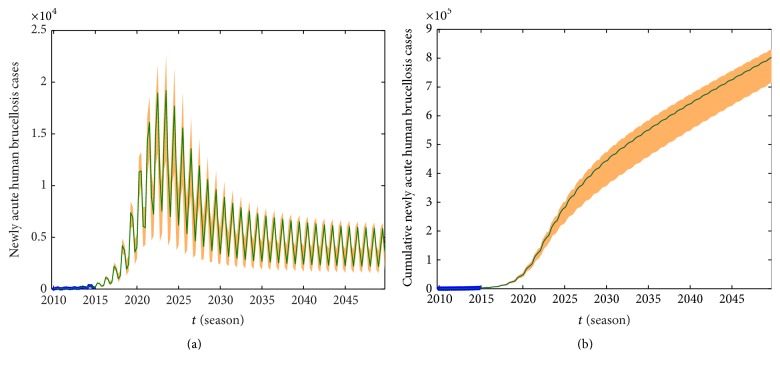
Brucellosis is one of the severe public health problems; the cumulative number of new human brucellosis cases reached 211515 from 2010 to 2014 in China. Bayingolin Mongol Autonomous Prefecture is situated in the southeast of Xinjiang, where brucellosis infection occurs every year. Based on the reported data of newly acute human brucellosis cases for each season in Bayingolin Mongol Autonomous Prefecture, we proposed a susceptible, exposed, infected, and vaccinated (SEIV) model with periodic transmission rates to investigate the seasonal brucellosis transmission dynamics among sheep/cattle and from sheep/cattle to humans. Compared with the criteria of MAPE and RMSPE, the model simulations agree to the data on newly acute human brucellosis. We predict that the number of newly acute human brucellosis is increasing and will peak 15325 [95% CI: 11920-18242] around the summer of 2023. We also estimate the basic reproduction number R0 = 2.5524 [95% CI: 2.5129-2.6225] and perform some sensitivity analysis of the newly acute human brucellosis cases and the basic reproduction number R0 in terms of model parameters. Our study demonstrates that reducing the birth number of sheep/cattle, raising the slaughter rate of infected sheep/cattle, increasing the vaccination rate of susceptible sheep/cattle, and decreasing the loss rate of vaccination are effective strategies to control brucellosis epidemic.


Figures
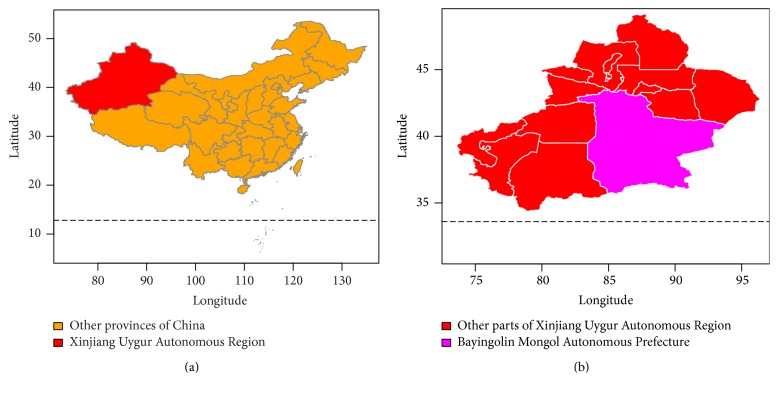
Figure 1
Figure 1
The specific geography location of Bayingolin Mongol Autonomous Prefecture. (a) The map of China. (b) The map of Xinjiang Uygur Autonomous Region.
Figure 2
Figure 2
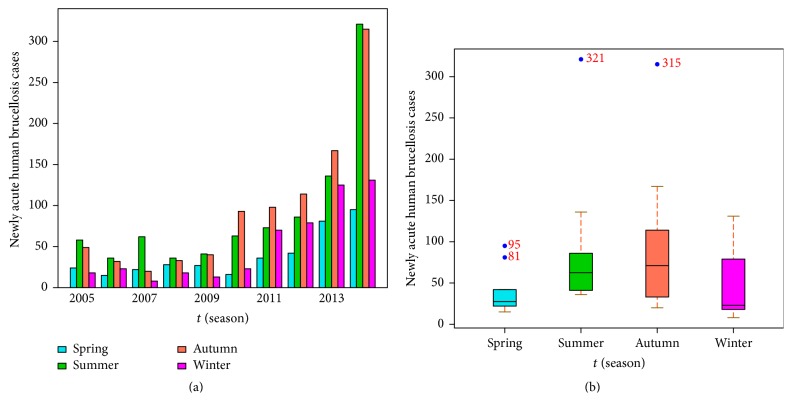
The reported data of newly acute human brucellosis cases in each season from 2005 to 2014. (a) The reported data are described with a bar diagram. (b) The reported data are displayed with a boxplot.
Figure 3
Figure 3
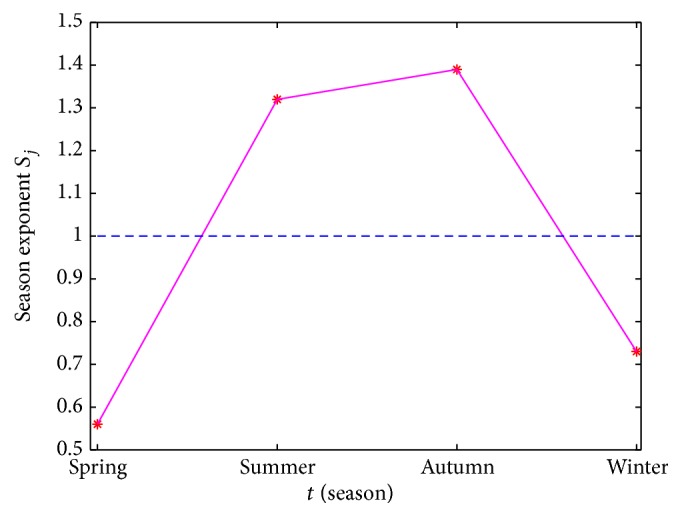
The season exponent of average newly acute human brucellosis cases from 2005 to 2014. The asterisks represent the season exponent values.
Figure 4
Figure 4
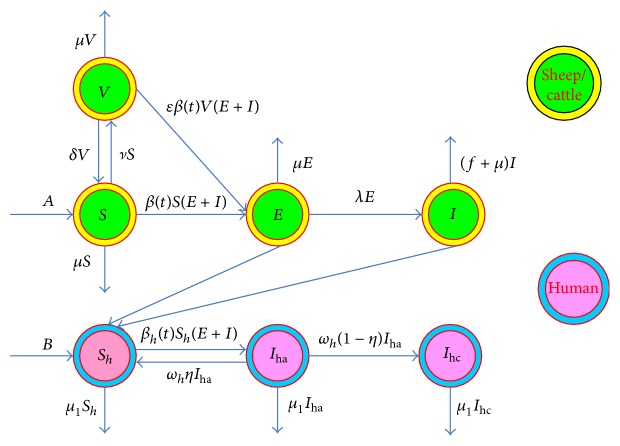
The flowchart of brucellosis transmission among sheep/cattle and from sheep/cattle to humans.
Figure 5
Figure 5
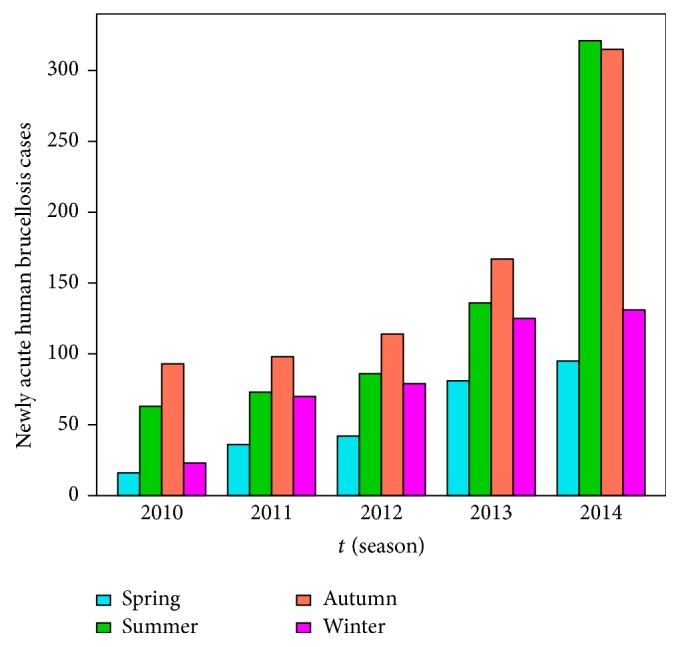
The reported number of newly acute human brucellosis cases from 2010 to 2014.
Figure 6
Figure 6
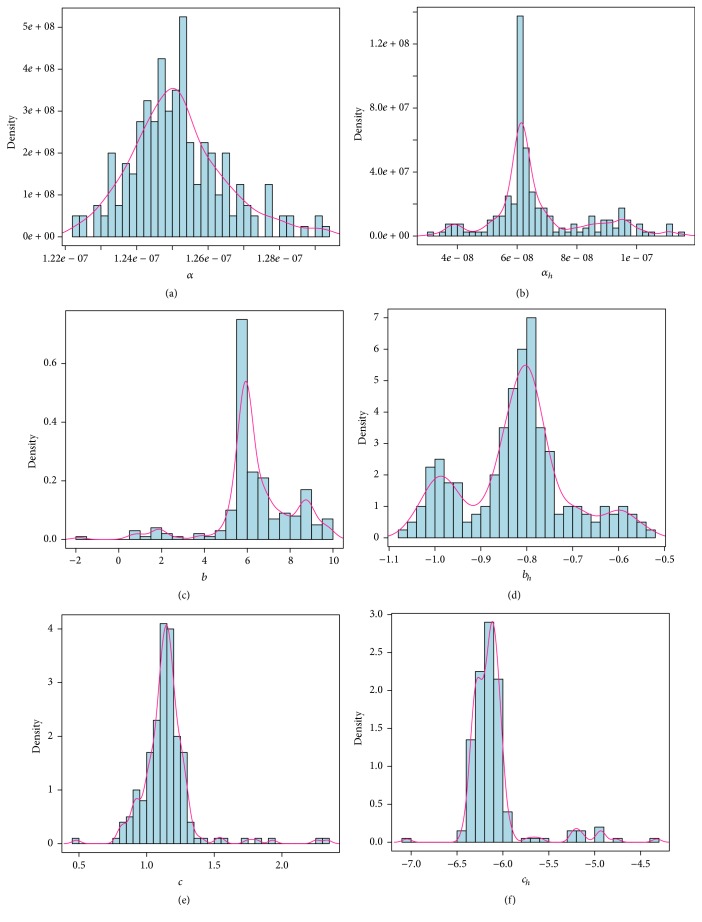
Frequency distribution histograms and probability density curves of the estimated parameters α, b, c, α h, b h, c h. The blue bars represent frequency distribution histograms and pink lines represent probability density curves.
Figure 7
Figure 7
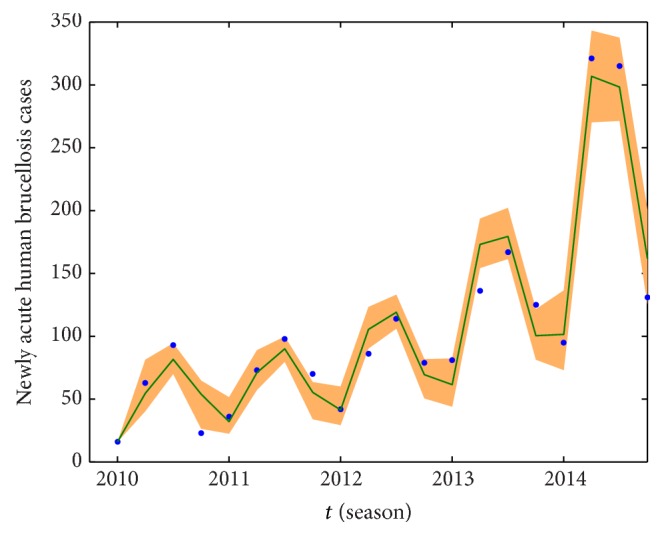
The number of newly acute human brucellosis cases and fitted curve. The blue dots represent the real data while the dark green solid curve is fitted by using our model, and the salmon area represents the 95% confidence interval around model fitted.
Figure 8
Figure 8
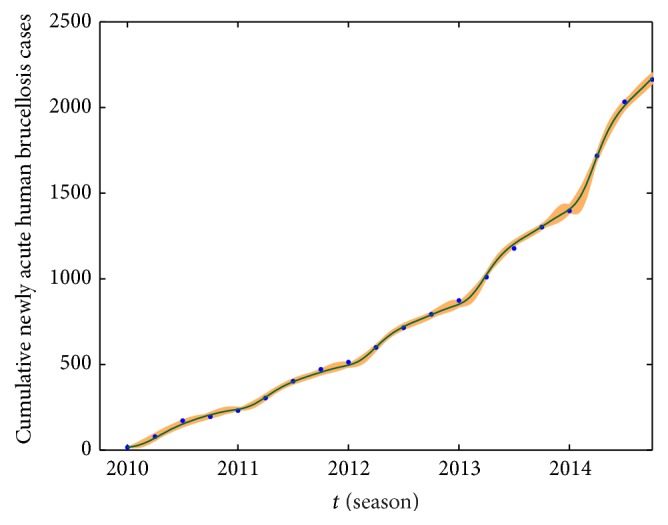
The cumulative number of newly acute human cases and fitted curve. The blue dots represent the real data while the dark green solid curve is fitted by using our model, and the salmon area represents the 95% confidence interval around model fitted.
Figure 9
Figure 9
Prediction of newly acute human brucellosis in 35 years from 2015 to 2049. (a) The number of newly acute human brucellosis cases. (b) The cumulative number of newly acute human brucellosis cases.
Figure 10
Figure 10
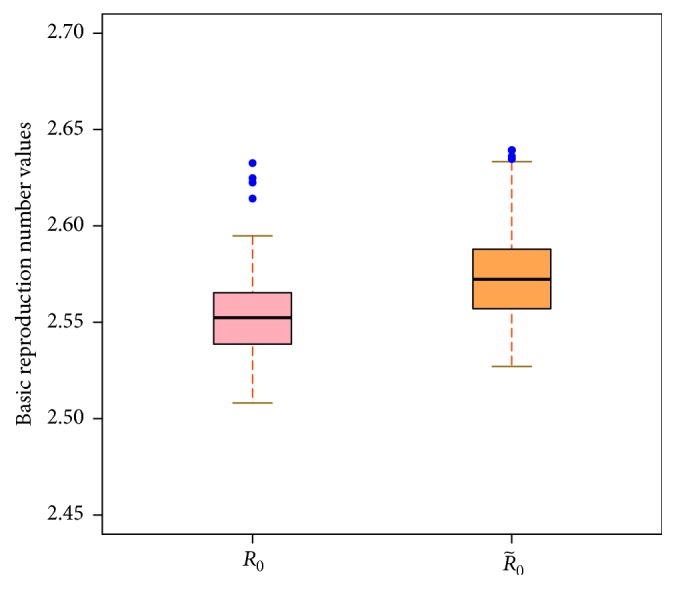
The boxplots of estimated basic reproduction number R 0 and average basic reproduction number R~0.
Figure 11
Figure 11
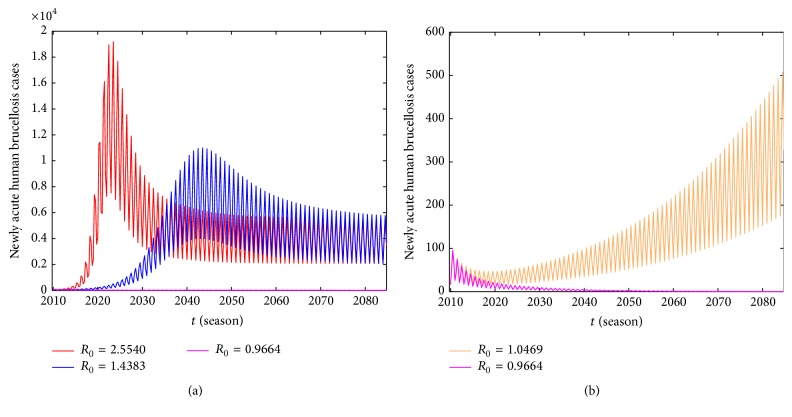
The variations of the newly acute human brucellosis cases for different values of R 0. (a) When ν = 0.0412, 0.206, and 0.412, R 0 = 2.554, 1.4383, and 0.9664, respectively. (b) When ν = 0.36, R 0 = 1.0469. Other parameters are as in Tables 2 and 3.
Figure 12
Figure 12
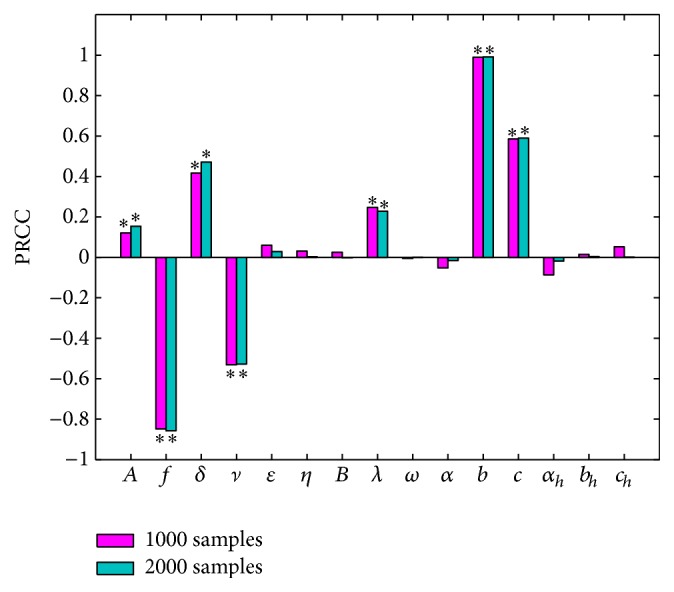
Partial rank correlation coefficients (PRCC) results for the dependence of newly acute human brucellosis cases in each season on each parameter. denotes the value of PRCC which is not zero significantly, where the significance level is 0.05.
Figure 13
Figure 13
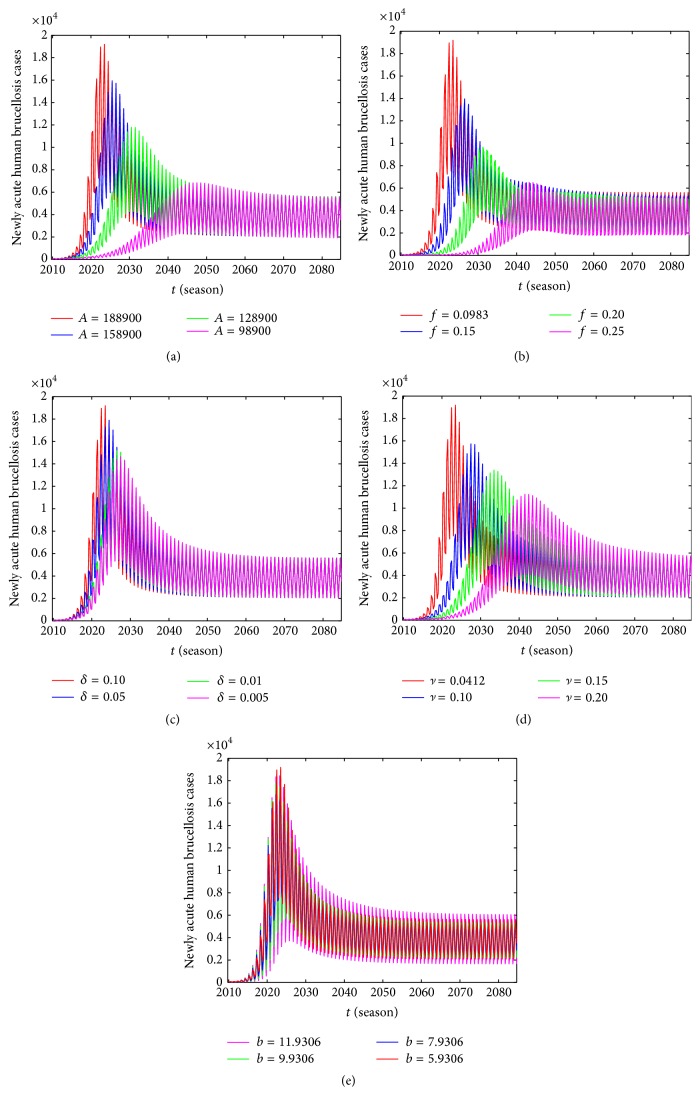
The influence of different parameters on the number of newly acute human brucellosis cases I ha(t): (a) different values of A; (b) different values of f; (c) different values of δ; (d) different values of ν; (e) different values of b.
Figure 14
Figure 14
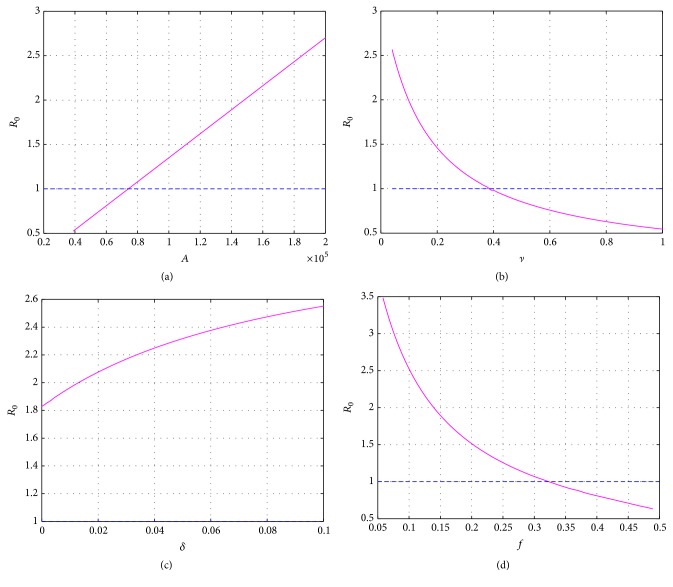
The influence of parameters on R 0: (a) versus A; (b) versus ν; (c) versus δ; (d) versus f.

References

    1. Dean A. S., Bonfoh B., Kulo A. E., et al. Epidemiology of brucellosis and Q fever in linked human and animal populations in northern togo. PLoS ONE. 2013;8(8, article e71501) doi: 10.1371/journal.pone.0071501. - DOI - PMC - PubMed
    1. Li M.-T., Sun G.-Q., Wu Y.-F., Zhang J., Jin Z. Transmission dynamics of a multi-group brucellosis model with mixed cross infection in public farm. Applied Mathematics and Computation. 2014;237(11):582–594. doi: 10.1016/j.amc.2014.03.094. - DOI
    1. Zhou Y. B., Liu X. L. The research progress in terms of prevalence, incidence reason and control strategies of brucellosis. Liaoning Medical University. 2010;1(1):81–85.
    1. Zhang F. B., Li Z. W., La X. L., et al. Multiple-locus variable-number tandem-repeat analysis of Brucella isolates from patients in Xinjiang, China. International Journal of Clinical and Experimental Medicine. 2015;8(9):15716–15723. - PMC - PubMed
    1. Pappas G., Papadimitriou P., Akritidis N., Christou L., Tsianos E. V. The new global map of human brucellosis. The Lancet Infectious Diseases. 2006;6(2):91–99. doi: 10.1016/s1473-3099(06)70382-6. - DOI - PubMed

LinkOut - more resources