


Electrochemical Determination of the Antioxidant Potential of Some Less Common Fruit Species
- PMID: 27873945
- PMCID: PMC3790976
- DOI: 10.3390/s8127564
Electrochemical Determination of the Antioxidant Potential of Some Less Common Fruit Species
Abstract
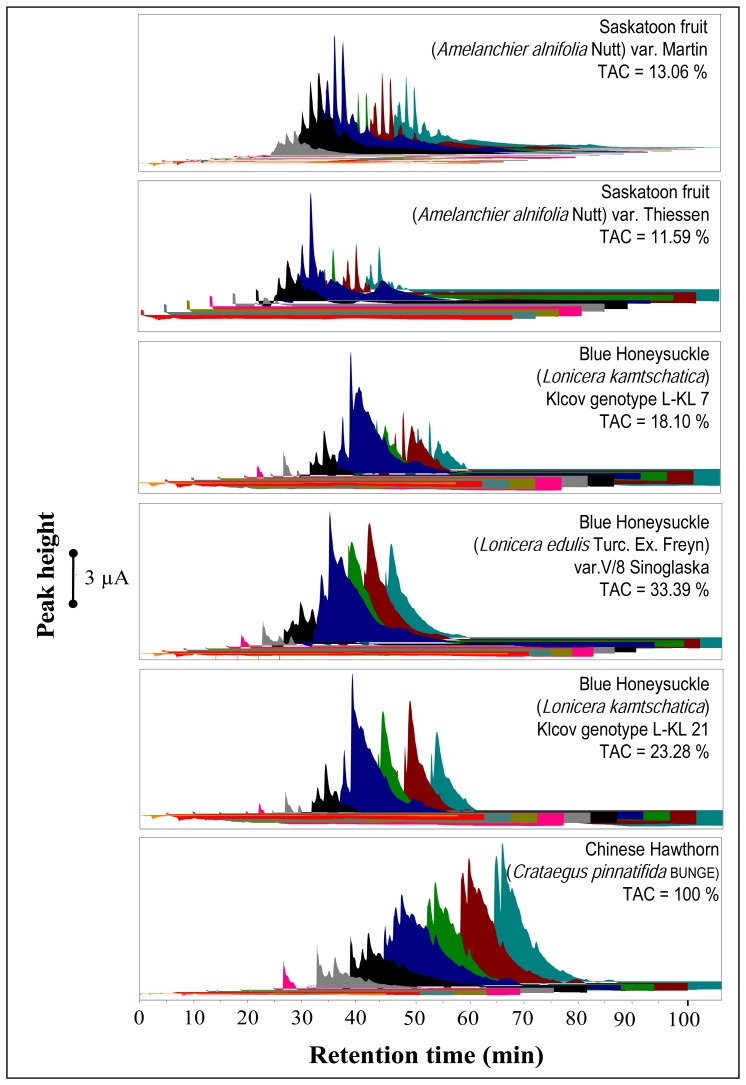
Various berries and fruit types of less common fruit species are known to contain antioxidants. Consumption of high amounts of antioxidant flavonoids, which display a variety of biological properties, including antiproliferative and anti-inflammatory activity, may have a positive impact on human health, particularly for the prevention of cancer and other inflammatory diseases. In these studies, based on the hypothesis that the fruit extract with the highest content would possess significantly higher health benefits, flavonoid-rich extracts were obtained from some less common fruit species - Blue Honeysuckles (Lonicera Kamtschatica and Lonicera edulis, Turcz. ex. Freyn), Saskatoon berry (Amelanchier alnifolia Nutt.) and Chinese Hawthorn (Crataegus pinnatifida BUNGE) - grown from germplasm held at the Mendel University of Agriculture and Forestry in Brno, Czech Republic and then characterized in terms of biological value based on the results from a relative antioxidant capacity assessment. The antioxidant content evaluation was based on the total flavonoid amount, determined by liquid chromatography with electrochemical detection (HPLC-ED). A DPPH• test was applied as a reference. The antioxidant content measured in Chinese Hawthorn fruit extract identified it as a potent source of flavonoid antioxidants, with a content 9-fold higher than that seen in Amelanchier fruit. The multifunctional HPLC-ED array method coupled with a DPPH• reference appears to be the optimal analytical progress, accurately reflecting the nutritivetherapeutic properties of a fruit.
Keywords: Antioxidant Capacity; DPPH• test; Flavonoids; Less Common Fruit Species; Liquid Chromatography with Electrochemical Detection.
Figures
References
-
- Gey K.F. The Antioxidant Hypothesis of Cardiovascular-Disease - Epidemiology and Mechanisms. Biochem. Soc. Trans. 1990;18:1041–1045. - PubMed
-
- Gillman M.W., Cupples L.A., Gagnon D., Posner B.M., Ellison R.C., Castelli W.P., Wolf P.A. Protective Effect of Fruits and Vegetables on Development of Stroke in Men. JAMA. 1995;273:1113–1117. - PubMed
-
- Hodek P., Hanustiak P., Krizkova J., Mikelova R., Krizkova S., Stiborova M., Trnkova L., Horna A., Beklova M., Kizek R. Toxicological aspects of flavonoid interaction with biomacromolecules. Neuroendocrinol. Lett. 2006;27:14–17. - PubMed
-
- Gey K.F., Puska P., Jordan P., Moser U.K. Inverse Correlation between Plasma Vitamin-E and Mortality from Ischemic-Heart-Disease in Cross-Cultural Epidemiology. Am. J. Clin. Nutr. 1991;53:S326–S334. - PubMed
-
- La Vecchia C., Altieri A., Tavani A. Vegetables, fruit, antioxidants and cancer: a review of Italian studies. Eur. J. Nutr. 2001;40:261–267. - PubMed
LinkOut - more resources
Full Text Sources
