


Urgency traits moderate daily relations between affect and drinking to intoxication among young adults
- PMID: 27875802
- PMCID: PMC5183550
- DOI: 10.1016/j.drugalcdep.2016.10.035
Urgency traits moderate daily relations between affect and drinking to intoxication among young adults
Abstract
Background: Young adults with higher trait urgency (i.e., a tendency to act rashly in response to heightened affect) may be especially vulnerable to heavy drinking. The current study examined 1) the influence of urgency on daily relations between affect and drinking to intoxication, and 2) whether urgency influenced the effectiveness of naltrexone (vs. placebo) for reducing alcohol use.
Methods: This study is a secondary analysis of data from 126 (n=40 female) heavy drinking young adults, ages 18-25, enrolled in a double-blind, 8-week clinical trial comparing brief motivational intervention and either naltrexone or placebo. Multilevel models examined whether trait urgency moderated daily relations between positive and negative affect and drinking to intoxication, measured by an estimated blood-alcohol concentration (eBAC) at or above the legal limit (≥0.08g%). Person-level interactions examined whether naltrexone was more effective than placebo at reducing the odds of eBAC≥0.08g% for individuals with higher vs. lower trait urgency.
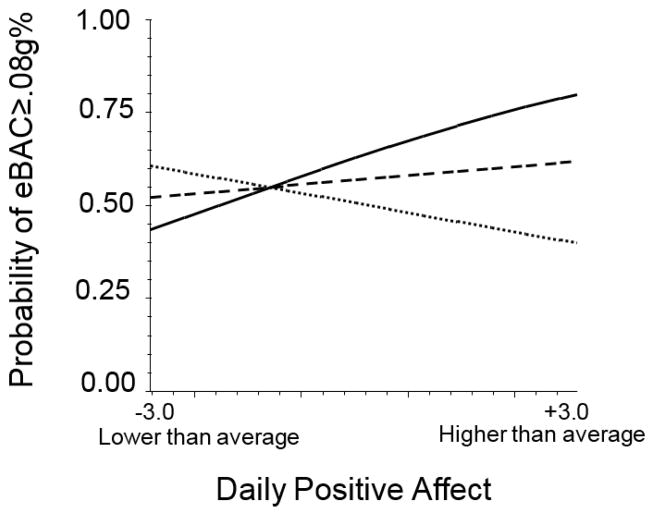
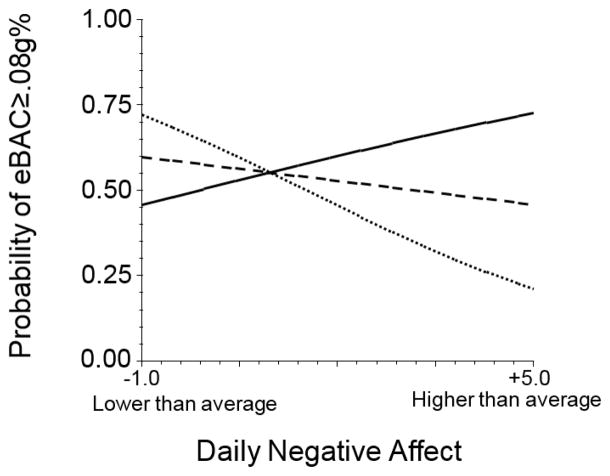
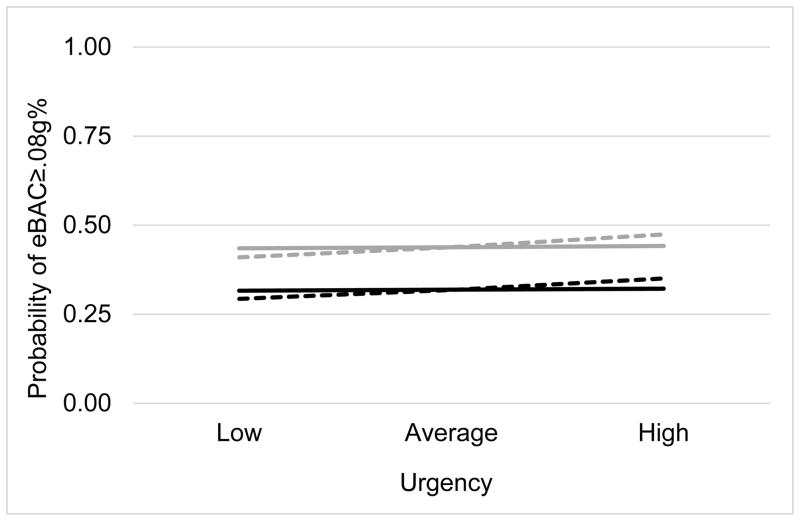
Results: On days of greater within-person positive or negative affect, young adults with higher urgency were more likely to drink to intoxication than those with lower urgency. Naltrexone reduced the odds of drinking to intoxication significantly more than placebo, independent of positive or negative urgency.
Conclusions: Although naltrexone treatment reduced drinking overall, young adults with higher trait urgency were still at increased risk for hazardous drinking following times of strong positive or negative mood. Targeted interventions are needed to reduce the risk of heavy drinking among young adults with high trait urgency.
Keywords: Affect; Alcohol; Drinking; Impulsivity; Mood; Urgency.
Copyright © 2016 Elsevier Ireland Ltd. All rights reserved.
Conflict of interest statement
None.
Figures
References
-
- Anton RF, Drobes DJ, Voronin K, Durazo-Avizu R, Moak D. Naltrexone effects on alcohol consumption in a clinical laboratory paradigm: temporal effects of drinking. Psychopharmacology. 2004;173:32–40. - PubMed
-
- Armeli S, Todd M, Conner TS, Tennen H. Drinking to cope with negative moods and the immediacy of drinking within the weekly cycle among college students. J Stud Alcohol Drugs. 2008;69:313–322. - PubMed
-
- Biener L, Abrams DB. The Contemplation Ladder: validation of a measure of readiness to consider smoking cessation. Health Psychol. 1991;10:360. - PubMed
-
- Benjamin D, Grant ER, Pohorecky LA. Naltrexone reverses ethanol-induced dopamine release in the nucleus accumbens in awake, freely moving rats. Brain Res. 1993;621:137–140. - PubMed
Publication types
MeSH terms
Substances
Grants and funding
LinkOut - more resources
Full Text Sources
Other Literature Sources
Medical
