


Do We Still Have a Digital Divide in Mental Health? A Five-Year Survey Follow-up
- PMID: 27876684
- PMCID: PMC5141335
- DOI: 10.2196/jmir.6511
Do We Still Have a Digital Divide in Mental Health? A Five-Year Survey Follow-up
Abstract
Background: Nearly everyone in society uses the Internet in one form or another. The Internet is heralded as an efficient way of providing mental health treatments and services. However, some people are still excluded from using Internet-enabled technology through lack of resources, skills, and confidence.
Objective: Five years ago, we showed that people with severe mental illness were at risk of digital exclusion, especially middle-aged patients with psychosis and/or people from black or minority ethnic groups with psychosis. An understanding of the breadth of potential digital exclusion is vital for the implementation of digital health services. The aim of this study is to understand the context of digital exclusion for people who experience mental illness.
Methods: We conducted a survey involving people with a primary diagnosis of psychosis or depression in London, United Kingdom. A total of 241 participants were recruited: 121 with psychosis and 120 with depression. The majority of surveys were collected face-to-face (psychosis: n=109; depression: n=71). Participants answered questions regarding familiarity, access, use, motivation, and confidence with Internet-enabled technologies (ie, computers and mobile phones). Variables predicting digital exclusion were identified in regression analyses. The results were compared with the survey conducted in 2011.
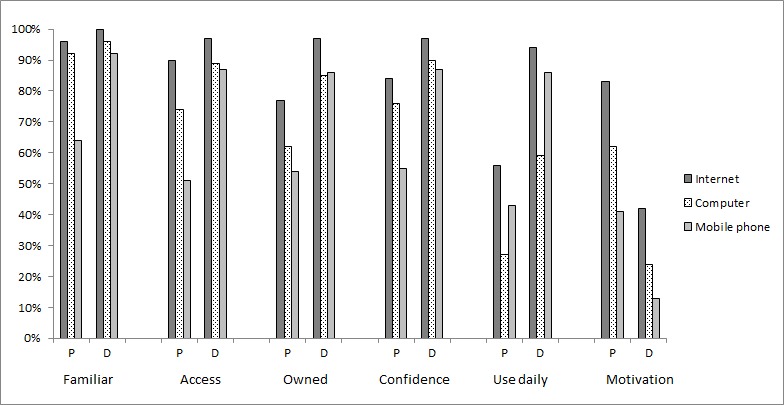
Results: Digital exclusion has declined since 2011. Online survey collection introduced biases into the sample, masking those who were likely to be excluded. Only 18.3% (20/109) of people with psychosis in our sample were digitally excluded, compared with 30% (28/93) in 2011 (χ21=3.8, P=.04). People with psychosis had less confidence in using the Internet than people with depression (χ21=7.4, P=.004). Only 9.9% (24/241) of participants in the total sample were digitally excluded, but the majority of these people had psychosis (n=20). Those with psychosis who were digitally excluded were significantly older than their included peers (t30=3.3, P=.002) and had used services for longer (t97=2.5, P=.02). Younger people were more likely to use mobile phones. Digitally excluded participants cited a lack of knowledge as a barrier to digital inclusion, and most wanted to use the Internet via computers (rather than mobile phones).
Conclusions: Digital exclusion is lower, but some remain excluded. Facilitating inclusion among this population means helping them develop skills and confidence in using technology, and providing them with access. Providing mobile phones without basic information technology training may be counterproductive because excluded people may be excluded from mobile technology too. An evidence-based digital inclusion strategy is needed within the National Health Service to help digitally excluded populations access Internet-enabled services.
Keywords: digital divide; distance counseling; mobile phone; psychotic disorders; socioeconomic factors; technology.
©Dan Robotham, Safarina Satkunanathan, Lisa Doughty, Til Wykes. Originally published in the Journal of Medical Internet Research (http://www.jmir.org), 22.11.2016.
Conflict of interest statement
Conflicts of Interest: None declared.
Figures
References
-
- National Information Board . Personalised health and care 2020: using data and technology to transform outcomes for patients and citizens: a framework for action. London: HM Government; 2014. Nov, [2016-11-15]. https://www.gov.uk/government/uploads/system/uploads/attachment_data/fil... .
-
- Internet Word Stats. [2016-08-18]. Internet users in the world by regions. 2016 Aug 05. http://www.internetworldstats.com/stats.htm .
-
- Office for National Statistics. [2016-08-18]. Internet access - households and individuals 2015: use of the internet by adults in Great Britain including mobile access, activities, shopping, security and storage. 2015 Aug 06. http://www.ons.gov.uk/peoplepopulationandcommunity/householdcharacterist... .
-
- Office for National Statistics. [2016-08-18]. Internet users in the UK: 2016. 2016. https://www.ons.gov.uk/businessindustryandtrade/itandinternetindustry/bu... .
-
- Lane Fox M. [2016-08-18]. Digital recommendations for the NHS. Doteveryone. 2015 Dec 08. https://doteveryone.org.uk/blog/2015/12/martha-lane-foxs-digital-recomme...
MeSH terms
LinkOut - more resources
Full Text Sources
Other Literature Sources
Medical
