


Flies evolved small bodies and cells at high or fluctuating temperatures
- PMID: 27878071
- PMCID: PMC5108251
- DOI: 10.1002/ece3.2534
Flies evolved small bodies and cells at high or fluctuating temperatures
Abstract
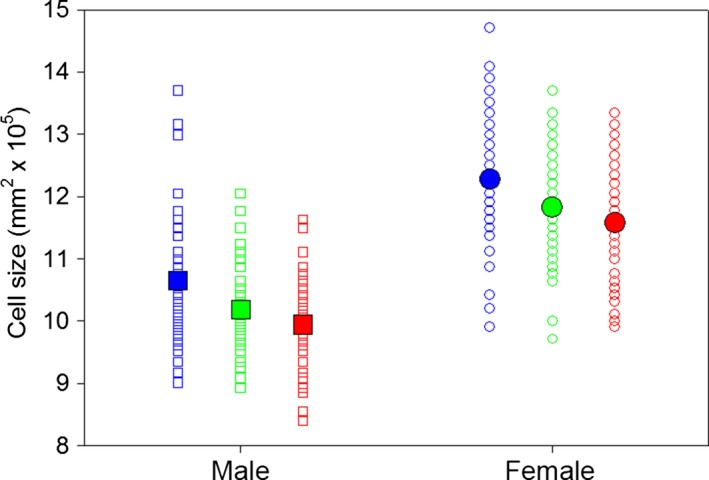
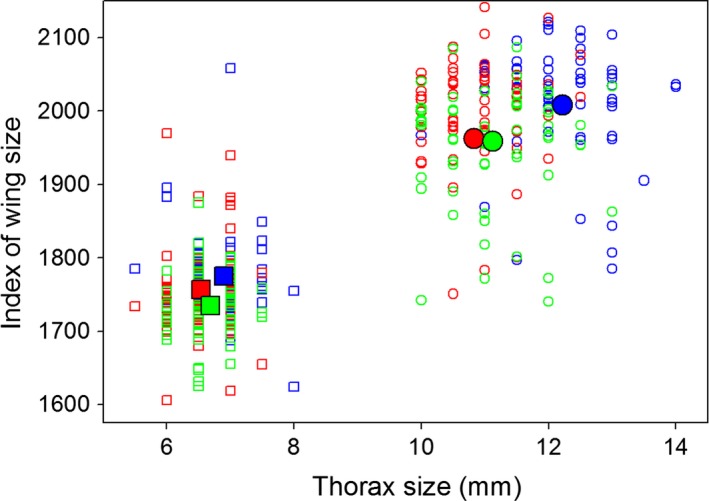
Recent theory predicts that the sizes of cells will evolve according to fluctuations in body temperature. Smaller cells speed metabolism during periods of warming but require more energy to maintain and repair. To evaluate this theory, we studied the evolution of cell size in populations of Drosophila melanogaster held at either a constant temperature (16°C or 25°C) or fluctuating temperatures (16 and 25°C). Populations that evolved at fluctuating temperatures or a constant 25°C developed smaller thoraxes, wings, and cells than did flies exposed to a constant 16°C. The cells of flies from fluctuating environments were intermediate in size to those of flies from constant environments. Most genetic variation in cell size was independent of variation in wing size, suggesting that cell size was a target of selection. These evolutionary patterns accord with patterns of developmental plasticity documented previously. Future studies should focus on the mechanisms that underlie the selective advantage of small cells at high or fluctuating temperatures.
Keywords: Drosophila; body size; cell size; experimental evolution; fluctuations; selection; temperature.
Figures
References
-
- Anderson, W. W. (1966). Genetic divergence in M. Vetukhiv's experimental populations of Drosophila pseudoobscura . Genetical Research, 7, 255–266.
-
- Angilletta, M. J. , Niewiarowski, P. H. , Dunham, A. E. , Leache, A. D. , & Porter, W. P. (2004). Bergmann's clines in ectotherms: Illustrating a life‐history perspective with sceloporine lizards. The American Naturalist, 164, E168–E183. - PubMed
-
- Angilletta, M. J. , Steury, T. D. , & Sears, M. W. (2004). Temperature, growth rate, and body size in ectotherms: Fitting pieces of a life‐history puzzle. Integrative and Comparative Biology, 44, 498–509. - PubMed
-
- Arendt, J. (2007). Ecological correlates of body size in relation to cell size and number: Patterns in flies, fish, fruits, and foliage. Biological Reviews, 82, 241–256. - PubMed
-
- Arendt, J. D. (2011). Size‐fecundity relationships, growth trajectories, and the temperature‐size rule for ectotherms. Evolution, 65, 43–51. - PubMed
LinkOut - more resources
Full Text Sources
Other Literature Sources
Molecular Biology Databases
