Review
. 2016 Nov 12;5(4):144-154.
doi: 10.5501/wjv.v5.i4.144.

Regulation of Wnt/β-catenin signaling by herpesviruses

Affiliations
Review

Regulation of Wnt/β-catenin signaling by herpesviruses

Kevin J Zwezdaryk et al. World J Virol. .

Abstract

The Wnt/β-catenin signaling pathway is instrumental in successful differentiation and proliferation of mammalian cells. It is therefore not surprising that the herpesvirus family has developed mechanisms to interact with and manipulate this pathway. Successful coexistence with the host requires that herpesviruses establish a lifelong infection that includes periods of latency and reactivation or persistence. Many herpesviruses establish latency in progenitor cells and viral reactivation is linked to host-cell proliferation and differentiation status. Importantly, Wnt/β-catenin is tightly connected to stem/progenitor cell maintenance and differentiation. Numerous studies have linked Wnt/β-catenin signaling to a variety of cancers, emphasizing the importance of Wnt/β-catenin pathways in development, tissue homeostasis and disease. This review details how the alpha-, beta-, and gammaherpesviruses interact and manipulate the Wnt/β-catenin pathway to promote a virus-centric agenda.

Keywords: Axin; Cytomegalovirus; Epstein-Barr virus; Glycogen synthase kinase-3; Herpes simplex virus-1; Herpesvirus; Kaposi’s sarcoma-associated herpesvirus; Varicella zoster virus; Wnt/β-catenin.


Conflict of interest statement

Conflict-of-interest statement: The authors have no conflicts to disclose.

Figures
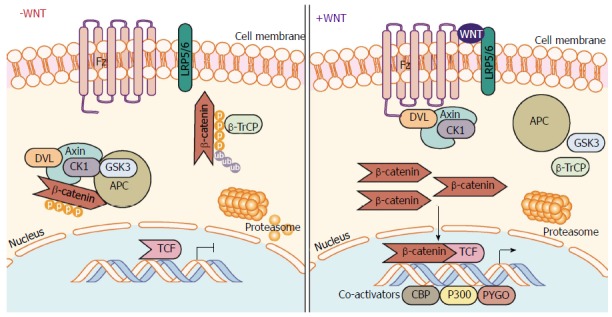
Figure 1
Figure 1
Canonical Wnt/β-catenin signaling pathway. In the absence of Wnt ligand stimulation, the β-catenin destruction complex - consisting of the proteins Axin, CK1, GSK-3α/β, APC, and DVL - phosphorylate β-catenin allowing β-TrCP to ubiquitinate β-catenin marking it for proteasomal degradation. When stimulated by Wnt ligands, engagement of the Fz receptor and co-receptors LRP5/6, induces signaling through DVL inhibiting the action of the destruction complex. This frees β-catenin from degradation pathways allowing β-catenin to translocate and accumulate in the nucleus. β-catenin mediated interaction with TCF family transcription factors and co-activators (CBP, etc.) and initiates transcription of target genes. APC: Adenomatous polyposis coli; β-TrCP: Beta-transducin repeat containing E3 ubiquitin protein ligase; CBP: CREB-binding protein; CK1: Casein kinase 1; DVL: Dishevelled; Fz: Frizzled receptor; GSK-3: Glycogen synthase kinase 3; LRP: Low-density lipoprotein receptor-related protein; TCF/LEF-1: T-cell factor/lymphoid enhancer-binding factor 1.
Figure 2
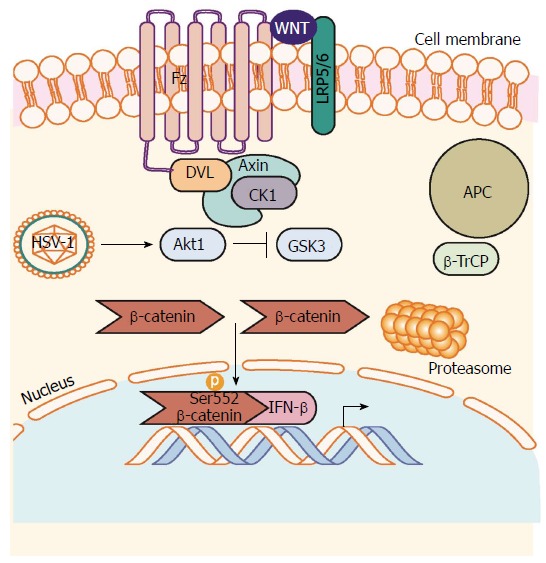
Figure 2
β-catenin mediated antiviral interferon response during herpes simplex virus 1 infection. HSV-1 infection induces activation of Akt1 activity. Akt1 phosphorylates β-catenin on Serine 552 inhibiting degradation signaling through GSK-3-mediated phosphorylation of β-catenin on Serine 9. β-catenin can then accumulate in the nucleus to induce transcription of β-catenin target genes such as the antiviral cytokine IFN-β. Akt1: Protein kinase B; HSV-1: Herpes simplex virus 1.
Figure 3
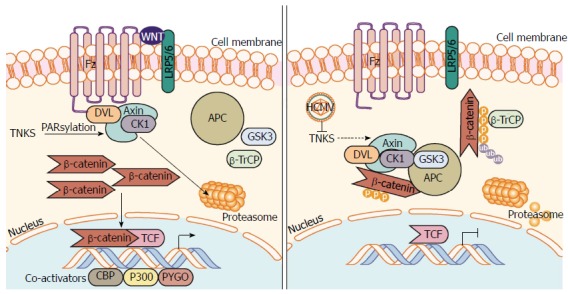
Figure 3
Human cytomegalovirus inhibits PARsylation activity of tankyrase 1 and 2 (PARP5a/b) to enhance infection. Regulation of Axin is the rate-limiting step in the assembly and function of the β-catenin destruction complex. PARsylation, a process driven by NAD+, marks Axin for proteasomal degradation, inhibiting β-catenin destruction complex formation resulting in β-catenin accumulation and transcription in the nucleus. HCMV infection causes inhibition of TNKS (PARP5a/b) PARsylation activity, which inhibits PARsylation of Axin and increases its stability. Further inhibition of TNKS PARsylation activity or knockdown of TNKS significantly aids in HCMV replication. An increase in stable Axin permits β-catenin destruction complex formation, increased β-catenin degradation, and subsequent inhibition of β-catenin-mediated transcription. HCMV: Human cytomegalovirus; NAD+: Nicotinamide adenine dinucleotide; PARsylation: Poly-ADP ribose modification; PARP5a/b: Poly-ADP ribose polymerase 5a/b; TNKS: Tankyrase 1 and 2 (PARP5a/b).
Figure 4
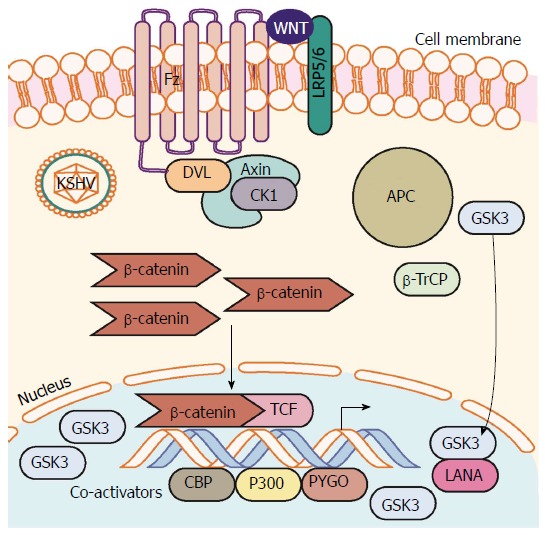
Figure 4
Kaposi’s sarcoma-associated herpesvirus latency upregulates β-catenin. Establishment of KSHV latency involves expression of the latency associated protein LANA. LANA binds with and translocates GSK-3 into the nucleus after phosphorylation by GSK-3. This translocation of cytoplasmic pools of GSK-3 prevents β-catenin destruction complex formation and stability of cytoplasmic β-catenin. β-catenin translocation to the nucleus occurs resulting in increased β-catenin-mediated transcription. LANA: Latency-associated nuclear antigen; KSHV: Kaposi’s sarcoma-associated herpesvirus.

References

    1. Grinde B. Herpesviruses: latency and reactivation - viral strategies and host response. J Oral Microbiol. 2013:5. - PMC - PubMed
    1. Evans CM, Kudesia G, McKendrick M. Management of herpesvirus infections. Int J Antimicrob Agents. 2013;42:119–128. - PubMed
    1. Logan CY, Nusse R. The Wnt signaling pathway in development and disease. Annu Rev Cell Dev Biol. 2004;20:781–810. - PubMed
    1. van Amerongen R, Nusse R. Towards an integrated view of Wnt signaling in development. Development. 2009;136:3205–3214. - PubMed
    1. Webster MR, Weeraratna AT. A Wnt-er migration: the confusing role of β-catenin in melanoma metastasis. Sci Signal. 2013;6:pe11. - PubMed

LinkOut - more resources