Review
. 2017 Feb;60(2):215-225.
doi: 10.1007/s00125-016-4157-3. Epub 2016 Nov 22.

Targeting renal glucose reabsorption to treat hyperglycaemia: the pleiotropic effects of SGLT2 inhibition

Affiliations
Review

Targeting renal glucose reabsorption to treat hyperglycaemia: the pleiotropic effects of SGLT2 inhibition

Volker Vallon et al. Diabetologia. 2017 Feb.

Abstract

Healthy kidneys filter ∼160 g/day of glucose (∼30% of daily energy intake) under euglycaemic conditions. To prevent valuable energy from being lost in the urine, the proximal tubule avidly reabsorbs filtered glucose up to a limit of ∼450 g/day. When blood glucose levels increase to the point that the filtered load exceeds this limit, the surplus is excreted in the urine. Thus, the kidney provides a safety valve that can prevent extreme hyperglycaemia as long as glomerular filtration is maintained. Most of the capacity for renal glucose reabsorption is provided by sodium glucose cotransporter (SGLT) 2 in the early proximal tubule. In the absence or with inhibition of SGLT2, the renal reabsorptive capacity for glucose declines to ∼80 g/day (the residual capacity of SGLT1), i.e. the safety valve opens at a lower threshold, which makes it relevant to glucose homeostasis from day-to-day. Several SGLT2 inhibitors are now approved glucose lowering agents for individuals with type 2 diabetes and preserved kidney function. By inducing glucosuria, these drugs improve glycaemic control in all stages of type 2 diabetes, while their risk of causing hypoglycaemia is low because they naturally stop working when the filtered glucose load falls below ∼80 g/day and they do not otherwise interfere with metabolic counterregulation. Through glucosuria, SGLT2 inhibitors reduce body weight and body fat, and shift substrate utilisation from carbohydrates to lipids and, possibly, ketone bodies. Because SGLT2 reabsorbs sodium along with glucose, SGLT2 blockers are natriuretic and antihypertensive. Also, because they work in the proximal tubule, SGLT2 inhibitors increase delivery of fluid and electrolytes to the macula densa, thereby activating tubuloglomerular feedback and increasing tubular back pressure. This mitigates glomerular hyperfiltration, reduces the kidney's demand for oxygen and lessens albuminuria. For reasons that are less well understood, SGLT2 inhibitors are also uricosuric. These pleiotropic effects of SGLT2 inhibitors are likely to have contributed to the results of the EMPA-REG OUTCOME trial in which the SGLT2 inhibitor, empagliflozin, slowed the progression of chronic kidney disease and reduced major adverse cardiovascular events in high-risk individuals with type 2 diabetes. This review discusses the role of SGLT2 in the physiology and pathophysiology of renal glucose reabsorption and outlines the unexpected logic of inhibiting SGLT2 in the diabetic kidney.

Keywords: Body weight; Cardiovascular outcome; Chronic kidney disease; Diabetic nephropathy; EMPA-REG OUTCOME trial; Glomerular hyperfiltration; Gluconeogenesis; Hypertension; Renal glucose reabsorption; Review; Sodium glucose cotransport.


Figures

Fig. 1
Fig. 1
SGLT2-mediated glucose reabsorption in the kidney: consequences of diabetes and links to Na+ reabsorption. (a) SGLT2 and SGLT1 exist in the luminal membrane of the early and late proximal tubule, respectively. SGLT2 reabsorbs ~97% of filtered glucose in normoglycaemia, whilst SGLT1 reabsorbs ~3%. Consequently, between 0–0.2% of glucose is excreted in the urine in normoglycaemia. Contrastingly, SGLT2 inhibition shifts glucose reabsorption downstream, unmasking a significant capacity for SGLT1 to reabsorb ~50% of filtered glucose. Thus, following SGLT2 inhibition, up to ~50% of filtered glucose is excreted in normoglycaemia. (b) In health, sodium and glucose reabsorption via luminal SGLT2 and SGLT1 is followed by basolateral glucose reabsorption via the facilitative glucose transporters, GLUT2 and GLUT1, respectively, and sodium reabsorption via the Na+/K+ pump. (c) Diabetes induces tubular hypertrophy, which is associated with increased SGLT2. Consequently, this may lead to hyperglycaemia and primary tubular Na+ hyperreabsorption. SGLT2 inhibition counteracts these effects and promotes partial compensation by downstream SGLT1. Preclinical studies propose that SGLT2 inhibition may also attenuate the diabetes-induced increase in renal gluconeogenesis. This figure was modified with permission from the Annual Review of Medicine, Volume 66 © 2015 by Annual Reviews, www.annualreviews.org [26]. Blue arrows, symbols and text relate to SGLT2; green arrows, symbols and text relate to SGLT1; the grey arrow in (a) indicates urinary excretion; black arrows refer to transport mechanisms; in (c), red arrows, symbols and text relate to variables/processes affected by diabetes
Fig. 2
Fig. 2
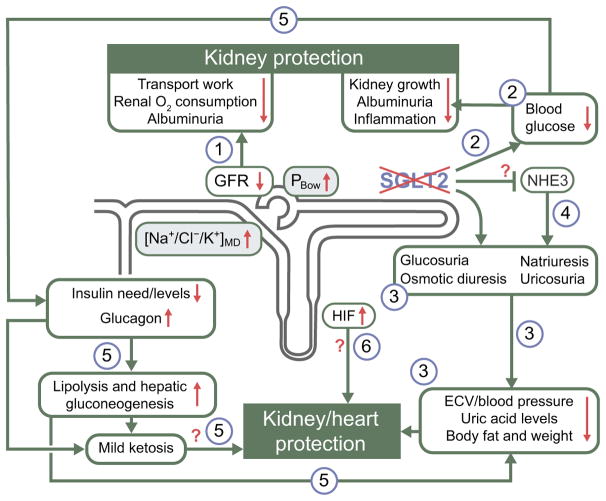
The pleiotropic effects of SGLT2 inhibition: the potential for kidney and cardiovascular protection in diabetes. SGLT2 inhibition may provide its cardioprotective and renal protective effects via several pleiotropic mechanisms: (1) SGLT2 inhibition attenuates primary proximal tubular hyperreabsorption in the kidney in diabetes, increasing/restoring the tubuloglomerular feedback signal at the macula densa ([Na+/Cl/K+]MD) and hydrostatic pressure in Bowman’s space (PBow). This reduces glomerular hyperfiltration, beneficially affecting albumin filtration and tubular transport work and, thus, renal oxygen consumption; (2) by lowering blood glucose levels, SGLT2 inhibitors can reduce kidney growth, albuminuria and inflammation; (3) SGLT2 inhibitors have a modest osmotic diuretic, natriuretic and uricosuric effect, which can reduce extracellular volume (ECV), blood pressure, serum uric acid levels and body weight. These changes may have beneficial effects on both the renal and cardiovascular systems; (4) SGLT2 may be functionally linked to NHE3, such that SGLT2 inhibition may also inhibit NHE3 in the proximal tubule, with implications on the natriuretic, GFR and blood pressure effect; (5) SGLT2 inhibition reduces insulin levels and the need for therapeutic and/or endogenous insulin, and increases glucagon levels. As a consequence, lipolysis and hepatic gluconeogenesis are elevated. These metabolic adaptations reduce fat tissue/body weight and hypoglycaemia risk, and result in mild ketosis, potentially having beneficial effects on both the renal and cardiovascular systems; (6) SGLT2 inhibition may also enhance renal HIF content, which may have renal protective effects. White text boxes indicate affected variables; grey text boxes indicate processes that link SGLT2 inhibition to the reduction in GFR. Green arrows demonstrate consequences; red arrows indicate changes in associated variables (increase/decrease)
Fig. 3
Fig. 3
SGLT2 inhibition lowers diabetic glomerular hyperfiltration. (a) In vivo micropuncture studies were performed in non-diabetic and streptozotocin-induced diabetic rats, both with superficial glomeruli [65]. Measurements were performed under control conditions or following application of phlorizin directly into the early proximal tubule, i.e. systemic blood glucose levels were not changed. Small amounts of blue dye were injected into the Bowman’s space to determine the configuration of the nephron, including the early proximal tubular loop and the early distal tubule located near the macula densa. The distal tubule is stained with blue dye in picture. The macula densa is just upstream of the early distal tubule but does not project to the kidney surface. Tubular fluid was collected from the early distal tubule, i.e. just downstream of the macula densa, to determine; (1) the strength of the tubuloglomerular feedback signal at the macula densa ([Na+/Cl/K+]MD); and (2) single nephron glomerular filtration rate (SNGFR) by inulin clearance. Additionally, the Bowman’s space was punctured to determine the hydrostatic pressure (PBow). BS, Bowman’s space; EPT, early proximal tubule; EDT, early distal tubule; SG, superficial glomerulus. Scale bar, 100 μm. ‘V-shaped’ lines indicate the micropuncture capillaries and their position; arrows indicate the withdrawal or application of fluid or pressure measurement. (be) Basal measurements (B) revealed that glomerular hyperfiltration in diabetes was associated with reductions in (b) [Na+] and [Cl] at the macula densa ([Na+/Cl]MD), (c) [K+] at the macula densa ([K+]MD) and (d) in PBow, and (e) an increase in SNGFR (nanoliter per minute [nl/min]). Phlorizin (P) did not greatly affect any of these measures in non-diabetic rats, but normalised [Na+/Cl/K+]MD, PBow and SNGFR in diabetes [65]. In (be), white circles, non-diabetic; black circles, diabetic. (f) Diabetes induces a primary hyperreabsorption in the proximal tubule, which causes glomerular hyperfiltration via tubuloglomerular feedback (reduction in [Na+/Cl/K+]MD levels) and reductions in tubular back pressure (PBow). SGLT2 contributes to hyperreabsorption (this process is further enhanced by tubular growth in diabetes) and, consequently, SGLT2 inhibition mitigates hyperreabsorption in diabetes, inhibiting glomerular hyperfiltration. In (f), yellow boxes indicate the main consequences of diabetes; grey boxes indicate mechanisms that link hyperreabsorption to hyperfiltration; black arrows indicate changes in variable (increase/decrease); red arrows indicate the enhanced reabsorption

References

    1. International Diabetes Federation. [Accessed 15 Aug 2015];2013 www.idf.org/diabetesatlas.
    1. DeFronzo RA. Banting lecture. From the triumvirate to the ominous octet: a new paradigm for the treatment of type 2 diabetes mellitus. Diabetes. 2009;58:773–795. - PMC - PubMed
    1. The Diabetes Control and Complications Trial Research Group. The effect of intensive treatment of diabetes on the development and progression of long-term complications in insulin-dependent diabetes mellitus. N Engl J Med. 1993;329:977–986. - PubMed
    1. Gerstein HC, Miller ME, Byington RP, et al. Effects of intensive glucose lowering in type 2 diabetes. N Engl J Med. 2008;358:2545–2559. - PMC - PubMed
    1. Zinman B, Wa nner C, Lachin JM, et al. Empagliflozin, cardiovascular outcomes, and mortality in type 2 diabetes. N Engl J Med. 2015;373:2117–2128. - PubMed

MeSH terms