Review
. 2008 Jan 21;8(1):290-313.
doi: 10.3390/s8010290.

A Review on the Electrochemical Sensors and Biosensors Composed of Nanowires as Sensing Material

Affiliations
Review

A Review on the Electrochemical Sensors and Biosensors Composed of Nanowires as Sensing Material

Umasankar Yogeswaran et al. Sensors (Basel). .

Abstract

The development and application of nanowires for electrochemical sensors and biosensors are reviewed in this article. Next generation sensor platforms will require significant improvements in sensitivity, specificity and parallelism in order to meet the future needs in variety of fields. Sensors made of nanowires exploit some fundamental nanoscopic effect in order to meet these requirements. Nanowires are new materials, which have the characteristic of low weight with extraordinary mechanical, electrical, thermal and multifunctional properties. The advantages such as size scale, aspect ratio and other properties of nanowires are especially apparent in the use of electrical sensors such as electrochemical sensors and in the use of field-effect transistors. The preparation methods of nanowires and their properties are discussed along with their advantages towards electrochemical sensors and biosensors. Some key results from each article are summarized, relating the concept and mechanism behind each sensor, with experimental conditions as well as their behavior at different conditions.

Keywords: Nanowires; biosensors; electroanalysis; electrochemical sensors; nano; nanotechnology; sensors.


Figures
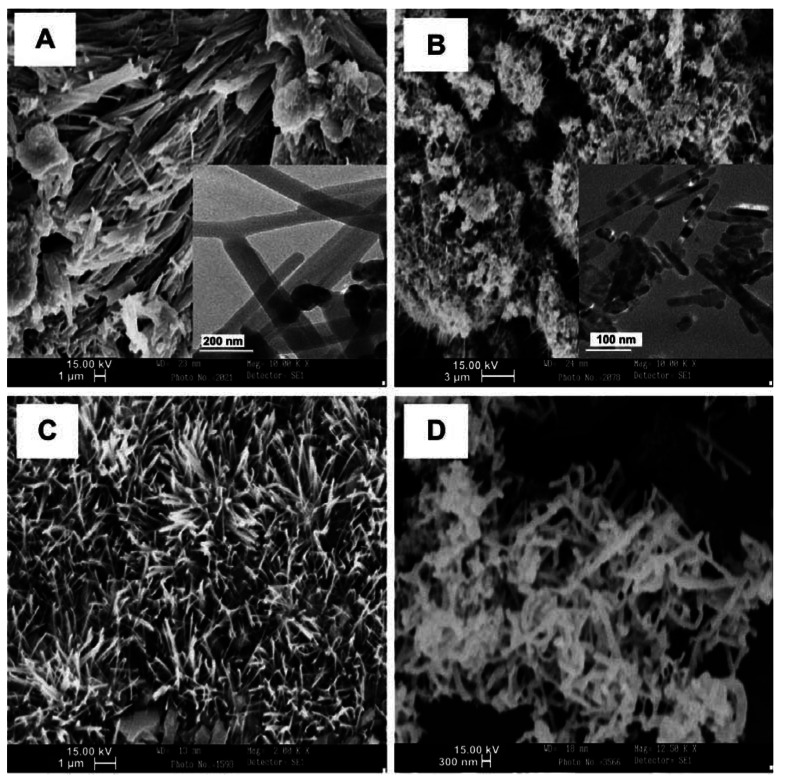
Figure 1.
Figure 1.
(A) SEM image of ZnO nanorods-1 with the inset showing a TEM image of the nanorods, (B) SEM image of ZnO nanorods-2 with the inset showing a TEM image, (C) SEM image of ZnO nanowires and (D) SEM image of ZnO nanotubes. (Reproduced with permission from Rout, C.S.; Krishna, S.H.; Vivekchand, S.R.C.; Govindaraj, A.; Rao, C.N.R. Chem. Phy. Lett. 2006, 418, 586-590).
Figure 2.
Figure 2.
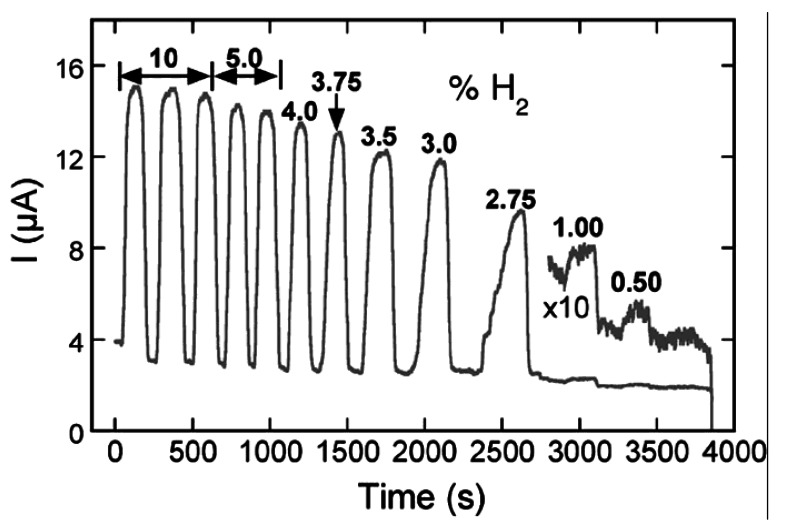
Current response of a palladium nanowire-based H2 sensor to hydrogen/nitrogen mixture (concentration of H2 as shown) (Reproduced with permission from Walter, E.C; Ng, K; Zach, M.P; Penner, R.M; Favier, F. Microelectronic Eng. 2002, 61-62, 555-561).
Figure 3.
Figure 3.
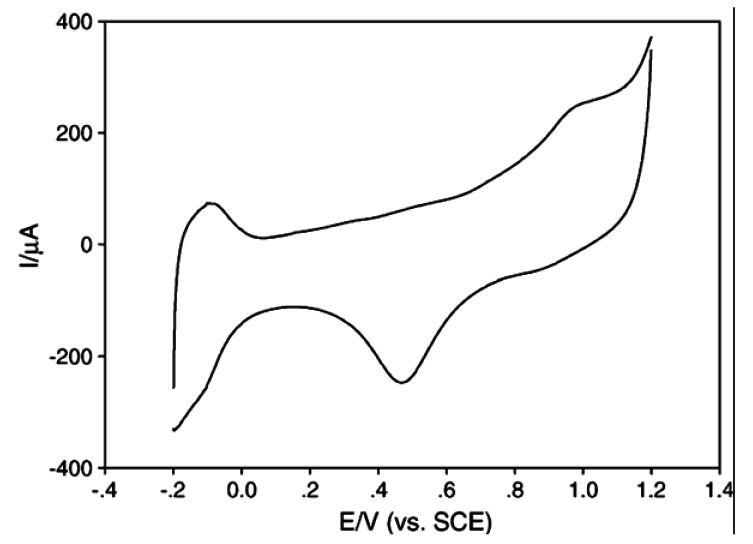
CVs of the gold nanowire modified electrode in H2SO4 (0.5 M) (Reproduced with permission from Lu, Y.; Yang, M.; Qu, F.; Shen G.; Yu, R. Bioelectrochem. 2007, 71, 211-216).
Figure 4.
Figure 4.
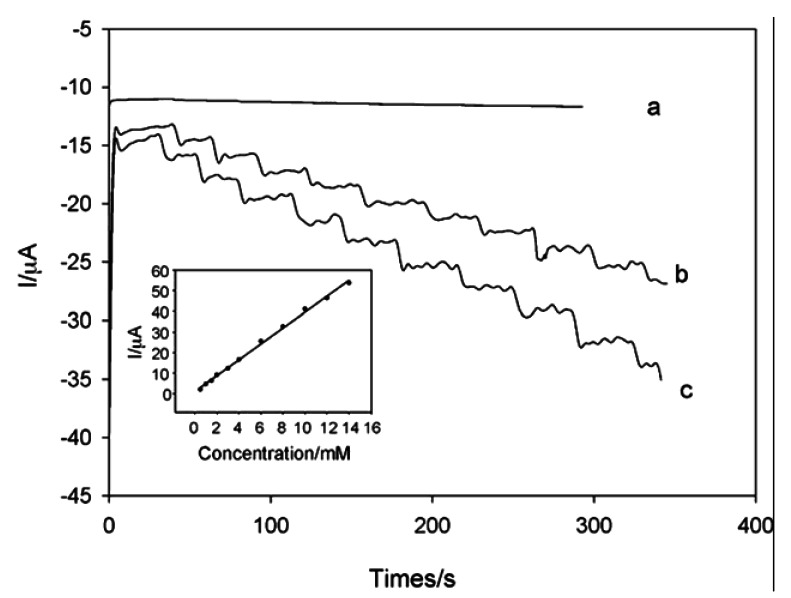
Amperometric responses of the CNT-chitosan/GOx (a), PtNW-chitosan/GOx (b) and PtNW-CNT-chitosan/GOx (c) glucose biosensors to subsequent additions of 0.5 mM glucose in buffer at -0.1 V and the calibration curve of the PtNW-CNT-chitosan/GOx biosensor (inset) (Reproduced with permission from Qu, F.; Yang, M.; Shen, G.; Yu, R. Biosen. Bioelectron. 2007, 22, 1749-1755).
Figure 5.
Figure 5.
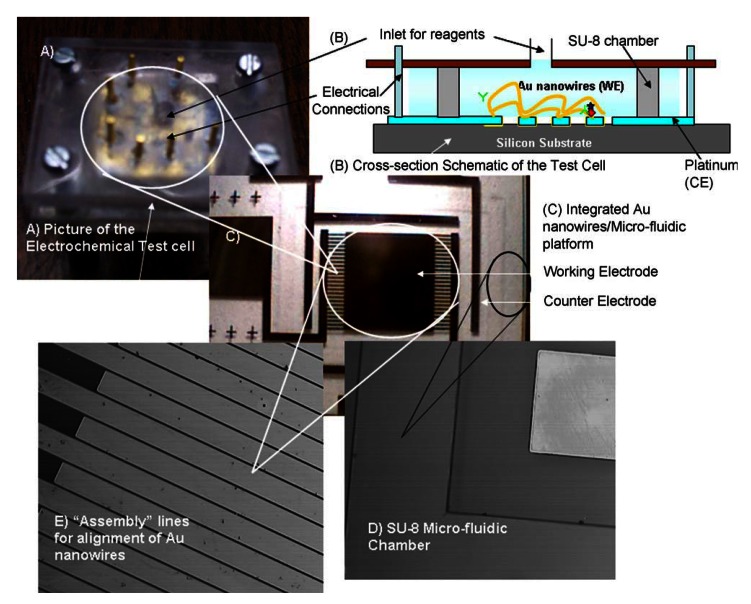
(A) Picture of the electrochemical test set up, shown with the silicon chip, inlet for reagents and electrical connections. (B) Cross-sectional schematic of the test cell, with nanowires aligned on the platinum “assembly lines” for dielectrophoresis. (C) Actual image of the micro-fluidic platform in silicon with electrodes/gold nanowires and SU-8 chamber. (D) Image of the platinum “assembly” lines for nanowire alignment. (E) Image of the hard-baked SU-8 micro-fluidic chamber (Reproduced with permission from Aravamudhan, S.; Kumar, A.; Mohapatra, S.; Bhansali, S. Biosen. Bioelectron. 2007, 22, 2289-2294).
Figure 6.
Figure 6.
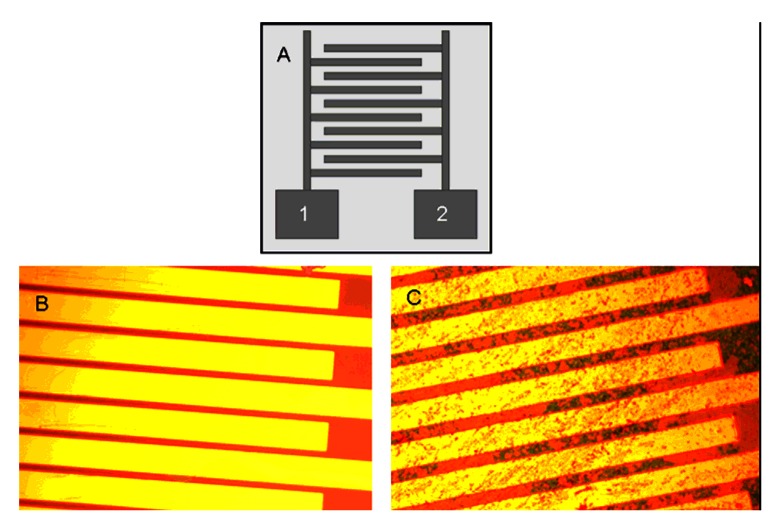
(A) Schematic top view of the interdigitated Pt lines used for dielectrophoresis of Au nanowires. AC voltage of 30 Vrms at frequency of 20 KHz is applied on electrode 1 relative to grounded electrode 2. (B) Image of interdigitated Pt lines (50 μm width and 10 μm spacing) before dielectrophoresis process and (C) image of interdigitated Pt lines with random alignment of Au nanowires after dielectrophoresis for 20 s. (Reproduced with permission from Aravamudhan, S; Ramgir, N.S; Bhansali, S. Sensors and Actuators B 2007, 127, 29-35).
Scheme 1.
Scheme 1.
Contact geometry for multiple nanowire gas sensor.
Scheme 2.
Scheme 2.
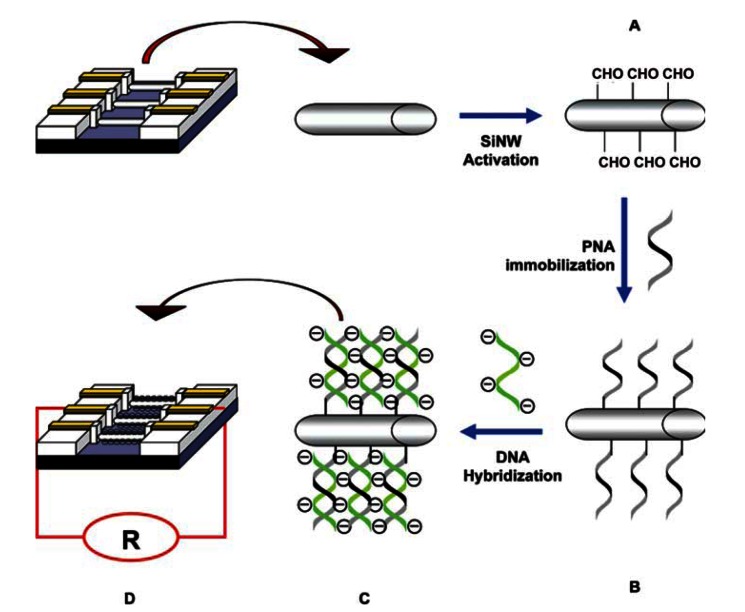
Schematic representation of the principle of the SiNW array biosensor for DNA (Reproduced with permission from Gao, Z; Agarwal, A; Trigg, A.D; Singh, N; Fang, C; Tung, C.H; Fan, Y; Buddharaju, K.D; Kong, J. Anal. Chem. 2007, 79, 3291-3297).

References

    1. Wilson G.S., Gifford R. Biosensors for real-time in vivo measurements. Biosens. Bioelectron. 2005;20:2388–2403. doi: 10.1016/j.bios.2004.12.003. PubMed 15854814. - DOI - PubMed
    1. Sakaguchi T., Morioka Y., Yamasaki M., Iwanaga J., Beppu K., Maeda H., Morita Y., Tamiya E. Rapid and onsite BOD sensing system using luminous bacterial cells-immobilized chip. Biosens. Bioelectron. 2007;22:1345–1350. doi: 10.1016/j.bios.2006.06.008. PubMed 16846732. - DOI - PubMed
    1. Chen S.M., Chzo W.Y. Simultaneous voltammetric detection of dopamine and ascorbic acid using didodecyldimethylammonium bromide (DDAB) film-modified electrodes. J. Electroanal. Chem. 2006;587:226–234. doi: 10.1016/j.jelechem.2005.11.019. - DOI
    1. Vasantha V.S., Chen S.M. Electrocatalysis and simultaneous detection of dopamine and ascorbic acid using poly(3,4-ethylenedioxy)thiophene film modified electrodes. J. Electroanal. Chem. 2006;592:77–87. doi: 10.1016/j.jelechem.2006.04.026. - DOI
    1. Simoyi M.F., Falkenstein E., Dyke K.V., Blemings K.P., Klandorf H. Allantoin the oxidation product of uric acid is present in chicken and turkey plasma. Comparative Biochemistry and Physiology Part B. 2003;135:325–335. doi: 10.1016/S1096-4959(03)00086-1. - DOI - PubMed

LinkOut - more resources