


No End in Sight: Benzodiazepine Use in Older Adults in the United States
- PMID: 27879984
- PMCID: PMC5173408
- DOI: 10.1111/jgs.14379
No End in Sight: Benzodiazepine Use in Older Adults in the United States
Abstract
Objectives: To establish the rate of new and continuation of benzodiazepine use in older adults seen by nonpsychiatrist physicians and to identify subpopulations at risk of new and continuation benzodiazepine use.
Design: Cross-sectional analysis.
Setting: National Ambulatory Medical Care Survey (2007-10).
Participants: Adults visiting office-based nonpsychiatrist physicians (n = 98,818) who were prescribed a benzodiazepine (new or continuation).
Measurements: Percentage of benzodiazepine visits of all outpatient encounters according to patient age and corresponding annual visit rate per 1,000 population. Analysis was then limited to adults aged 65 and older, demographic, clinical, and visits characteristics were used to compare visits of benzodiazepine users with those of nonusers and visits of continuation users with those of new users.
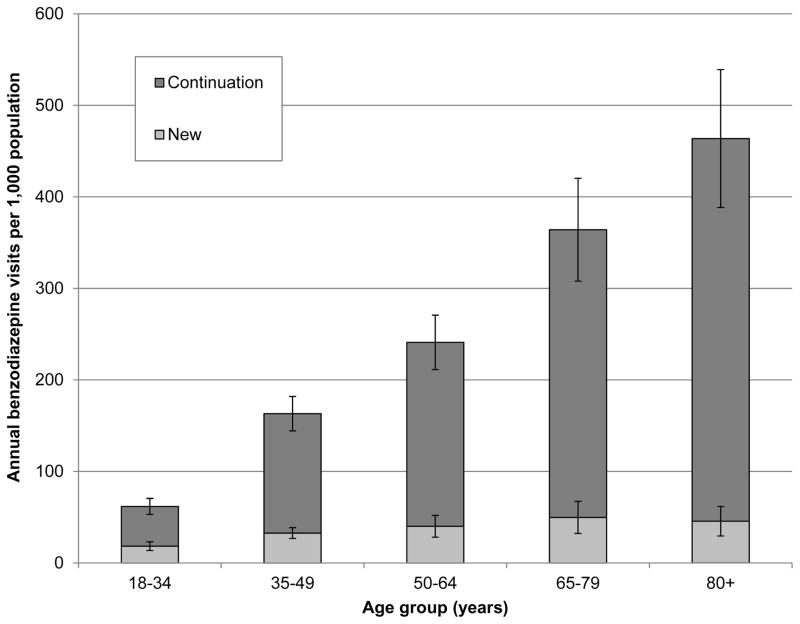
Results: The overall proportion of benzodiazepine visits ranged from 3.2% (95% confidence interval (CI) = 2.7-3.7) of those aged 18 to 34 to 6.6% (95% CI = 5.8-7.6) of those aged 80 and older, and the proportion of continuation visits increased with age, rising to 90.2% (95% CI = 86.2-93.1) of those aged 80 and older. The population-based visit rate ranged from 61.7 (95% CI = 50.7-72.7) per 1,000 persons in the youngest adults to 463.7 (95% CI = 385.4-542.0) in those aged 80 and older. Only 16.0% (95% CI = 13.5-18.8) of continuation users had any mental health diagnosis. Of all benzodiazepine users, fewer than 1% (95% CI = .4-1.8) were provided or referred to psychotherapy, and 10.0% (95% CI = 7. 2-13.3) were also prescribed an opioid.
Conclusion: In the United States, few older adult benzodiazepine users receive a clinical mental health diagnosis, and almost none are provided or referred to psychotherapy. Prescribing to older adults continues despite decades of evidence documenting safety concerns, effective alternative treatments, and effective methods for tapering even chronic users.
Keywords: anxiety; benzodiazepine; insomnia; psychotropic.
© 2016, Copyright the Authors Journal compilation © 2016, The American Geriatrics Society.
Conflict of interest statement
Dr. Olfson is principal investigator of a grant to Columbia University from Sunovion Pharmaceuticals. Otherwise, the authors have no conflicts to disclose.
Figures
References
-
- Olfson M, King M, Schoenbaum M. Benzodiazepine Use in the United States. JAMA Psychiatry. 2015;72(2):136–142. - PubMed
-
- Baldwin D, Woods R, Lawson R, Taylor D. Efficacy of drug treatments for generalised anxiety disorder: systematic review and meta-analysis. BMJ. 2011;342:d1199. - PubMed
-
- Smith MT, Perlis ML, Park A, et al. Comparative meta-analysis of pharmacotherapy and behavior therapy for persistent insomnia. Am J Psychiatry. 2014;159(1):5–11. - PubMed
-
- Wu JQ, Appleman ER, Salazar RD, Ong JC. Cognitive behavioral therapy for insomnia comorbid with psychiatric and medical conditions: A meta-analysis. JAMA Intern Med. 2015 - PubMed
-
- Woolcott JC, Richardson KJ, Wiens MO, et al. Meta-analysis of the impact of 9 medication classes on falls in elderly persons. Arch Intern Med. 2009;169(21):1952–1960. - PubMed
Publication types
MeSH terms
Substances
Grants and funding
LinkOut - more resources
Full Text Sources
Other Literature Sources
