. 2016 Nov 23;11(11):e0166108.
doi: 10.1371/journal.pone.0166108. eCollection 2016.

A Mighty Claw: Pinching Force of the Coconut Crab, the Largest Terrestrial Crustacean

Affiliations

A Mighty Claw: Pinching Force of the Coconut Crab, the Largest Terrestrial Crustacean

Shin-Ichiro Oka et al. PLoS One. .

Abstract

Crustaceans can exert a greater force using their claws than many animals can with other appendages. Furthermore, in decapods, the chela is a notable organ with multifunctional roles. The coconut crab, Birgus latro, is the largest terrestrial crustacean and has a remarkable ability to lift weights up to approximately 30 kg. However, the pinching force of this crab's chelae has not been previously investigated. In the present study, we measured the pinching force of the chelae in 29 wild coconut crabs (33-2,120 g in body weight). The maximum force ranged from 29.4 to 1,765.2 N, and showed a strong positive correlation with body mass. Based on the correlation between pinching force and body weight, the force potentially exerted by the largest crab (4 kg weight) reported in a previous study would be 3300 N, which greatly exceeds the pinching force of other crustaceans as well as the bite force of most terrestrial predators. The mighty claw is a terrestrial adaptation that is not only a weapon, which can be used to prevent predator attack and inhibit competitors, but is also a tool to hunt other terrestrial organisms with rigid exteriors, aiding in these organisms to be omnivores.


Conflict of interest statement

The authors have declared that no competing interests exist.

Figures
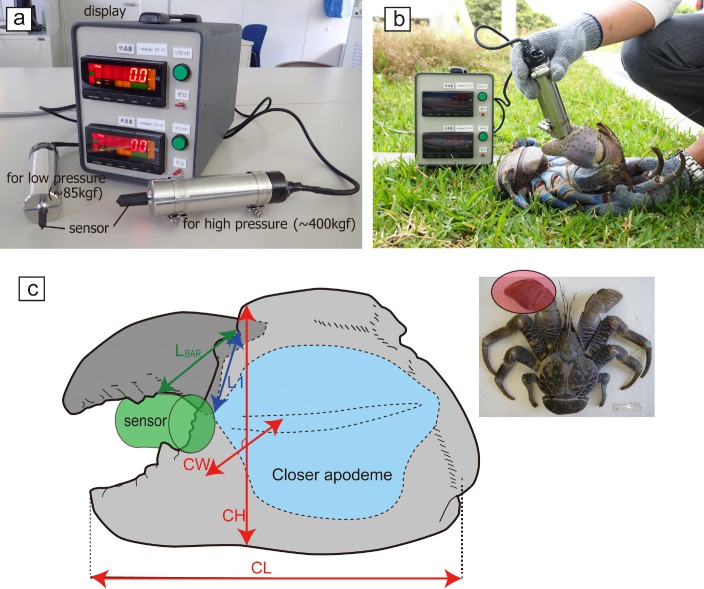
Fig 1
Fig 1. Measurement of the pinching force and claw morphology in the coconut crabs.
(a) The force was measured with the SK-MBF-01F device (SkyScience Co. Tokyo, Japan) and related sensors and (b) demonstration of the method by which pinching force was measured. (c) Claw measurements of the coconut crab used in this study. The placement of the sensor used for pressure measurement is highlighted in green. The measurements used for claw length (CL), claw height (CH), and claw width (CW) are also indicated. L1: in-lever length from the fulcrum to the apodemes insertion; LBAE: out-lever length from the fulcrum to the tubercle (the contact point with the device sensor).
Fig 2
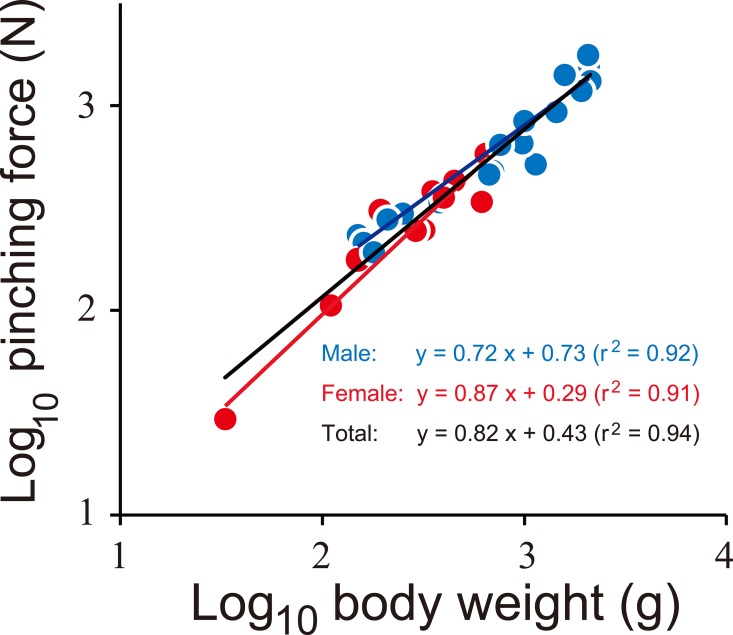
Fig 2. The relationship between body weight and pinching force of the coconut crabs.
Blue and red indicate male and female, respectively. Black line is a regression line using the combined data of both sexes.
Fig 3
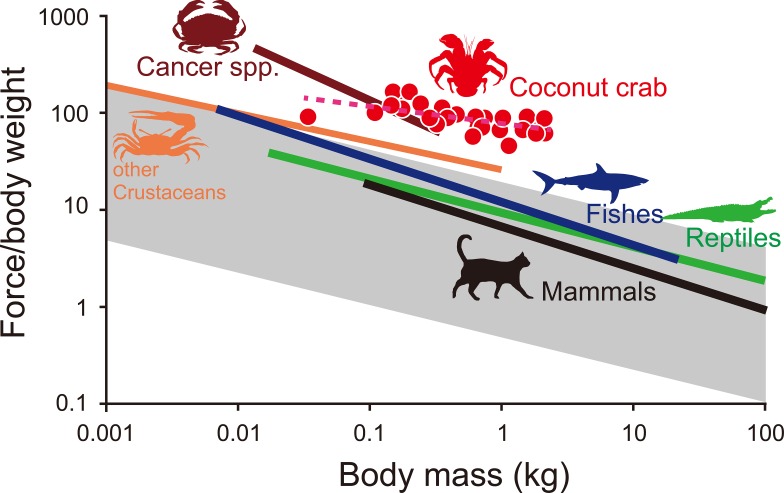
Fig 3. Regression analysis of the maximum force per unit body weight vs. body mass across several animal groups, including coconut crabs.
The shaded gray area represents the range of the maximum force exerted by various animal activities (running, jumping, pushing, pulling, swimming, flight, nipping, and biting) [11]. Colored lines were calculated based on the relationship between the closing forces of crustacean chelae, vertebrate jaws and body masses determined previously [1, 2].
Fig 4
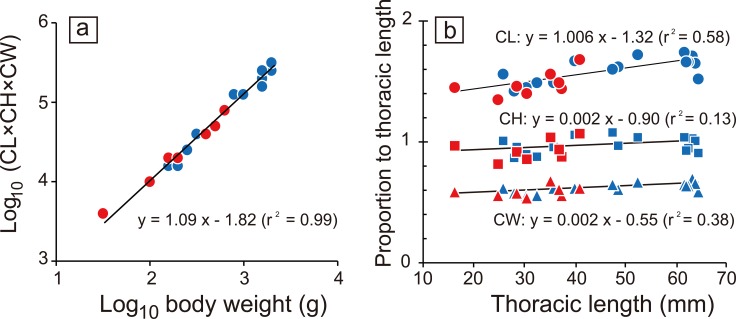
Fig 4
The relationship between (a) body weight and the index of claw-mass, multiplied by claw length (CL), claw height (CH), and claw width, and (b) the thoracic length and each claw size measurement (circle: CL, square: CH, triangle: CW). Blue and red indicate male and female, respectively. Black lines are regression lines based on the combined data of both sexes.

References

    1. Claussen DL, Gerald GW, Kotcher JE, Miskell CA. Pinching forces in crayfish and fiddler crabs, and comparisons with the closing force of other animals. J Comp Physiol B. 2008; 178: 333–342. 10.1007/s00360-007-0226-8 - DOI - PubMed
    1. Taylor GM. Maximum force production: why are crabs so strong? Proc R Soc Lond. 2000; 267: 1475–1480. 10.1098/rspb.2000.1167 - DOI - PMC - PubMed
    1. Reese ES. Shell use: an adaptation for emigration from the sea by the coconut crab. Science. 1968; 161: 385–386. 10.1126/science.161.3839.385 - DOI - PubMed
    1. Greenaway P. Terrestrial adaptations in the Anomura (Crustacea: Decapoda). Memor Mus Victoria. 2003; 60: 13–26.
    1. Oka S, Matsuzaki S, Toda M. Identification of individual coconut crabs, Birgus latro, on the basis of the pattern of grooves on the carapace. Crust Res. 2013; 42: 17–23.

LinkOut - more resources