


Balancing the immune response in the brain: IL-10 and its regulation
- PMID: 27881137
- PMCID: PMC5121946
- DOI: 10.1186/s12974-016-0763-8
Balancing the immune response in the brain: IL-10 and its regulation
Abstract
Background: The inflammatory response is critical to fight insults, such as pathogen invasion or tissue damage, but if not resolved often becomes detrimental to the host. A growing body of evidence places non-resolved inflammation at the core of various pathologies, from cancer to neurodegenerative diseases. It is therefore not surprising that the immune system has evolved several regulatory mechanisms to achieve maximum protection in the absence of pathology.
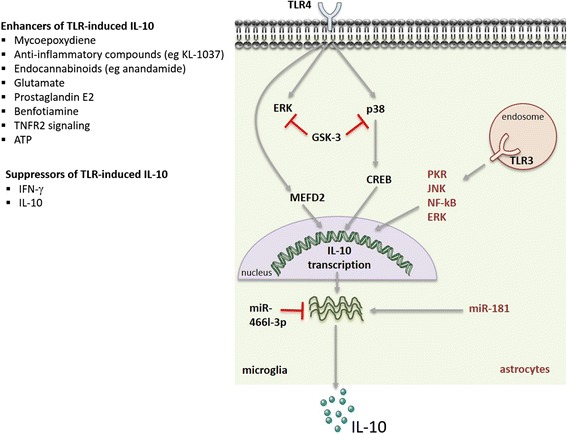
Main body: The production of the anti-inflammatory cytokine interleukin (IL)-10 is one of the most important mechanisms evolved by many immune cells to counteract damage driven by excessive inflammation. Innate immune cells of the central nervous system, notably microglia, are no exception and produce IL-10 downstream of pattern recognition receptors activation. However, whereas the molecular mechanisms regulating IL-10 expression by innate and acquired immune cells of the periphery have been extensively addressed, our knowledge on the modulation of IL-10 expression by central nervous cells is much scattered. This review addresses the current understanding on the molecular mechanisms regulating IL-10 expression by innate immune cells of the brain and the implications of IL-10 modulation in neurodegenerative disorders.
Conclusion: The regulation of IL-10 production by central nervous cells remains a challenging field. Answering the many remaining outstanding questions will contribute to the design of targeted approaches aiming at controlling deleterious inflammation in the brain.
Keywords: Glial cells; Interleukin-10; Molecular regulation; Neurodegeneration; Pattern recognition receptors.
Figures

References
-
- Engelhardt KR, Grimbacher B. IL-10 in humans: lessons from the gut, IL-10/IL-10 receptor deficiencies, and IL-10 polymorphisms. Curr Top Microbiol Immunol. 2014;380:1–18. - PubMed
Publication types
MeSH terms
Substances
LinkOut - more resources
Full Text Sources
Other Literature Sources
Medical
