Review
. 2017 Feb 15;23(4):885-893.
doi: 10.1158/1078-0432.CCR-16-2071. Epub 2016 Nov 23.

The Expanding Role of the BCL6 Oncoprotein as a Cancer Therapeutic Target

Affiliations
Review

The Expanding Role of the BCL6 Oncoprotein as a Cancer Therapeutic Target

Mariano G Cardenas et al. Clin Cancer Res. .

Abstract

BCL6 was initially discovered as an oncogene in B-cell lymphomas, where it drives the malignant phenotype by repressing proliferation and DNA damage checkpoints and blocking B-cell terminal differentiation. BCL6 mediates its effects by binding to hundreds of target genes and then repressing these genes by recruiting several different chromatin-modifying corepressor complexes. Structural characterization of BCL6-corepressor complexes suggested that BCL6 might be a druggable target. Accordingly, a number of compounds have been designed to bind to BCL6 and block corepressor recruitment. These compounds, based on peptide or small-molecule scaffolds, can potently block BCL6 repression of target genes and kill lymphoma cells. In the case of diffuse large B-cell lymphomas (DLBCL), BCL6 inhibitors are equally effective in suppressing both the germinal center B-cell (GCB)- and the more aggressive activated B-cell (ABC)-DLBCL subtypes, both of which require BCL6 to maintain their survival. In addition, BCL6 is implicated in an expanding scope of hematologic and solid tumors. These include, but are not limited to, B-acute lymphoblastic leukemia, chronic myeloid leukemia, breast cancer, and non-small cell lung cancer. BCL6 inhibitors have been shown to exert potent effects against these tumor types. Moreover, mechanism-based combinations of BCL6 inhibitors with other agents have yielded synergistic and often quite dramatic activity. Hence, there is a compelling case to accelerate the development of BCL6-targeted therapies for translation to the clinical setting. Clin Cancer Res; 23(4); 885-93. ©2016 AACR.


Conflict of interest statement

Conflicts of interest statement: No potential conflicts of interest were disclosed by the other authors.

Figures

Figure 1
Figure 1. The biological functions of BCL6 are mediated through specific protein domains
The figure shows a cartoon representation of BCL6 domain structure indicating for each one the biochemical function, partner proteins, and biological functions.
Figure 2
Figure 2. The BTB domain of BCL6
The images represent the BCL6 BTB domain alone or in a complex with the SMRT BBD or compound 79-6 as determined by X-ray crystallography. The BTB domain forms an obligate homodimer, with the two monomers shown in red and blue in each panel. A) Ribbon view, with arrows pointing to the charged pocket motif and the hydrophobic surface, indicating examples of specific residues that participate in these features. B) Space fill representation of the BCL6 BTB domain in a complex with the SMRT BBD, which is the polypeptide chain shown in purple. The lateral groove is indicated in the boxed area.
Figure 3
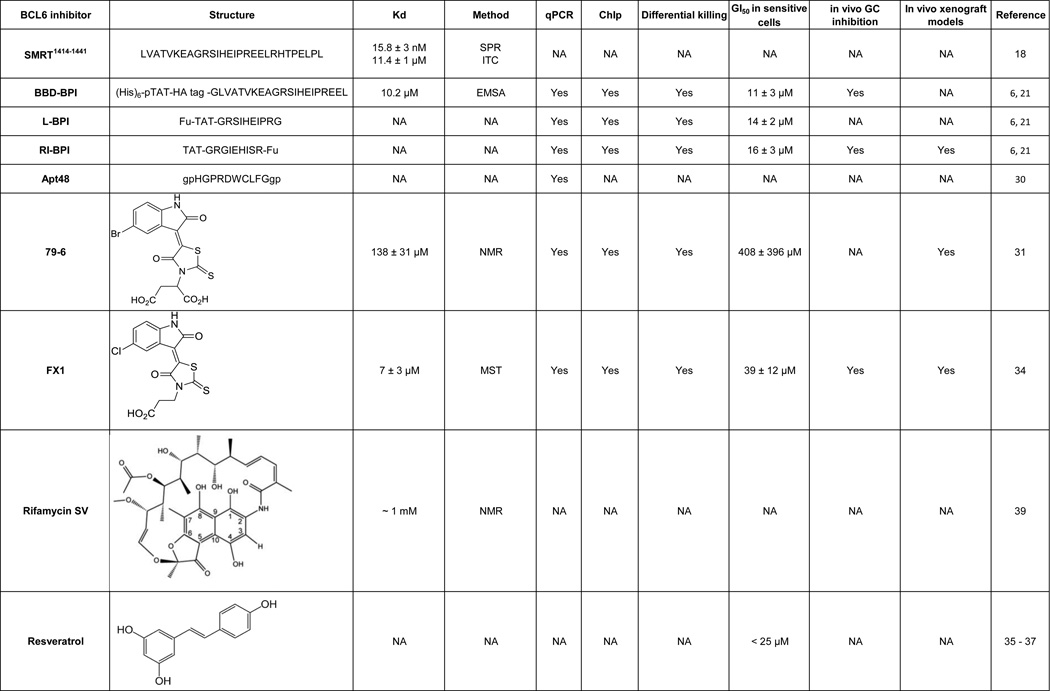
Figure 3. Current BCL6 inhibitors
The table depicts the structure and known activities of published BCL6 inhibitors. Abbreviations: NA, not applicable; SPR, surface plasmon resonance; ITC, isothermal titration calorimetry; EMSA, electrophoretic mobility shift assay; NMR, nuclear magnetic resonance; MST, MicroScale Thermophoresis; qPCR quantitative PCR; ChIP, Chomatin immunoprecipitation; GI50, growth inhibition 50%.
Figure 4
Figure 4. Strategies for rational combinatorial therapy against BCL6 in lymphomas
A) Targeting the BCL6-EZH2 combinatorial tethering mechanism. BCL6 and EZH2 cooperate to recruit the BCOR corepressor complex. BCL6 directly binds to BCOR and EZH2 deposits the H3K27me3 mark that is bound by the CBX8 subunit of the BCOR complex. Targeting BCL6 and EZH2 together results in more thorough disabling of transcriptional repression in lymphomas and greater therapeutic effect. B) Targeting the HSP90-BCL6 positive feedback loop through which BCL6 targets including TP53 are suppressed at the transcriptional and post-translational levels. Disruption of this axis can be partially achieved by targeting BCL6, HSP90 or HDACs, but more complete suppression of this axis by hitting at least two of these components is highly synergistic. C) Targeting the BCL6-BCL2 oncogene switching mechanism. Targeting BCL6 results in derepression of BCL2, enabling lymphoma cells to survive by switching to a dependency on BCL2. Targeting both together prevents lymphoma cells from utilizing this escape mechanism, and also is useful in cases with BCL2 translocation where BCL2 has become independent of regulation through BCL6.

References

    1. Ye BH, Lista F, Lo Coco F, Knowles DM, Offit K, Chaganti RS, et al. Alterations of a zinc finger-encoding gene, BCL-6, in diffuse large-cell lymphoma. Science. 1993;262:747–750. - PubMed
    1. Ye BH, Cattoretti G, Shen Q, Zhang J, Hawe N, de Waard R, et al. The BCL-6 proto-oncogene controls germinal-centre formation and Th2-type inflammation. Nat Genet. 1997;16:161–170. - PubMed
    1. Dent AL, Shaffer AL, Yu X, Allman D, Staudt LM. Control of inflammation, cytokine expression, and germinal center formation by BCL-6. Science. 1997;276:589–592. - PubMed
    1. Fukuda T, Yoshida T, Okada S, Hatano M, Miki T, Ishibashi K, et al. Disruption of the Bcl6 gene results in an impaired germinal center formation. J Exp Med. 1997;186:439–448. - PMC - PubMed
    1. Klein U, Dalla-Favera R. Germinal centres: role in B-cell physiology and malignancy. Nat Rev Immunol. 2008;8:22–33. - PubMed

MeSH terms

Substances