Review
. 2017 Mar;22(2):51-73.
doi: 10.1080/13510002.2016.1256119. Epub 2016 Nov 25.

The roles of myeloperoxidase in coronary artery disease and its potential implication in plaque rupture

Affiliations
Review

The roles of myeloperoxidase in coronary artery disease and its potential implication in plaque rupture

Nathaniel Teng et al. Redox Rep. 2017 Mar.

Abstract

Atherosclerosis is the main pathophysiological process underlying coronary artery disease (CAD). Acute complications of atherosclerosis, such as myocardial infarction, are caused by the rupture of vulnerable atherosclerotic plaques, which are characterized by thin, highly inflamed, and collagen-poor fibrous caps. Several lines of evidence mechanistically link the heme peroxidase myeloperoxidase (MPO), inflammation as well as acute and chronic manifestations of atherosclerosis. MPO and MPO-derived oxidants have been shown to contribute to the formation of foam cells, endothelial dysfunction and apoptosis, the activation of latent matrix metalloproteinases, and the expression of tissue factor that can promote the development of vulnerable plaque. As such, detection, quantification and imaging of MPO mass and activity have become useful in cardiac risk stratification, both for disease assessment and in the identification of patients at risk of plaque rupture. This review summarizes the current knowledge about the role of MPO in CAD with a focus on its possible roles in plaque rupture and recent advances to quantify and image MPO in plasma and atherosclerotic plaques.

Keywords: Atherosclerosis; cardiovascular disease; coronary artery disease; imaging; myeloperoxidase; plaque rupture; reactive oxygen species; vulnerable plaques.


Figures
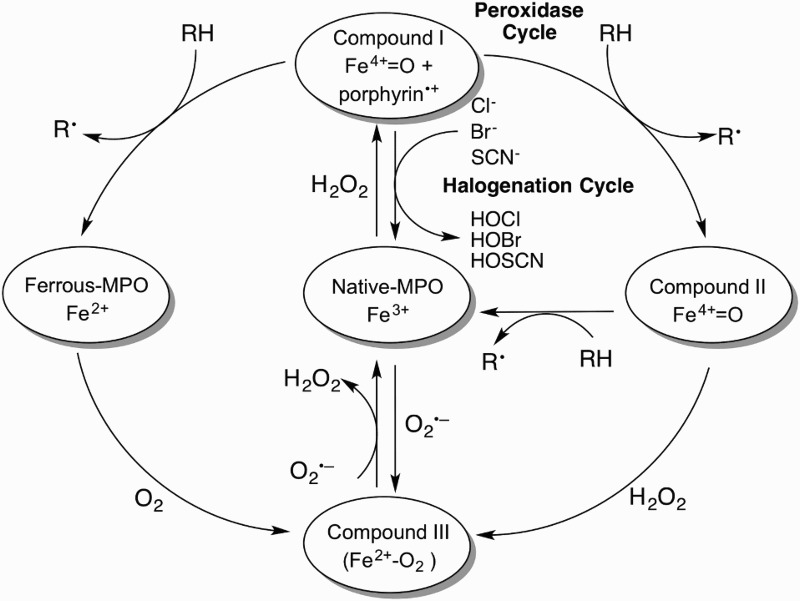
Figure 1.
Figure 1.
The MPO catalytic cycle. Native MPO reacts with H2O2 to form compound I. Compound I can be converted back to native MPO either by the halogenation cycle or by the two-step one-electron reduction in the peroxidase cycle. Ferrous-MPO and compound III are redox forms of MPO that exist outside the two catalytic cycles.
Figure 2.
Figure 2.
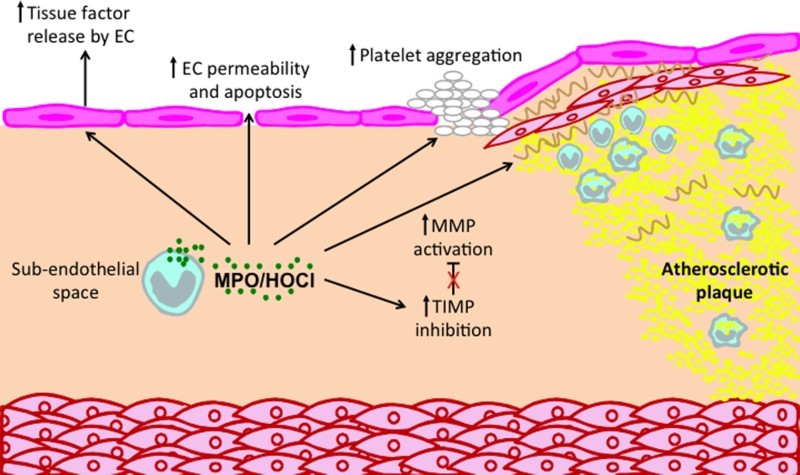
Potential roles of MPO and MPO-derived oxidants in promoting atherosclerotic plaque instability. MPO can affect a number of processes that contribute to plaque instability and possible plaque rupture. MPO released by monocyte/macrophages and neutrophil can activate MMPs and inhibit TIMPs, leading to reduction in ECM, especially in the fibrous cap. In addition, MPO may contribute to a thrombogenic environment by inducing endothelial cells to release tissue factor and by priming of platelet aggregation. Finally, MPO can increase endothelial cell (EC) permeability and apoptosis, thereby increasing the leakiness of the endothelium.

References

    1. Zhang R, Brennan ML, Fu X, et al. Association between myeloperoxidase levels and risk of coronary artery disease. Jama. 2001;286:2136–2142. doi: 10.1001/jama.286.17.2136 - DOI - PubMed
    1. Yousuf O, Mohanty BD, Martin SS, et al. High-sensitivity C-reactive protein and cardiovascular disease: a resolute belief or an elusive link? J Am Coll Cardiol. 2013;62:397–408. doi: 10.1016/j.jacc.2013.05.016 - DOI - PubMed
    1. Koeth RA, Haselden V, Tang WH. Myeloperoxidase in cardiovascular disease. Adv Clin Chem. 2013;62:1–32. doi: 10.1016/B978-0-12-800096-0.00001-9 - DOI - PubMed
    1. Dominguez-Rodriguez A, Abreu-Gonzalez P. Current role of myeloperoxidase in routine clinical practice. Exp Rev Cardiovascul Ther. 2011;9:223–230. doi: 10.1586/erc.11.2 - DOI - PubMed
    1. Narula J, Nakano M, Virmani R, et al. Histopathologic characteristics of atherosclerotic coronary disease and implications of the findings for the invasive and noninvasive detection of vulnerable plaques. J Am Coll Cardiol. 2013;61:1041–1051. doi: 10.1016/j.jacc.2012.10.054 - DOI - PMC - PubMed

MeSH terms