


Review
doi: 10.1016/j.bj.2016.08.006.
Epub 2016 Oct 27.
Purinergic signalling in autoimmunity: A role for the P2X7R in systemic lupus erythematosus?
Affiliations
- PMID: 27884379
- PMCID: PMC6138817
- DOI: 10.1016/j.bj.2016.08.006
Item in Clipboard
Review
Purinergic signalling in autoimmunity: A role for the P2X7R in systemic lupus erythematosus?
Biomed J.
2016 Oct.
Abstract
Purinergic signalling plays a crucial role in immunity and autoimmunity. Among purinergic receptors, the P2X7 receptor (P2X7R) has an undisputed role as it is expressed to high level by immune cells, triggers cytokine release and modulates immune cell differentiation. In this review, we focus on evidence supporting a possible role of the P2X7R in the pathogenesis of systemic lupus erythematosus (SLE).
Keywords: Extracellular ATP; Interleukin-1β; NLRP3 inflammasome; P2X7R; Systemic lupus erythematosus.
Copyright © 2016 Chang Gung University. Published by Elsevier B.V. All rights reserved.
Figures
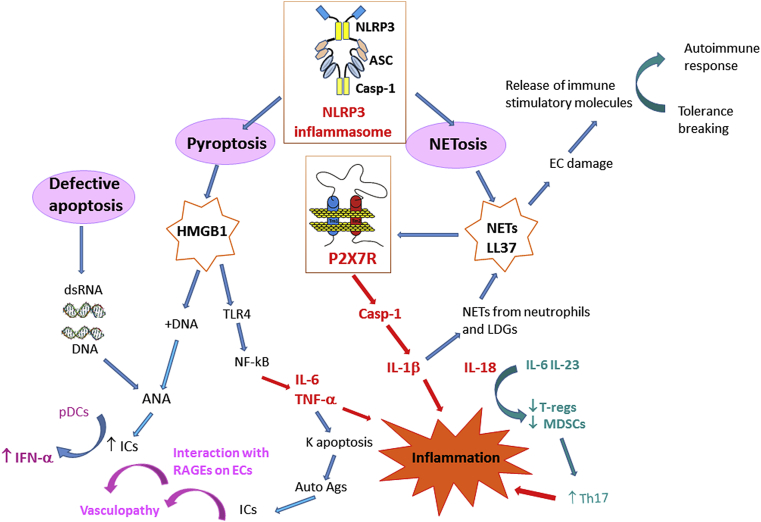
Suggested central role of P2X7R and NLRP3 inflammasome in the pathways leading to autoimmunity and tissue damage in SLE. The different types of cell death can generate molecules that contribute to inflammation and tissue damage in SLE. NETosis, which is dependent on NLRP3 inflammasome activation, produces NETs and the cathelicidin LL-37. Pyroptosis, also dependent on NLRP3 inflammasome activation, causes HMGB1 and DNA release. Finally, defective apoptosis is responsible for nucleic acid release. NETs/LL-37 activate the P2X7R leading to production and release of IL-1β and IL-18, thus promoting inflammation. IL-1β is in turn responsible of increased NETs formation from neutrophils and LDGs. Interleukin-18 works in combination with IL-6 and IL-23 to reduce T-reg and MDSC activity, to enhance Th17 activity and inflammation. NETs are also responsible for EC damage with consequent release of immune stimulatory molecules and tolerance breaking. HMGB1 interaction with TLR4 contributes to inflammation through activation of NF-kB and release of the inflammatory cytokines TNF-α and IL-6. TNF-α is responsible for keratinocyte apoptosis, a process that generates autoantigens. The alarmin HMGB1, is released upon P2X7R/NLRP3 activation and in cooperation with DNA contributes to ANA formation. Nucleic acids are responsible for production of ANAs that participate in formation of ICs. ICs on one hand, interact with RAGEs on endothelial cells, thus causing vasculopathy, whereas on the other stimulate pDCs to produce IFN-α. Abbreviations: NETs: neutrophil extracellular trap-associated proteins; HMGB1: high molecular group box-1; ANA: anti-nuclear antibodies; MDSC: myeloid derived suppressor cells; pDCs: plasmacytoid dendritic cells; K: keratinocytes; LDGs: low-density granulocytes; TLR4: Toll-like receptor 4; ICs: immune complexes; RAGEs: receptor for advanced glycation end products; NLRP3: NOD-like receptor family pyrin domain-containing 3.
Comment in
-
Purinergic signaling in infection and autoimmune disease.Biomed J. 2016 Oct;39(5):304-305. doi: 10.1016/j.bj.2016.09.002. Epub 2016 Oct 27. Biomed J. 2016. PMID: 27884376 Free PMC article.
Comment on
-
P2 purinoceptors in the immune system.Ciba Found Symp. 1996;198:290-302; discussion 302-5. doi: 10.1002/9780470514900.ch17. Ciba Found Symp. 1996. PMID: 8879832 Review.
References
-
- Sugiyama K., Yamasaki H. Calcium-dependent histamine release by ATP from isolated rat mast cells. Jpn J Pharmacol. 1969;19:175–176. - PubMed
-
- Dahlquist R., Diamant B. Further observations on ATP-induced histamine release from rat mast cells. Acta Pharmacol Toxicol (Copenh) 1970;28:43. - PubMed
-
- Dahlquist R., Diamant B., Kruger P.G. Increased permeability of the rat mast cell membrane to sodium and potassium caused by extracellular ATP and its relationship to histamine release. Int Arch Allergy Appl Immunol. 1974;46:655–675. - PubMed
-
- Cockcroft S., Gomperts B.D. ATP induces nucleotide permeability in rat mast cells. Nature. 1979;279:541–542. - PubMed
Publication types
MeSH terms
Substances
LinkOut - more resources
Full Text Sources
Other Literature Sources
