


Association of endothelial dysfunction and cytotoxin-associated gene A-positive Helicobacter pylori in patients with cardiac syndrome X
- PMID: 27884380
- PMCID: PMC6138800
- DOI: 10.1016/j.bj.2016.01.010
Association of endothelial dysfunction and cytotoxin-associated gene A-positive Helicobacter pylori in patients with cardiac syndrome X
Abstract
Background: Existence of coronary endothelial dysfunction has been demonstrated in patients with cardiac syndrome X (CSX). In addition, Helicobacter pylorus (H. pylori) has been associated with CSX. We aimed to assess the possible association of endothelial dysfunction and cytotoxin-associated gene A-positive H. pylori (CagA+) infection in CSX patients.
Methods: Fifty-six patients with CSX (23 male/33 female; age: 51.25 ± 8.86 years) who were anti-H. pylori IgG-positive [H. pylori(+)] and 24 CSX patients (7 male/17 female; age: 52.79 ± 9.88 years) who were H. pylori(-) were included. Also, anti-H. pylori IgG-positive patients were determined by the presence of IgG antibody to CagA. Levels of endothelin-1 (ET-1), E-selectin and intercellular adhesion molecule-1 (ICAM-1) were measured.
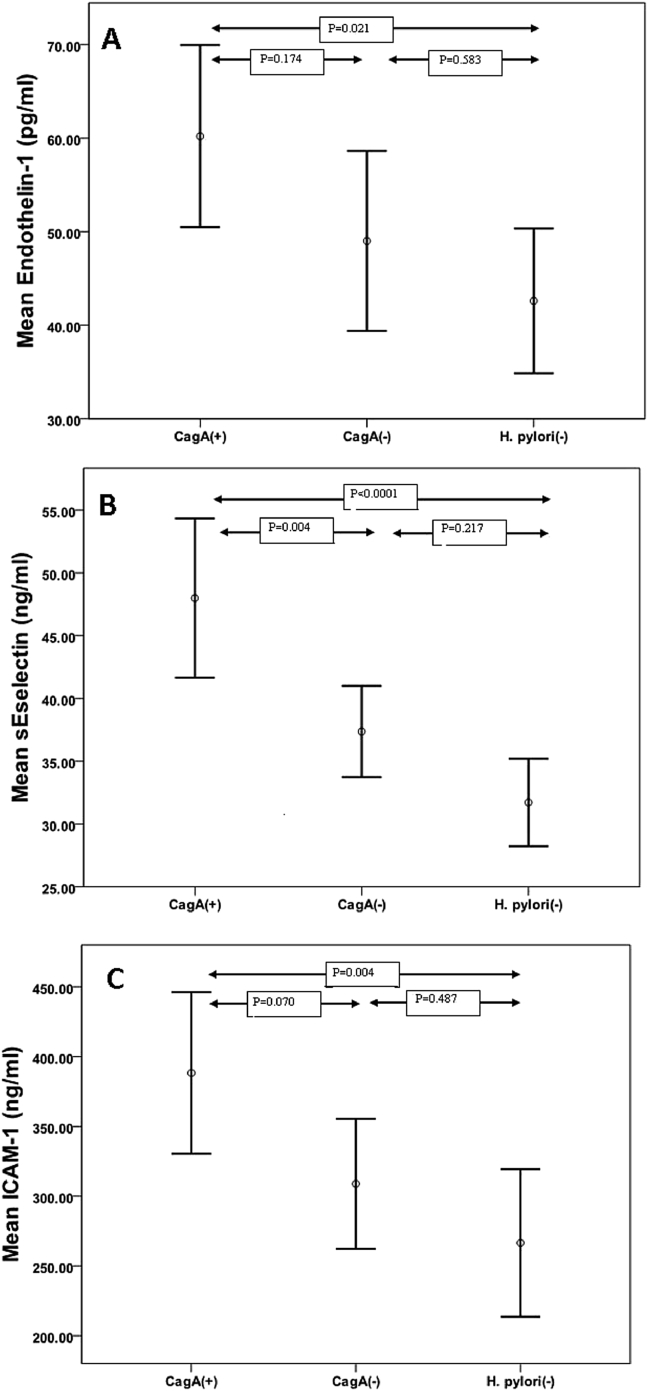
Results: Endothelial dysfunction biomarkers were higher in H. pylori(+) than in H. pylori(-) patients (ET-1: 54.60 ± 25.39 vs. 42.59 ± 18.37 pg/ml, p = 0.04; E-selectin: 42.68 ± 14.26 vs. 31.72 ± 8.26 ng/ml, p = 0.001; ICAM-1: 339.68 ± 135.8 vs. 266.51 ± 125.1 ng/ml, p = 0.02). Among H. pylori(+) subjects, 28 cases were CagA(+) and 28 cases were CagA(-). There were significant differences in measured levels of E-selectin between CagA(+) and CagA(-) groups (48.00 ± 16.37 vs. 37.37 ± 9.37 ng/ml, p = 0.004). For ET-1 and ICAM-1 levels, the difference between CagA(+) and CagA(-) was insignificant (p = 0.174 and p = 0.07, respectively).
Conclusion: High levels of endothelial dysfunction biomarkers are found in CSX patients with anti-CagA(+). These findings suggest the infection with CagA(+) H. pylori strain may play a role as a risk factor in development of CSX through provocation of endothelial dysfunction. Therefore, a long term follow up to investigate the outcomes of these patients is proposed.
Keywords: Cardiac syndrome X; Cytotoxin-associated gene A; Endothelial dysfunction; Helicobacter pylori.
Copyright © 2016 Chang Gung University. Published by Elsevier B.V. All rights reserved.
Figures
Comment on
-
Concentration of circulating plasma endothelin in patients with angina and normal coronary angiograms.Br Heart J. 1995 Dec;74(6):620-4. doi: 10.1136/hrt.74.6.620. Br Heart J. 1995. PMID: 8541166 Free PMC article.
-
Helicobacter pylori-induced activation of human endothelial cells.Infect Immun. 2002 Aug;70(8):4581-90. doi: 10.1128/IAI.70.8.4581-4590.2002. Infect Immun. 2002. PMID: 12117971 Free PMC article.
-
Increased levels of soluble adhesion molecules E-selectin and P-selectin in patients with cardiac syndrome X.Angiology. 2005 May-Jun;56(3):273-7. doi: 10.1177/000331970505600306. Angiology. 2005. PMID: 15889194
-
Association of Helicobacter pylori infection with cardiac syndrome X.Singapore Med J. 2006 Aug;47(8):704-6. Singapore Med J. 2006. PMID: 16865212
References
-
- Hurst T., Olson T.H., Olson L.E., Appleton C.P. Cardiac syndrome X and endothelial dysfunction: new concepts in prognosis and treatment. Am J Med. 2006;119:560–566. - PubMed
-
- Li J.J., Li Y.S., Zhang Y., Gao Z., Li Z., Qian H.Y. Inflammation: a possible pathogenic link to cardiac syndrome X. Med Hypotheses. 2006;66:87–91. - PubMed
-
- Barac A., Campia U., Panza J.A. Methods for evaluating endothelial function in humans. Hypertension. 2007;49:748–760. - PubMed
-
- Turhan H., Saydam G.S., Erbay A.R., Ayaz S., Yasar A.S., Aksoy Y. Increased plasma soluble adhesion molecules; ICAM-1, VCAM-1, and E-selectin levels in patients with slow coronary flow. Int J Cardiol. 2006;108:224–230. - PubMed
Publication types
MeSH terms
Substances
LinkOut - more resources
Full Text Sources
Other Literature Sources
Miscellaneous
