


Prevalence and determinants of carotid plaque in the cross-sectional REFINE-Reykjavik study
- PMID: 27884845
- PMCID: PMC5168519
- DOI: 10.1136/bmjopen-2016-012457
Prevalence and determinants of carotid plaque in the cross-sectional REFINE-Reykjavik study
Abstract
Objective: Carotid plaque and intima-media thickness are non-invasive arterial markers that are used as surrogate end points for cardiovascular disease. The aim was to assess the prevalence and severity of carotid plaque, and examine its determinant risk factors and their association to the common carotid artery intima-media thickness (CCA-IMT) in a general population.
Methods: We examined 6524 participants aged 25-69 years in the population-based REFINE (Risk Evaluation For INfarct Estimates)-Reykjavik study. Plaques at the bifurcation and internal carotid arteries were evaluated. Mean CCA-IMT was measured in the near and far walls of the common carotid arteries.
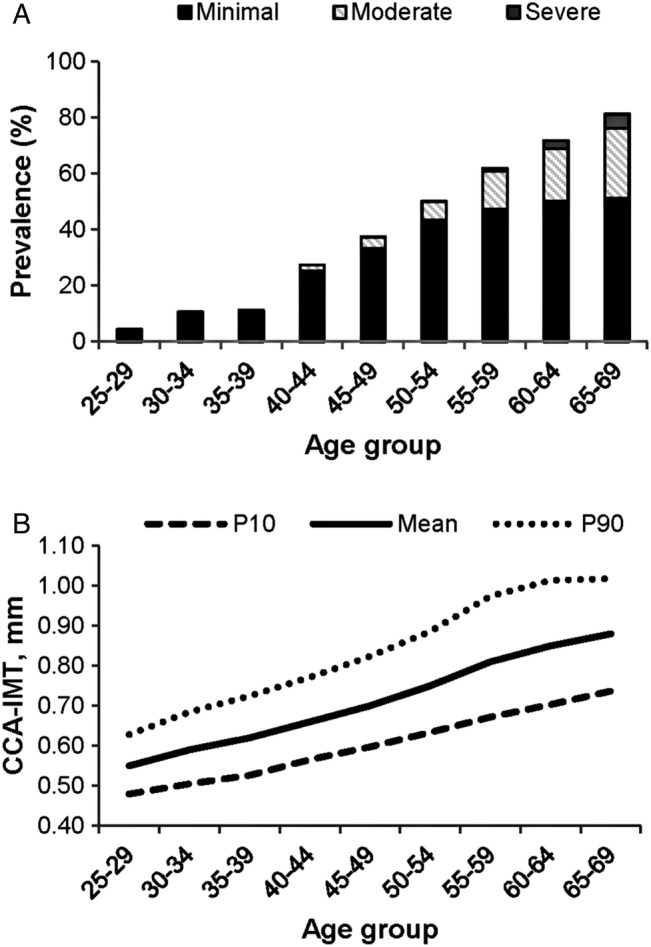
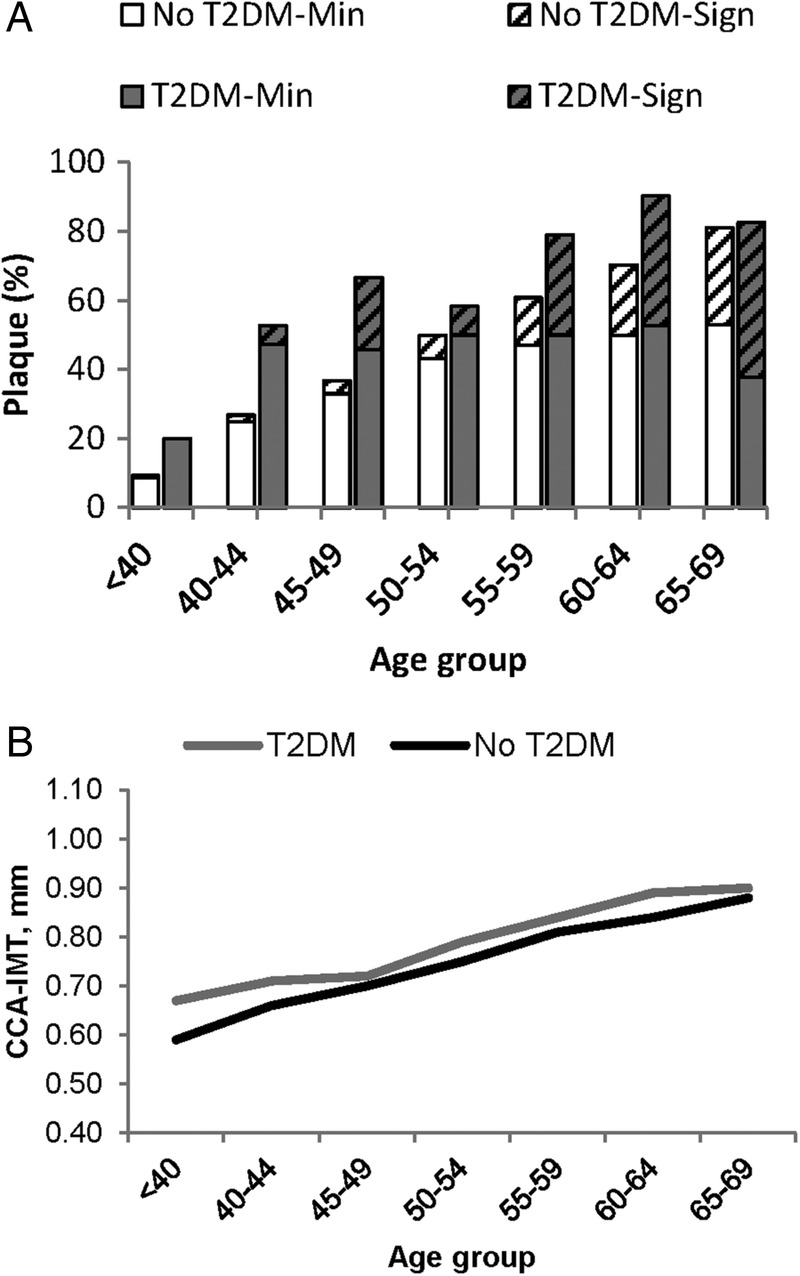
Results: The prevalence of minimal, moderate and severe plaque was 35.0%, 8.9% and 1.1%, respectively, and the mean CCA-IMT was 0.73 (SD 0.14) mm. Age, sex, smoking and type 2 diabetes mellitus (T2DM) were the strongest risk factors associated with plaque, followed by systolic blood pressure, total cholesterol, body mass index and family history of myocardial infarct. Low educational level was also strongly and independently associated with plaque. CCA-IMT shared the same risk factors except for a non-significant association with T2DM and family history of myocardial infarction (MI). Participants with T2DM had greater plaque prevalence, 2-fold higher in those <50 years and 17-30% greater in age groups 50-54 to 60-64, and more significant plaques (moderate or severe) were the difference in prevalence was 24% in age group 50-54 and ≥60% in older age groups, compared with non-T2DM.
Conclusions: Carotid plaque and CCA-IMT have mostly common determinants. However, T2DM and family history of MI were associated with plaque but not with CCA-IMT. Greater prevalence and more severe plaques in individuals with T2DM raise the concern that with increasing prevalence of T2DM we may expect an increase in atherosclerosis and its consequences.
Keywords: atherosclerosis; carotid arteries; risk factors; type 2 diabetes mellitus.
Published by the BMJ Publishing Group Limited. For permission to use (where not already granted under a licence) please go to http://www.bmj.com/company/products-services/rights-and-licensing/.
Conflict of interest statement
Conflicts of Interest: None declared.
Figures
References
Publication types
MeSH terms
Substances
LinkOut - more resources
Full Text Sources
Other Literature Sources
Medical
