. 2016 Nov 23;4(4):42.
doi: 10.3390/microorganisms4040042.

Dirty Money: A Matter of Bacterial Survival, Adherence, and Toxicity

Affiliations

Dirty Money: A Matter of Bacterial Survival, Adherence, and Toxicity

Frank Vriesekoop et al. Microorganisms. .

Abstract

In this study we report the underlying reasons to why bacteria are present on banknotes and coins. Despite the use of credit cards, mobile phone apps, near-field-communication systems, and cryptocurrencies such as bitcoins which are replacing the use of hard currencies, cash exchanges still make up a significant means of exchange for a wide range of purchases. The literature is awash with data that highlights that both coins and banknotes are frequently identified as fomites for a wide range of microorganisms. However, most of these publications fail to provide any insight into the extent to which bacteria adhere and persist on money. We treated the various currencies used in this study as microcosms, and the bacterial loading from human hands as the corresponding microbiome. We show that the substrate from which banknotes are produced have a significant influence on both the survival and adherence of bacteria to banknotes. Smooth, polymer surfaces provide a poor means of adherence and survival, while coarser and more fibrous surfaces provide strong bacterial adherence and an environment to survive on. Coins were found to be strongly inhibitory to bacteria with a relatively rapid decline in survival on almost all coin surfaces tested. The inhibitory influence of coins was demonstrated through the use of antimicrobial disks made from coins. Despite the toxic effects of coins on many bacteria, bacteria do have the ability to adapt to the presence of coins in their environment which goes some way to explain the persistent presence of low levels of bacteria on coins in circulation.

Keywords: bacteria; banknotes; coins; microbiome; microcosm; substrate.


Conflict of interest statement

The authors declare no conflict of interest.

Figures
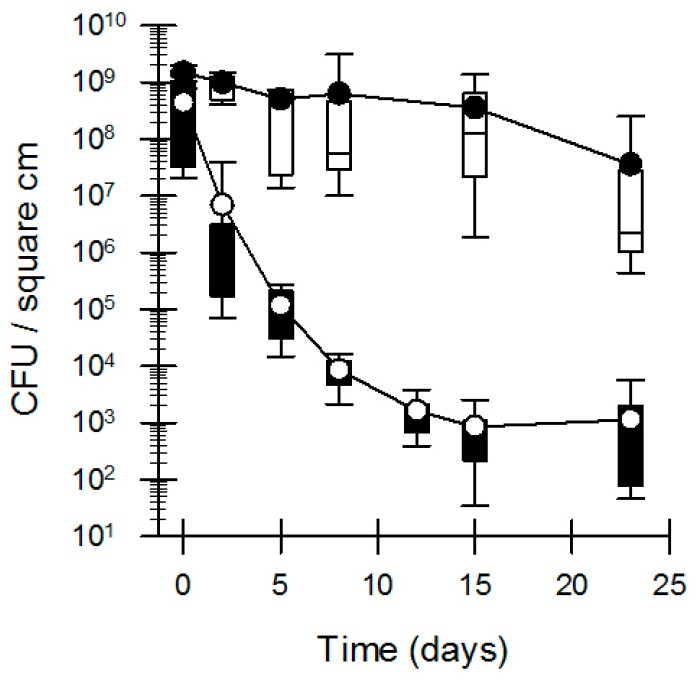
Figure 1
Figure 1
Box plot of the survival of bacteria on banknotes over time. Open boxes and closed dots: cotton-linen notes (Chinese yuan); Closed boxes and open dots: polymer (Australia dollar). Data shows recoverable bacteria after a single extraction. The bacterial inoculum (hand microbiome) in this experiment was facilitated by soaking the notes in nutrient broth in which volunteers washed their hands. The bacterial loading of the broth at the time of removing the notes from the broth was approximately 1 × 10¹¹ CFU (colony forming units)/mL. The boxes represent the interquartile range (central 50%) of the data regarding the number of bacteria on banknotes analysed. The dots represent the average number of recoverable bacteria, whereas the whiskers (viz. error bars) represent either the upper or lower 25% of banknotes analysed (n = 30).
Figure 2
Figure 2
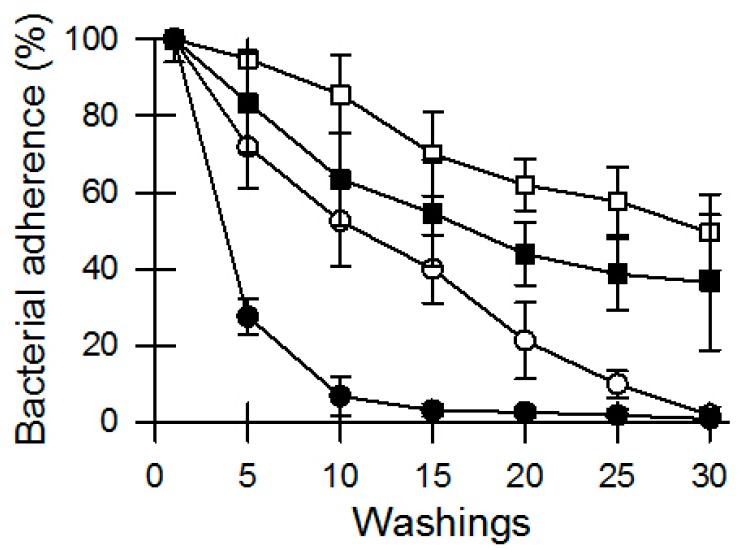
Attachment of bacteria to banknotes following multiple extractions. □ washi-style paper notes (Japanese yen); ■ cotton notes (Chinese yuan); ○ cotton-linen notes (USA dollar); and ● polymer (Australian dollar). The bacterial inoculum (hand microbiome) in this experiment was facilitated by soaking the notes in nutrient broth in which volunteers washed their hands. Data shows remaining bacteria after a series of washings in saline buffer, relative to the first washing. Data are shown are the averages of quintuplicate (n = 5) samples while the error bars indicate standard deviation.
Figure 3
Figure 3
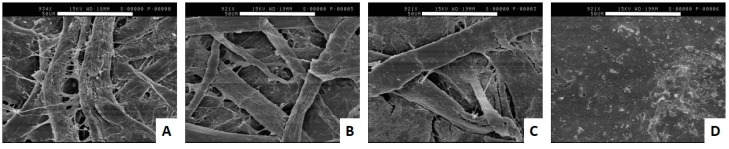
Electron micrographs (SEM) of the surface of banknotes. (A) Micrograph of a typical cotton-based banknote (Chinese Yuan); (B) micrograph of a typical washi-style paper-based banknote (Japanese Yen); (C) micrograph of a typical cotton-linen-based banknote (USA Dollar); and (D) micrograph of a typical polymer-based banknote (Australian Dollar). Scale bar represent 50 µm.
Figure 4
Figure 4
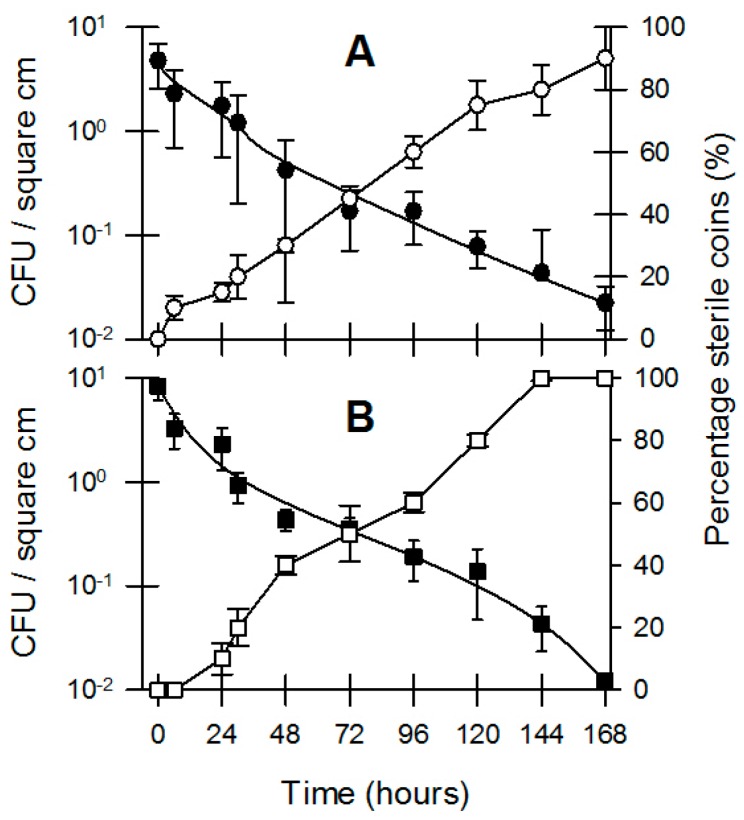
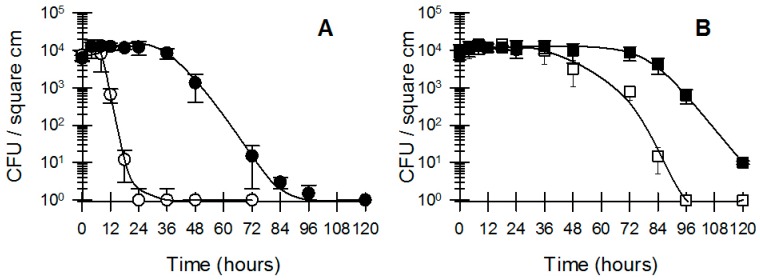
Survival of a bacterial microcosm on currency coins over time. (A) Australian 20 cent (silver) coins (● bacterial loading (CFU/cm2) on coins; ○ % sterile coins in batch of 10); (B) Australian one dollar (gold) coins (■ bacterial loading (CFU/cm2) on coins; □ % sterile coins in batch of 10). The bacterial inoculum in this experiment was facilitated by direct human contact; at least five volunteers were used to handle the currency continuously for at least 15 min (see Section 2.2 for more detail). Data shown are the average and standard deviation of recoverable bacteria after a single extraction (n = 10).
Figure 5
Figure 5
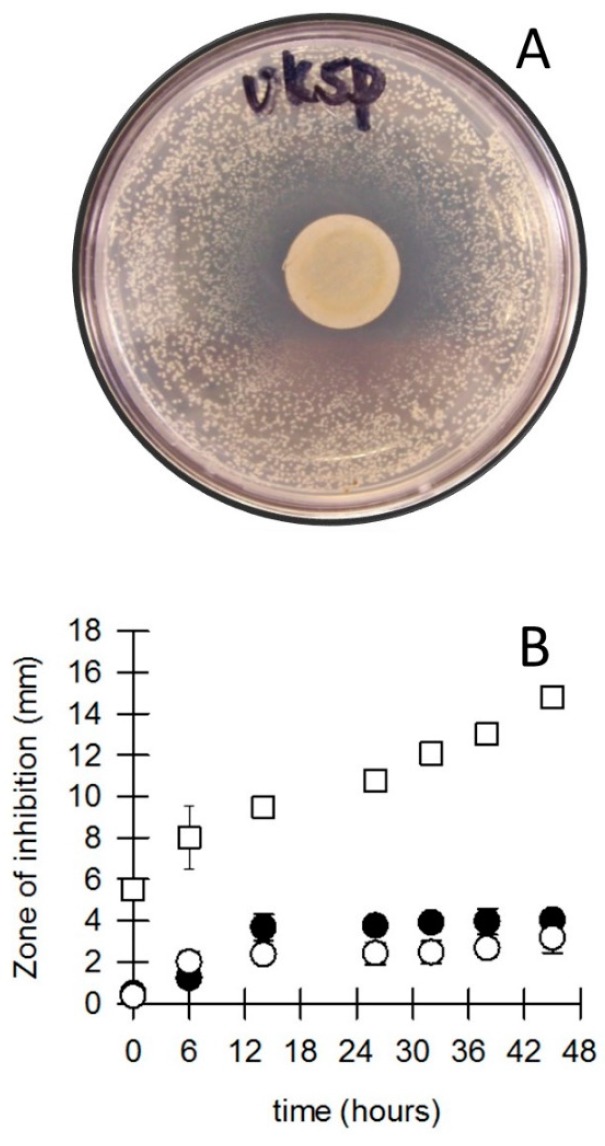
Zones of inhibition of bacteria (Staphylococcus aureus) due to the presence of coins. (A) Zone of inhibition around a 12 × 1 mm disk of a UK 5 pence coin (disk is still present in picture); (B) The coins were placed on the bacterial growth media at various times before the bacteria were applied. □ old Dutch bronze one cent coins; ● Australian twenty cent coins; ○ Australian one dollar coins. (n = 6).
Figure 6
Figure 6
Effect of pre-exposure of bacterial parent cultures to coin metal (Australian $1) prior to survival on the same coinage. (A) L. monocytogenes; ○ non-exposed culture; ● pre-exposed culture; (B) E. coli; □ non-exposed culture; ■ pre-exposed culture. The bacterial inoculum in this experiment was facilitated by introducing a fixed aliquot of bacterial suspension to one side (heads only) of sterile coins. Data shown are the average and standard deviation of recoverable bacteria after a single extraction (n = 6).

References

    1. Dodgson M., Gann D., Wladawsky-Berger I., Sultan N., George G. Managing digital money. Acad. Manag. J. 2015;58:325–333. doi: 10.5465/amj.2015.4002. - DOI
    1. Koblitz N., Menezes A.J. Cryptocash, cryptocurrencies, and cryptocontracts. Des. Code Cryptogr. 2016;78:87–102. doi: 10.1007/s10623-015-0148-5. - DOI
    1. Ward C.B., Tanner F.W. Bacteria on subsidiary coins and currency. Am. J. Med. Sci. 1921;162:585–592. doi: 10.1097/00000441-192110000-00011. - DOI
    1. Mihaéloff S. The transference of pathogenic organisms on paper money and on coins. Ann. d’Hyg. Pub. Indust. et Sociale. 1940;18:226–233. (In French)
    1. Warsa R. Coins and paper money as potential vectors of pathogenic germs. Doc. Med. Geogr. Trop. 1952;4:139–174. (In French)

LinkOut - more resources