


Fluorescence chromosome banding and FISH mapping in perennial ryegrass, Lolium perenne L
- PMID: 27887567
- PMCID: PMC5124321
- DOI: 10.1186/s12864-016-3231-z
Fluorescence chromosome banding and FISH mapping in perennial ryegrass, Lolium perenne L
Abstract
Background: The unambiguous identification of individual chromosomes is a key part of the genomic characterization of any species. In this respect, the development and application of chromosome banding techniques has revolutionised mammalian and especially, human genomics. However, partly because of the traditional use of chromosome squash preparations, consistent fluorescence banding has rarely been achieved in plants. Here, successful fluorescence chromosome banding has been achieved for the first time in perennial ryegrass (Lolium perenne), a forage and turf grass with a large genome and a symmetrical karyotype with chromosomes that are difficult to distinguish.
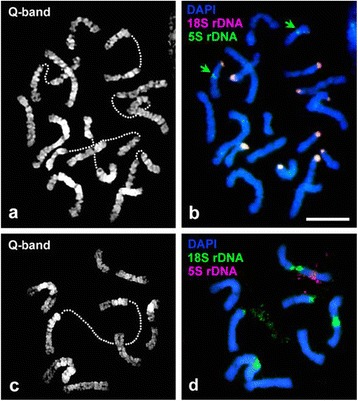
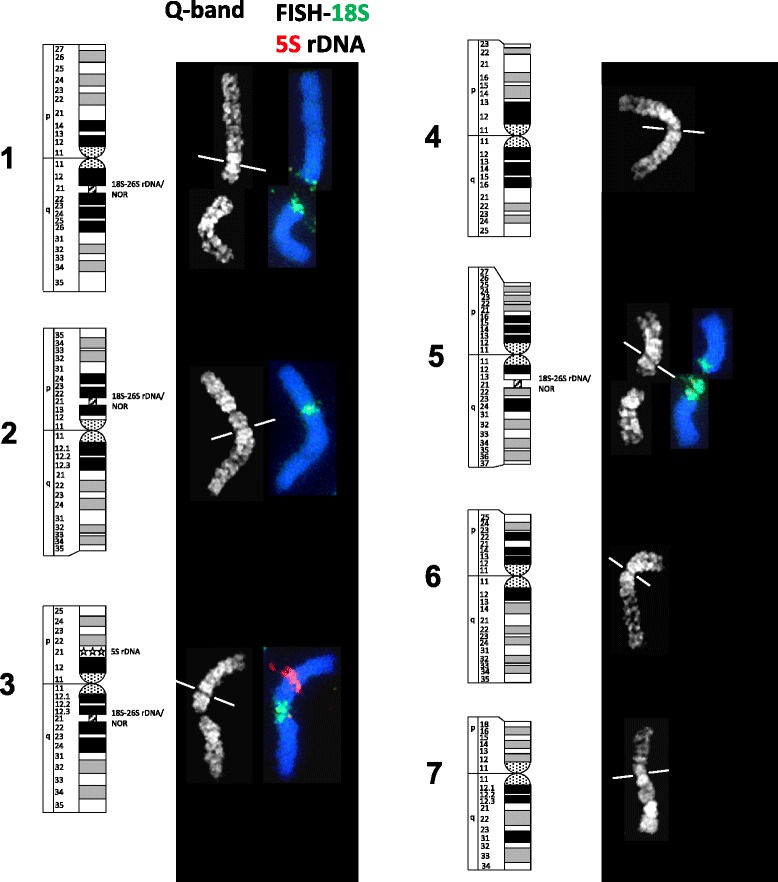
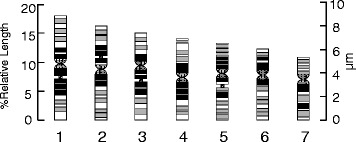
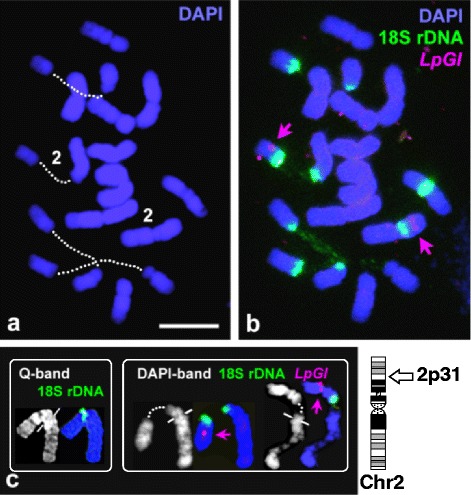
Results: Based on flame-dried chromosome preparations instead of squashes, a simple fluorescence Q-banding technique using quinacrine mustard, unambiguously identified each chromosome and enabled the development of a banded karyotype and ideogram of the species. This Q-banding technique was also shown to be compatible with sequential FISH mapping enabling labelled genes and molecular markers to be precisely assigned to specific cytogenetic bands. A technique for DAPI-banding, which gave a similar pattern to Q-banding, was also introduced. This was compatible with FISH mapping and was used to anchor a single copy gene from an earlier mapped linkage group of L. perenne, thus providing a step towards integration of the genetic and cytogenetic maps.
Conclusions: By enabling the allocation of genes mapped by other methods to physically identified chromosome positions, this work will contribute to a better understanding of genomic structures and functions in grasses.
Keywords: Banded ideogram; Chromosome Q-banding; Chromosome identification; FISH mapping; Lolium perenne; Perennial ryegrass; Standardized banded karyotype.
Figures
References
-
- Levan A, Fredga K, Sandberg AA. Nomenclature for centromeric position on chromosomes. Hereditas. 1964;52:201–20. doi: 10.1111/j.1601-5223.1964.tb01953.x. - DOI
-
- Hsu T-C. Human and Mammalian Cytogenetics: An Historical Perspective. New York: Springer; 1979.
-
- ISCN. An international system for human cytogenetic nomenclature: report of the Standing Committee on Human Cytogenetic Nomenclature. Harnden DG, Klinger HP, editors. Basel: Karger; 1985.
-
- DiBerardino D, Hayes H, Fries R, Long S. International system for cytogenetic nomenclature of domestic animals. The Second International Conference on Standardization of Domestic Animal Karyotypes, INRA, Jouy-en Josas, France, 22nd-26th May, 1989. Cytogenet Cell Genet. 1990;53:65–79. doi: 10.1159/000132898. - DOI - PubMed
Publication types
MeSH terms
LinkOut - more resources
Full Text Sources
Other Literature Sources
