


Impact of epidemiological characteristics of supratentorial gliomas in adults brought about by the 2016 world health organization classification of tumors of the central nervous system
- PMID: 27888628
- PMCID: PMC5386767
- DOI: 10.18632/oncotarget.13555
Impact of epidemiological characteristics of supratentorial gliomas in adults brought about by the 2016 world health organization classification of tumors of the central nervous system
Abstract
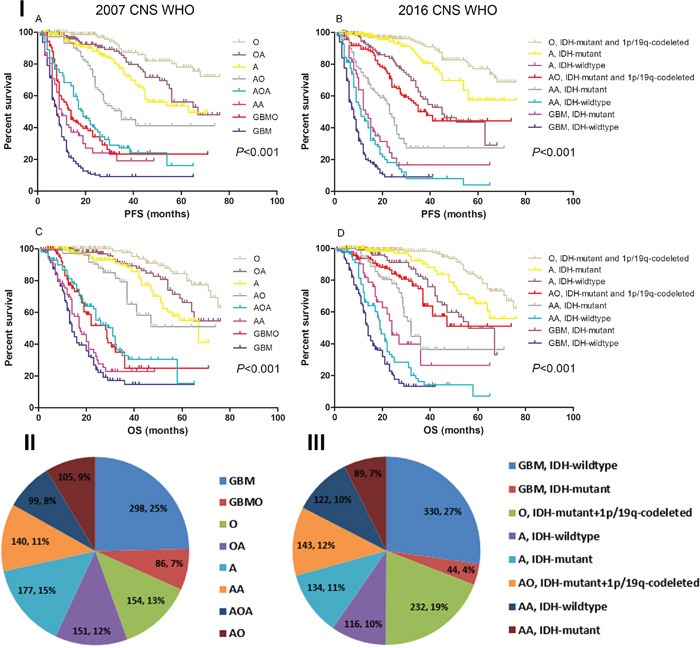
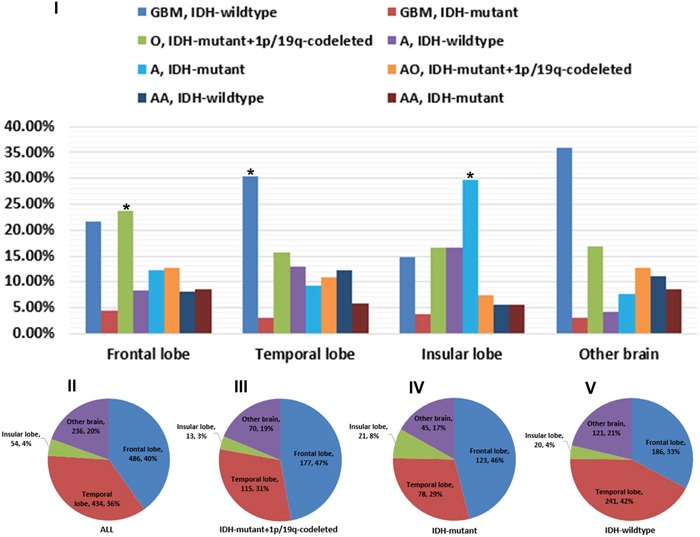
The latest World Health Organization (WHO) classification of tumors of the central nervous system (CNS) integrates both histological and molecular features in the definition of diagnostic entities. This new approach enrolls novel entities of gliomas. In this study, we aimed to reveal the epidemiological characteristics, including age at diagnosis, gender ratio, tumor distribution and survival, of these new entities. We retrospectively reclassified 1210 glioma samples according to the 2016 CNS WHO diagnostic criteria. In our cohort, glioblastoma multiforme (GBM) with wildtype isocitrate dehydrogenase (IDH) was the most common malignant tumor in the brain. Almost all gliomas were more prevalent in males, especially in the cluster of WHO grade III gliomas and IDH-wildtype GBM. Age at diagnosis was directly proportional to tumor grade. With respect to the distribution by histology, we found that gliomas concurrent with IDH-mutant and 1p/19q-codeleted or with single IDH-mutant were mainly distributed in frontal lobe, while those with IDH-wildtype were dominant in temporal lobe. Lesions located in insular lobe were more likely to be IDH-mutant astrocytoma. In summary, our results elucidated the epidemiological characteristics as well as the regional constituents of these new gliomas entities, which could bring insights into tumorigenesis and personalized treatment of Chinese glioma population.
Keywords: classification; epidemiology; gliomas; impact.
Conflict of interest statement
No potential conflicts of interest were disclosed.
Figures
References
-
- Louis DN, Perry A, Reifenberger G, von Deimling A, Figarella-Branger D, Cavenee WK, Ohgaki H, Wiestler OD, Kleihues P, Ellison DW. The 2016 World Health Organization Classification of Tumors of the Central Nervous System: a summary. Acta Neuropathol. 2016;131:803–20. - PubMed
-
- Giannini C, Scheithauer BW, Weaver AL, Burger PC, Kros JM, Mork S, Graeber MB, Bauserman S, Buckner JC, Burton J, Riepe R, Tazelaar HD, Nascimento AG, et al. Oligodendrogliomas: reproducibility and prognostic value of histologic diagnosis and grading. J Neuropathol Exp Neurol. 2001;60:248–62. - PubMed
-
- Kraus JA, Lamszus K, Glesmann N, Beck M, Wolter M, Sabel M, Krex D, Klockgether T, Reifenberger G, Schlegel U. Molecular genetic alterations in glioblastomas with oligodendroglial component. Acta Neuropathol. 2001;101:311–20. - PubMed
MeSH terms
LinkOut - more resources
Full Text Sources
Other Literature Sources
