Review
. 2017 Apr:11:91-102.
doi: 10.1016/j.redox.2016.11.005. Epub 2016 Nov 16.

Redox control of senescence and age-related disease

Affiliations
Review

Redox control of senescence and age-related disease

Akshaya Chandrasekaran et al. Redox Biol. 2017 Apr.

Abstract

The signaling networks that drive the aging process, associated functional deterioration, and pathologies has captured the scientific community's attention for decades. While many theories exist to explain the aging process, the production of reactive oxygen species (ROS) provides a signaling link between engagement of cellular senescence and several age-associated pathologies. Cellular senescence has evolved to restrict tumor progression but the accompanying senescence-associated secretory phenotype (SASP) promotes pathogenic pathways. Here, we review known biological theories of aging and how ROS mechanistically control senescence and the aging process. We also describe the redox-regulated signaling networks controlling the SASP and its important role in driving age-related diseases. Finally, we discuss progress in designing therapeutic strategies that manipulate the cellular redox environment to restrict age-associated pathology.

Keywords: Aging; Oxidative stress; Reactive oxygen species (ROS); Senescence; Senescence-associated secretory phenotype (SASP).


Figures

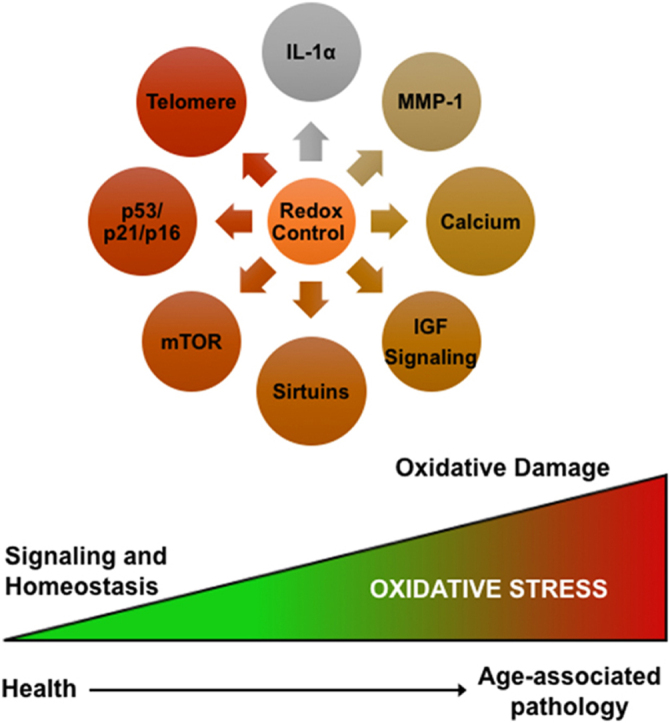
fx1
Graphical abstract
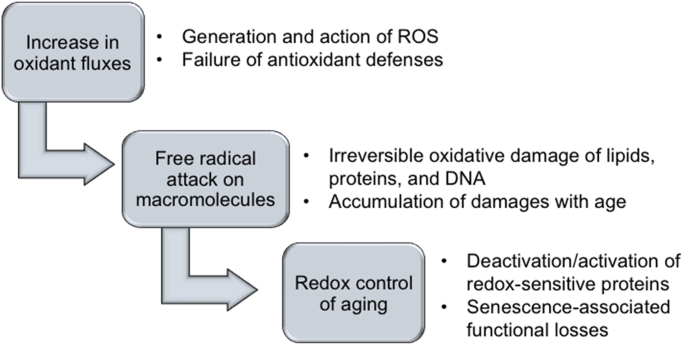
Fig. 1
Fig. 1
Schematic representation of the oxidative stress theory of aging. The key features of this hypothesis are that increase in oxidants and concomitant failure of antioxidant mechanisms cause structural damage to macromolecules which accumulates with age leading to corresponding decline or loss in function.
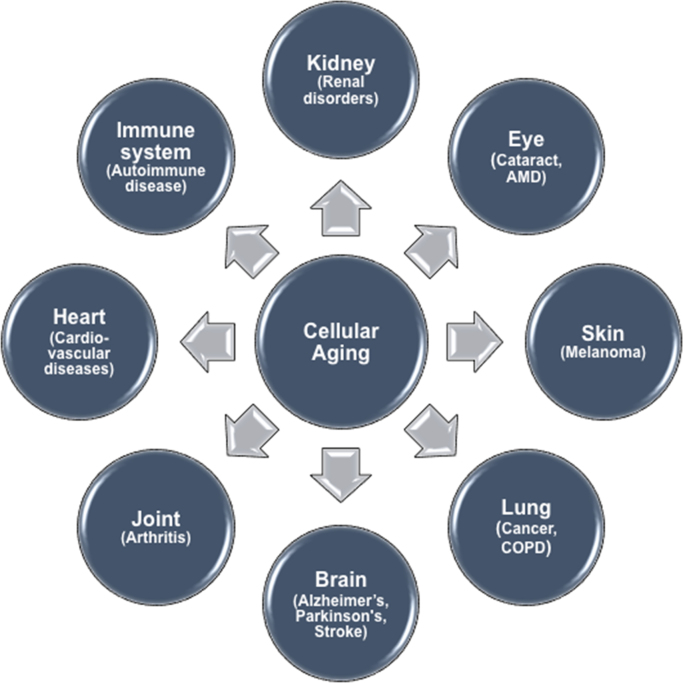
Fig. 2
Fig. 2
Schematic representation of diseases propagated by age. Cellular senescence and the associated secretory phenotype have been implicated in initiation and progress of several acute and chronic pathological maladies driven by age-associated inflammation (inflammaging) and oxidative stress-mediated damage. AMD – Age-related macular degeneration; COPD – Chronic obstructive pulmonary disease).
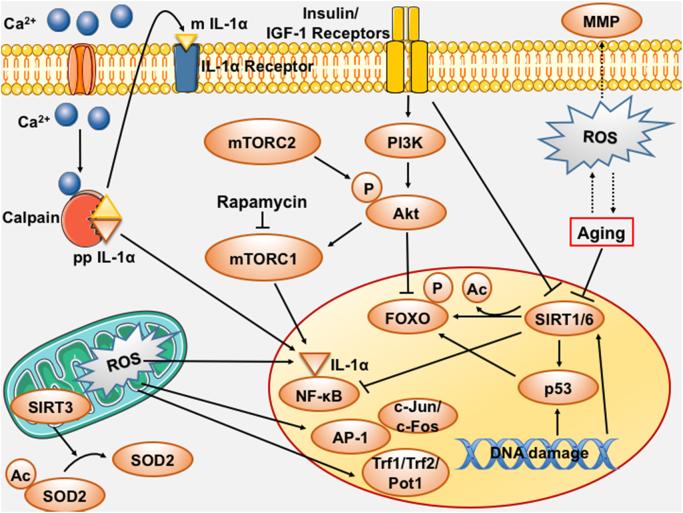
Fig. 3
Fig. 3
Schematic representation of the redox-control of pro-aging mechanisms. Oxidative stress-mediated regulation of several factors and mechanistic pathways plays a critical role in senescence regulation. Several of these components can interact with each other to induce effects of the senescent phenotype. AP‐1 – Activator protein 1; Ca2+– Calcium; FOXO – Forkhead box O; IGF-1 – Insulin-like growth factor-1; IL – Interleukin; MMP – Matrix metalloproteinase; mTORC – Mammalian target of rapamycin complex; NF-κB – Nuclear factor kappa-light-chain-enhancer of activated B cells; PI3K – Phosphoinositide 3-kinase; Pot-1 – Protection of telomeres protein 1; pRb – Retinoblastoma protein; ROS – Reactive oxygen species; SIRT – Sirtuin; SOD2 – Superoxide dismutase 2, mitochondrial; Trf – Telomeric repeat binding factor.
Fig. 4
Fig. 4
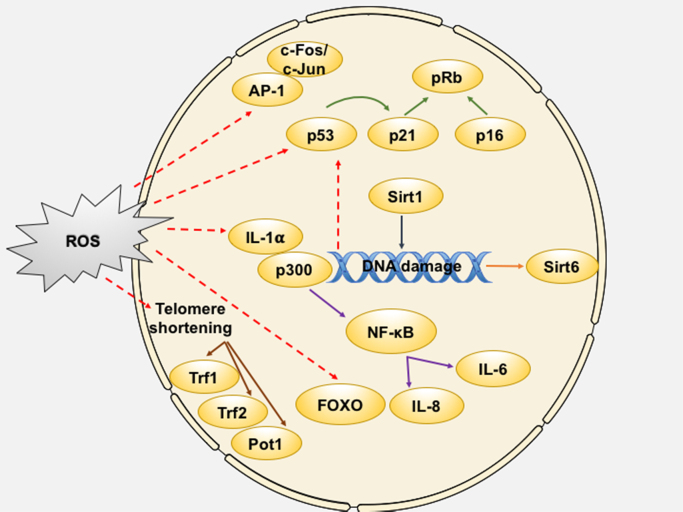
Schematic representation of the redox-control of pro-aging mechanisms in the nucleus. Oxidative stress-mediated regulation of nuclear proteins can happen via expression of factors induced by DNA damage-mediated responses or at the transcriptional/translational level via modulation of protein activity, thereby allowing for precise control over senescence effector mechanisms. AP-1 – Activator protein 1; FOXO – Forkhead box O; IL – Interleukin; NF-κB – Nuclear factor kappa-light-chain-enhancer of activated B cells; Pot-1 – Protection of telomeres protein 1; pRb – Retinoblastoma protein; SIRT – Sirtuin; Trf – Telomeric repeat binding factor.

References

    1. Kirkwood T.B.L. Understanding the odd science of aging. Cell. 2005;120(4):437–447. - PubMed
    1. Ljubuncic P., Reznick A.Z. The evolutionary theories of aging revisited - a mini-review. Gerontology. 2009;55(2):205–216. - PubMed
    1. Jin K. Modern biological theories of aging. Aging Dis. 2010;1(2):72–74. - PMC - PubMed
    1. Lipsky M.S., King M. Vol. 61. Elsevier; 2015. pp. 460–466. (Biological Theories of Aging. Disease-a-Month). - PubMed
    1. Peng C., Wang X., Chen J., Jiao R., Wang L., Li Y.M. Biology of ageing and role of dietary antioxidants. Biomed. Res Int. 2014;2014:831841. - PMC - PubMed

Substances