


Vitamin A deficiency and determinants of vitamin A status in Bangladeshi children and women: findings of a national survey
- PMID: 27890019
- PMCID: PMC10261654
- DOI: 10.1017/S1368980016003049
Vitamin A deficiency and determinants of vitamin A status in Bangladeshi children and women: findings of a national survey
Abstract
Objective: Using data from the national micronutrients survey 2011-2012, the present study explored the status of subclinical vitamin A nutrition and the underlying determinants in the Bangladeshi population.
Design: A nationwide cross-sectional study. Settings The survey covered 150 clusters; fifty in each of rural, urban and slum strata.
Subjects: Three population groups: (i) pre-school age children (6-59 months; PSAC); (ii) school age children (6-14 years; SAC); and (iii) non-pregnant non-lactating women (15-49 years; NPNLW).
Results: National prevalence of subclinical vitamin A deficiency was 20·5, 20·8 and 5·3 % in PSAC, SAC and NPNLW, respectively. Slum populations had higher prevalence compared with urban (PSAC: 38·1 v. 21·2 %, P0·05 for differences in β between <3 months v. 3-6 months, 6-9 months and 9-12 months).
Conclusions: Prevalence of subclinical vitamin A deficiency was high in children in Bangladesh. Intakes of animal-source foods and leafy vegetables were associated with higher and lower retinol status, respectively. Increased food diversity through animal-source foods is required.
Keywords: Animal-source foods; Bangladesh; Subclinical vitamin A status; Vitamin A supplementation.
Figures
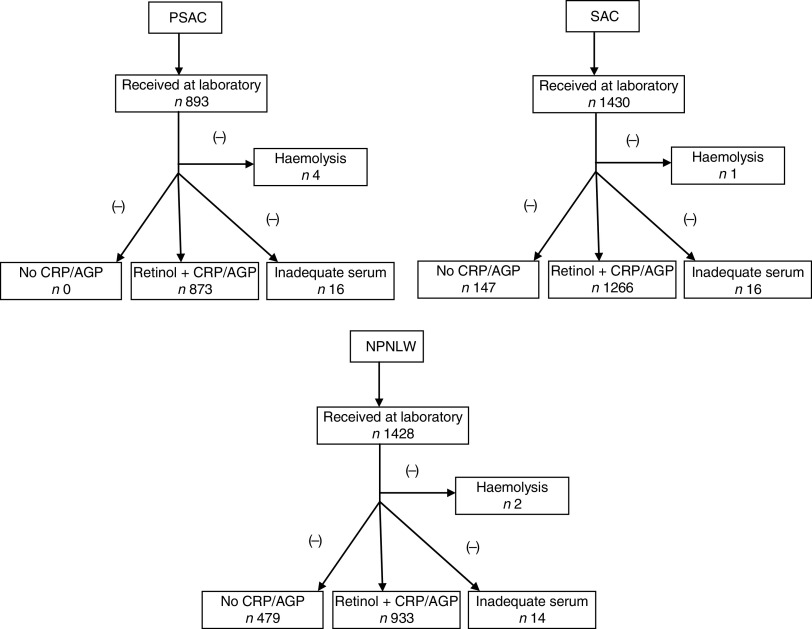
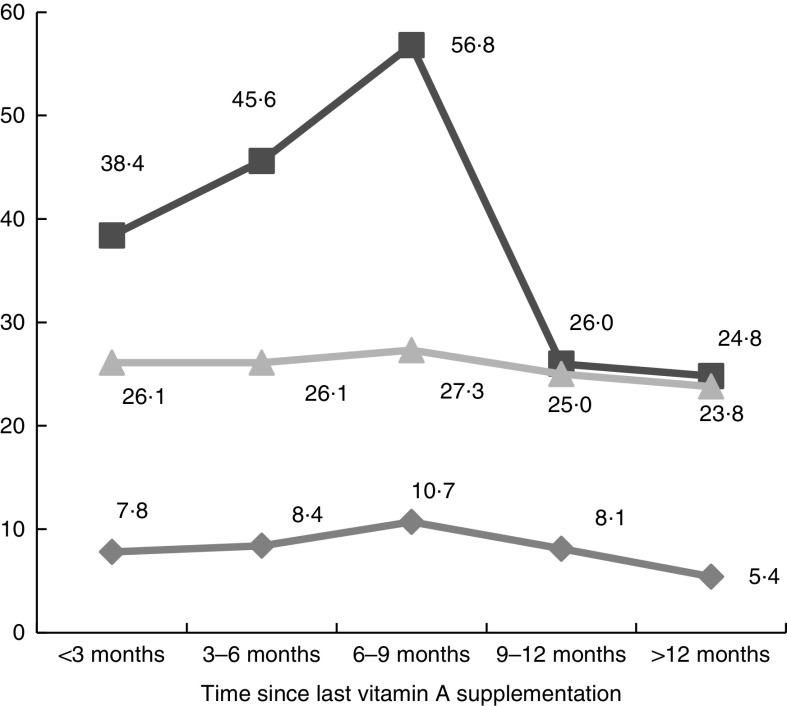
 ), household expenses (geometric mean, thousands of Bangladeshi Taka (BDT);
  ) and intake of animal-source vitamin A (geometric mean, retinol activity equivalents (RAE)/d;
  ) sorted by time since the last episode of vitamin A supplementation in pre-school age children (PSAC; 6–59 months), Bangladesh, 2011–2012. Figure shows serum retinol levels as a function of time from the last supplementation episode of vitamin A in PSAC, along with concomitant trends in household spending and intake of animal-source vitamin A. Serum retinol remained at similar levels for <3 months and 3–6 months post supplementation groups (26·1 and 26·1 μg/dl, respectively; P=1·0), while the groups had comparable levels of household spending (geometric mean: 7800 v. 8400 BDT, respectively; P=0·56). The trend of serum retinol level tended to be higher in the 6–9 months post supplementation group (27·3 μg/dl), coupled with a sharp rise in household spending and consumption of animal-origin vitamin A (geometric mean: 10 700 BDT and 56·8 μg RAE/d, respectively). In the 9–12 months and >12 months post supplementation groups, serum retinol levels appeared to be waning (25·0 and 23·8 μg/dl, respectively) along with decreasing household spending (geometric mean: 8100 and 5400 BDT, respectively; P<0·001) and declining consumption of animal-source vitamin A (geometric mean: 26·0 and 24·8 μg RAE/d, respectively; P=0·03)
References
-
- Imdad A, Herzer K, Mayo-Wilson E et al.. (2010) Vitamin A supplementation for preventing morbidity and mortality in children from 6 months to 5 years of age. Cochrane Database Syst Rev issue 12, CD008524. - PubMed
-
- World Health Organization (2009) Global Health Risks: Mortality and Burden of Diseases Attributable to Selected Major Risks. Geneva: WHO.
-
- Rice A, West K & Black R (2004) Vitamin A deficiency. In Comparative Quantification of Health Risks. Global and Regional Burden of Disease Attributable to Selected Major Risk Factors, pp. 00–00 [M Ezzati, AD Lopez, A Rodgers et al.., editors]. Geneva: WHO.
MeSH terms
Substances
LinkOut - more resources
Full Text Sources
Other Literature Sources
Medical
