Association Between Allergen Exposure in Inner-City Schools and Asthma Morbidity Among Students
- PMID: 27893060
- PMCID: PMC5349325
- DOI: 10.1001/jamapediatrics.2016.2543
Association Between Allergen Exposure in Inner-City Schools and Asthma Morbidity Among Students
Abstract
Importance: Home aeroallergen exposure is associated with increased asthma morbidity in children, yet little is known about the contribution of school aeroallergen exposures to such morbidity.
Objective: To evaluate the effect of school-specific aeroallergen exposures on asthma morbidity among students, adjusting for home exposures.
Design, setting, and participants: The School Inner-City Asthma Study was a prospective cohort study evaluating 284 students aged 4 to 13 years with asthma who were enrolled from 37 inner-city elementary schools in the northeastern United States between March 1, 2008, and August 31, 2013. Enrolled students underwent baseline clinical evaluations before the school year started and were then observed clinically for 1 year. During that same school year, classroom and home dust samples linked to the students were collected and analyzed for common indoor aeroallergens. Associations between school aeroallergen exposure and asthma outcomes during the school year were assessed, adjusting for home exposures.
Exposures: Indoor aeroallergens, including rat, mouse, cockroach, cat, dog, and dust mites, measured in dust samples collected from inner-city schools.
Main outcomes and measures: The primary outcome was maximum days in the past 2 weeks with asthma symptoms. Secondary outcomes included well-established markers of asthma morbidity, including asthma-associated health care use and lung function, measured by forced expiratory volume in 1 second.
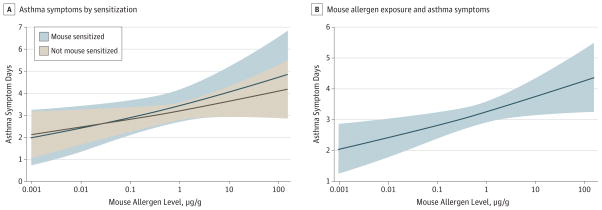
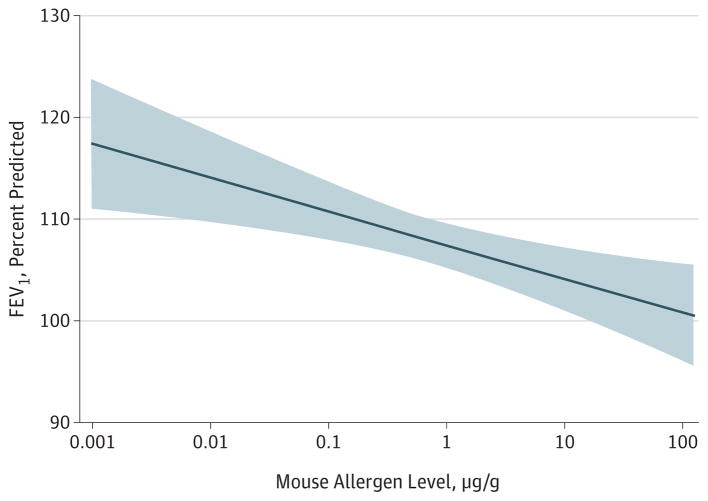
Results: Among 284 students (median age, 8 years [interquartile range, 6-9 years]; 148 boys and 136 girls), exposure to mouse allergen was detected in 441 (99.5%) of 443 school dust samples, cat allergen in 420 samples (94.8%), and dog allergen in 366 samples (82.6%). Levels of mouse allergen in schools were significantly higher than in students' homes (median settled dust level, 0.90 vs 0.14 µg/g; P < .001). Exposure to higher levels of mouse allergen in school (comparing 75th with 25th percentile) was associated with increased odds of having an asthma symptom day (odds ratio, 1.27; 95% CI, 1.05-1.54; P = .02) and 4.0 percentage points lower predicted forced expiratory volume in 1 second (95% CI, -6.6 to -1.5; P = .002). This effect was independent of allergic sensitization. None of the other indoor aeroallergens were associated with worsening asthma outcomes.
Conclusions and relevance: In this study of inner-city students with asthma, exposure to mouse allergen in schools was associated with increased asthma symptoms and decreased lung function. These findings demonstrate that the school environment is an important contributor to childhood asthma morbidity. Future school-based environmental interventions may be beneficial for this important public health problem.
Conflict of interest statement
Figures
Comment in
-
Small Steps Toward Asthma-Friendly School Environments.JAMA Pediatr. 2017 Jan 1;171(1):13-14. doi: 10.1001/jamapediatrics.2016.3274. JAMA Pediatr. 2017. PMID: 27893071 No abstract available.
References
-
- Centers for Disease Control and Prevention (CDC) Vital signs: asthma prevalence, disease characteristics, and self-management education: United States, 2001–2009. MMWR Morb Mortal Wkly Rep. 2011;60(17):547–552. - PubMed
-
- Rosenstreich DL, Eggleston P, Kattan M, et al. The role of cockroach allergy and exposure to cockroach allergen in causing morbidity among inner-city children with asthma. N Engl J Med. 1997;336(19):1356–1363. - PubMed
-
- Morgan WJ, Crain EF, Gruchalla RS, et al. Inner-City Asthma Study Group. Results of a home-based environmental intervention among urban children with asthma. N Engl J Med. 2004;351(11):1068–1080. - PubMed
Publication types
MeSH terms
Substances
Grants and funding
- KL2 TR001100/TR/NCATS NIH HHS/United States
- U01 AI110397/AI/NIAID NIH HHS/United States
- R01 AI073964/AI/NIAID NIH HHS/United States
- K23 AI104780/AI/NIAID NIH HHS/United States
- P30 ES000002/ES/NIEHS NIH HHS/United States
- K23 AI106945/AI/NIAID NIH HHS/United States
- L40 AI107923/AI/NIAID NIH HHS/United States
- U10 HL098102/HL/NHLBI NIH HHS/United States
- U01 AI126614/AI/NIAID NIH HHS/United States
- UL1 TR000170/TR/NCATS NIH HHS/United States
- K23 ES023700/ES/NIEHS NIH HHS/United States
- K24 AI106822/AI/NIAID NIH HHS/United States
LinkOut - more resources
Full Text Sources
Other Literature Sources
Medical
Miscellaneous