


Azithromycin vs. Placebo for the Clinical Outcome in Campylobacter concisus Diarrhoea in Adults: A Randomized, Double-Blinded, Placebo-Controlled Clinical Trial
- PMID: 27893820
- PMCID: PMC5125586
- DOI: 10.1371/journal.pone.0166395
Azithromycin vs. Placebo for the Clinical Outcome in Campylobacter concisus Diarrhoea in Adults: A Randomized, Double-Blinded, Placebo-Controlled Clinical Trial
Abstract
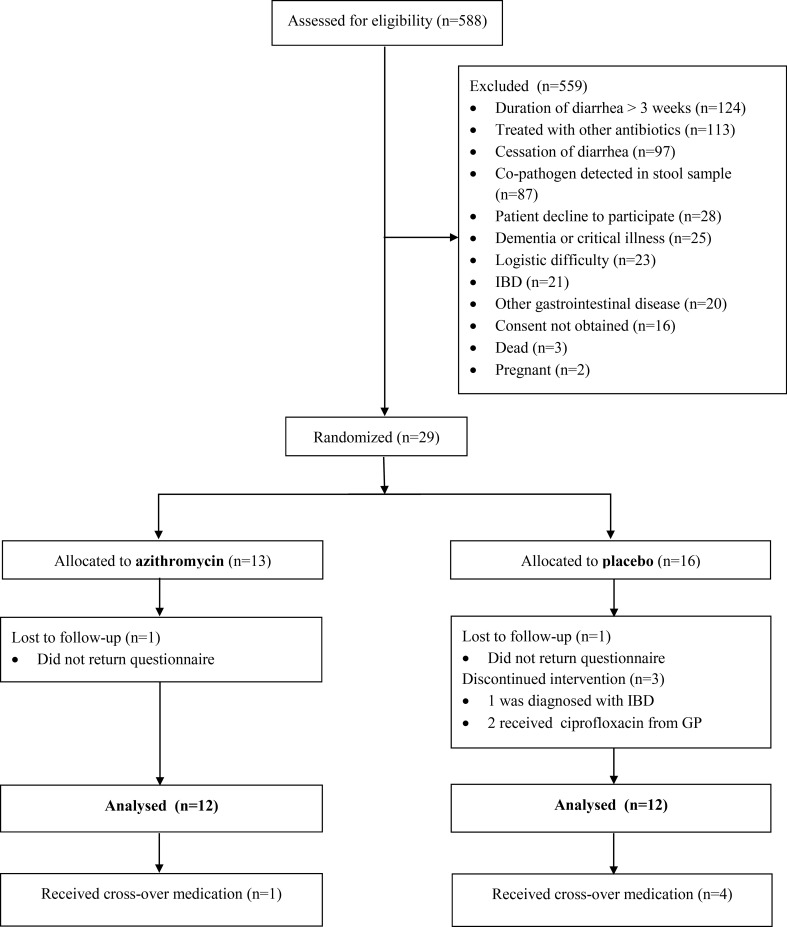
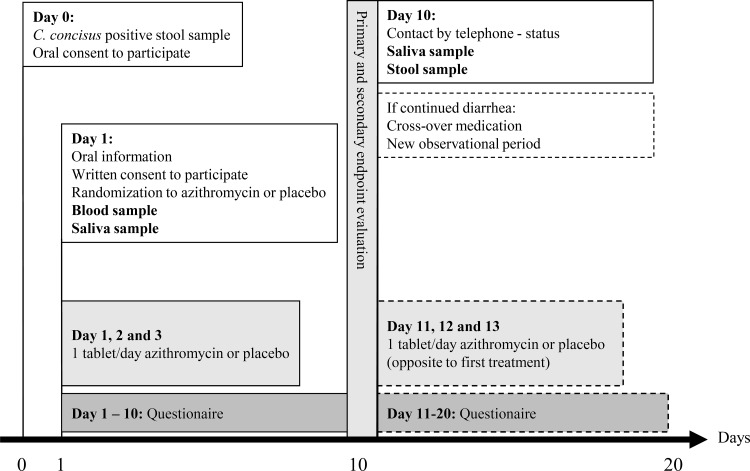
Campylobacter concisus has been associated with prolonged mild diarrhoea, but investigations regarding the efficacy of antimicrobial treatment have not been reported previously. We initiated a phase 3, single-centre, randomized, double-blinded, placebo-controlled study comparing the efficacy of 500 mg once-daily dose of azithromycin with a 500 mg once-daily dose of placebo for three days, for the treatment of C. concisus diarrhoea in adult patients with a follow-up period of ten days. If symptoms persisted at day ten, the patient was offered cross-over study treatment of three days and another ten-day follow-up period. The primary efficacy endpoint was the clinical response, defined as time to cessation of diarrhoea (<3 stools/day or reversal of accompanying symptoms). Our estimated sample size was 100 patients. We investigated a total of 10,036 diarrheic stool samples from 7,089 adult patients. Five-hundred and eighty-eight C. concisus positive patients were assessed for eligibility, of which 559 were excluded prior to randomization. The three main reasons for exclusion were duration of diarrhoea longer than 21 days (n = 124), previous antibiotic treatment (n = 113), and co-pathogens in stools (n = 87). Therefore, 24 patients completed the trial with either azithromycin (n = 12) or placebo (n = 12). Both groups presented symptoms of mild, prolonged diarrhoea with a mean duration of 18 days (95% CI: 16-19). One person in the azithromycin group and four from the placebo group chose to continue with crossover medication after the initial ten-day period. In the azithromycin group, there was a mean of seven days (95% CI: 5-9) to clinical cure and for the placebo group it was ten days (95% CI: 6-14) (OR-3 (95% CI: -7-1). We observed no differences in all examined outcomes between azithromycin treatment and placebo. However, due to unforeseen recruitment difficulties we did not reach our estimated sample size of 100 patients and statistical power to conclude on an effect of azithromycin treatment was not obtained.
Trial registration: Clinicaltrials.gov identifier: NCT01531218.
Conflict of interest statement
The authors have declared that no competing interests exist.
Figures
References
-
- European Centre for Disease Prevention and Control. Annual epidemiological report 2014 –food- and waterborne diseases and zoonoses. Campylobacteriosis, p. 20–24. Stockholm. ECDC;2014
-
- Tanner ACR, Badger S, Lai C-H, Listgarten MA, Visconti RA, Socransky SS. Wolinella gen. nov., Wolinella succinogenes (Vibrio succinogenes Wolin et al.) comb. nov., and description of Bacteroides gracilis sp. nov., Wolinella recta sp. nov., Campylobacter concisus sp. nov., and Eikenella corrodens from humans with periodontal disease. Int J Syst Bacteriol 1981;31:432–45.
Publication types
MeSH terms
Substances
Associated data
LinkOut - more resources
Full Text Sources
Other Literature Sources
Medical
