Review
. 2016 Nov 23:50:595-618.
doi: 10.1146/annurev-genet-120215-035349. Epub 2016 Oct 21.

Vaccination via Chloroplast Genetics: Affordable Protein Drugs for the Prevention and Treatment of Inherited or Infectious Human Diseases

Affiliations
Review

Vaccination via Chloroplast Genetics: Affordable Protein Drugs for the Prevention and Treatment of Inherited or Infectious Human Diseases

Henry Daniell et al. Annu Rev Genet. .

Abstract

Plastid-made biopharmaceuticals treat major metabolic or genetic disorders, including Alzheimer's, diabetes, hypertension, hemophilia, and retinopathy. Booster vaccines made in chloroplasts prevent global infectious diseases, such as tuberculosis, malaria, cholera, and polio, and biological threats, such as anthrax and plague. Recent advances in this field include commercial-scale production of human therapeutic proteins in FDA-approved cGMP facilities, development of tags to deliver protein drugs to targeted human cells or tissues, methods to deliver precise doses, and long-term stability of protein drugs at ambient temperature, maintaining their efficacy. Codon optimization utilizing valuable information from sequenced chloroplast genomes enhanced expression of eukaryotic human or viral genes in chloroplasts and offered unique insights into translation in chloroplasts. Support from major biopharmaceutical companies, development of hydroponic production systems, and evaluation by regulatory agencies, including the CDC, FDA, and USDA, augur well for advancing this novel concept to the clinic and revolutionizing affordable healthcare.

Keywords: chloroplast genome; mucosal/systemic immunity; oral drug delivery; oral tolerance; plant vaccines/biopharmaceuticals.


Figures
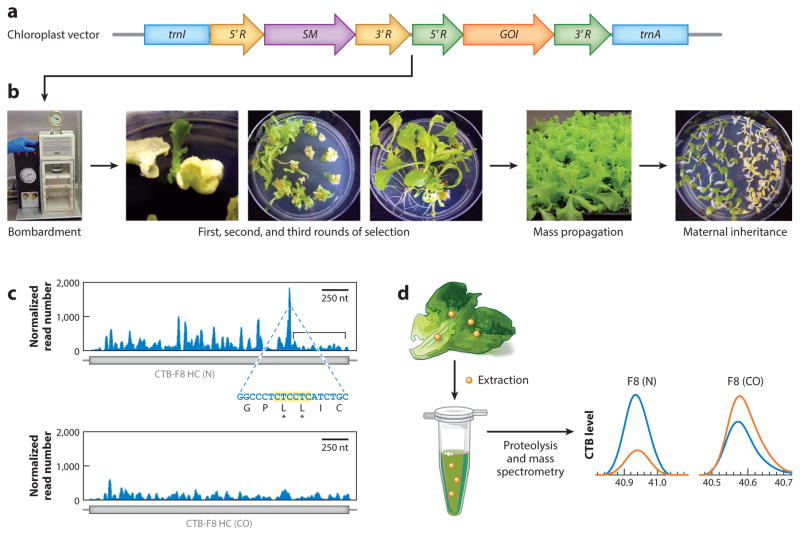
Figure 1
Figure 1
Concepts of chloroplast transformation and characterization of transplastomic plants. (a) Representation of a chloroplast vector containing the most commonly used flanking sequences for homologous recombination, trnI and trnA (blue). The selectable marker (SM) gene ( purple) and gene of interest (GOI; orange) are regulated by promoters and 5′ untranslated regions (UTRs) (5R; yellow and green) to enhance transcription and translation and by 3′ UTRs (3R; yellow and green) to enhance transcript stability. (b) The vector is bombarded into leaves with a gene gun. Homoplasmy is achieved after three rounds of selection on antibiotic-containing media, followed by mass propagation and verification of maternal inheritance. (c) Ribosome profiling demonstrates that ribosome stalling (blue peaks) occurs throughout a native human gene, Clotting Factor VIII (F8) (N; top), and especially in a region with consecutive lysines, but is substantially reduced when codons are optimized for plastid expression (CO; bottom). The bracketed region in the top graph indicates decreased ribosome occupancy of the transcript after the stalling site; this region is absent from the codon-optimized transcript, indicating increased translation of the entire open reading frame. (d ) Quantification of a therapeutic protein expressed in chloroplasts. Protein is extracted from transplastomic plants ( yellow dots), and the extract is subjected to proteolysis and mass spectrometry by parallel reaction monitoring. Levels of cholera toxin B (CTB) from the fusion protein (orange curves) are compared with standards (blue curves) and show higher levels in plants expressing codon-optimized human FVIII than in plants expressing the native gene. Panels c and d adapted with permission from Reference .
Figure 2
Figure 2
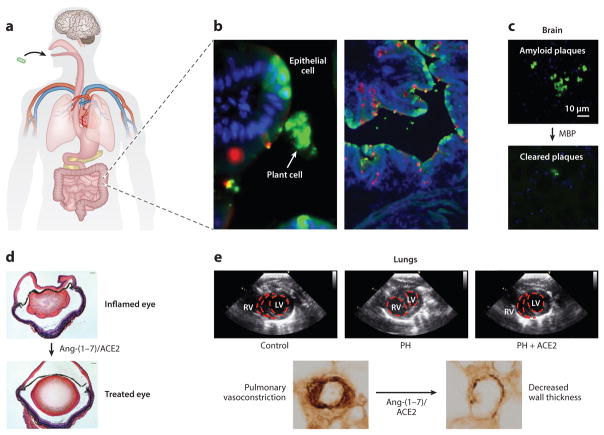
Efficacy of chloroplast-made human blood proteins. (a) Capsules containing lyophilized plant cells expressing human blood proteins are orally delivered. (b) Bioencapsulation of blood proteins within the plant cell wall protects them in the stomach until they reach the gut. (Left) Close-up image of intact plant cells (arrow) expressing cholera toxin B (CTB)-fused green fluorescent protein (GFP) that passed through the stomach and reached the small intestine without any disruption. Intestinal epithelial cells take up GFP after lysis of plant cells by gut microbes. (Right) Widespread GFP uptake by gut epithelial cells through binding of CTB to GM1 receptors. Panel b adapted with permission from Reference . (c) CTB-fused myelin basic protein (MBP) crossed the blood-brain barrier and cleared amyloid plaques in Alzheimer’s brain tissue. Panel c adapted with permission from Reference . (d ) CTB-fused angiotensin (Ang)-(–7) or angiotensin-converting enzyme 2 (ACE2) crossed the blood-retinal barrier, restored retinal folding, and reduced ocular inflammation. Panel d adapted with permission from Reference . (e) CTB-fused Ang-(–7) or ACE2 orally delivered to rats after induction of pulmonary hypertension (PH) arrested disease progression, improved right heart function by reducing the size of the right ventricle (RV) (top), and decreased pulmonary wall thickness and lung injury (bottom). Abbreviation: LV, left ventricle. Panel e adapted with permission from Reference .
Figure 3
Figure 3
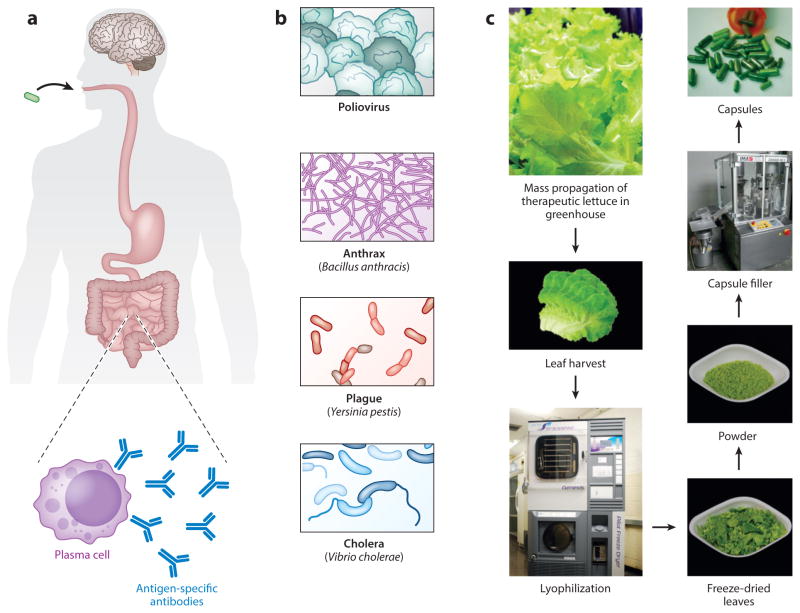
Vaccination with vaccine antigens made in chloroplasts prevents human infectious diseases; industrial-scale production of chloroplast-made human therapeutic proteins. (a) Orally administered antigens are taken up in the gut and captured by antigen-presenting cells, such as dendritic cells (DCs), inducing antigen-specific T and B cells (plasma cells) that secrete antibodies against various pathogens. Panel a redrawn with permission from Reference . (b) Examples of diseases for which functional chloroplast-made vaccines have been developed. Animal models fed with chloroplast-made vaccine antigens produced antibodies and conferred protective immunity against viral (polio), bacterial (anthrax, plague), and toxin (cholera) challenges. (c) Workflow for industrial-scale production of plastid-made pharmaceuticals. Lettuce plants expressing therapeutic proteins are propagated in an industrial hydroponic greenhouse, and leaves are harvested and lyophilized in a programmed freeze dryer to maintain sublimation temperature below −20°C. Freeze-dried leaves are ground to a fine powder and used to fill capsules that can be stored for years while maintaining their efficacy. Panel c adapted with permission from Reference .

References

    1. Adeniji JA, Faleye TO. Enterovirus C strains circulating in Nigeria and their contribution to the emergence of recombinant circulating vaccine-derived polioviruses. Arch Virol. 2015;160:675–83. - PubMed
    1. Arlen PA, Falconer R, Cherukumili S, Cole AM, Oishi KK, Daniell H. Field production and functional evaluation of chloroplast-derived interferon-α2b. Plant Biotechnol J. 2007;5:511–25. - PMC - PubMed
    1. Arlen PA, Singleton M, Adamovicz JJ, Ding Y, Davoodi-Semiromi A, Daniell H. Effective plague vaccination via oral delivery of plant cells expressing F1-V antigens in chloroplasts. Infect Immun. 2008;76:3640–50. - PMC - PubMed
    1. Azegami T, Yuki Y, Kiyono H. Challenges in mucosal vaccines for the control of infectious diseases. Int Immunol. 2014;26:517–28. - PubMed
    1. Baldauf KJ, Royal JM, Hamorsky KT, Matoba N. Cholera toxin B: one subunit with many pharmaceutical applications. Toxins. 2015;7:974–96. - PMC - PubMed

MeSH terms

LinkOut - more resources