Investigation of long-term survival outcomes and failure patterns of patients with nasopharyngeal carcinoma receiving intensity-modulated radiotherapy: a retrospective analysis
- PMID: 27894100
- PMCID: PMC5349963
- DOI: 10.18632/oncotarget.13564
Investigation of long-term survival outcomes and failure patterns of patients with nasopharyngeal carcinoma receiving intensity-modulated radiotherapy: a retrospective analysis
Abstract
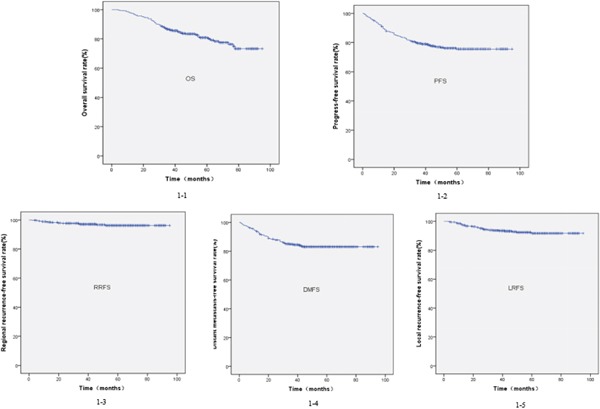
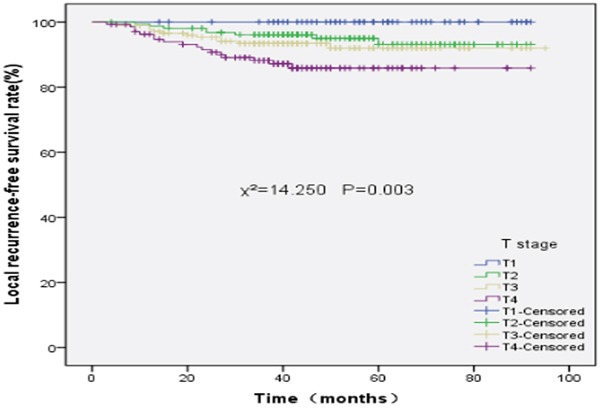
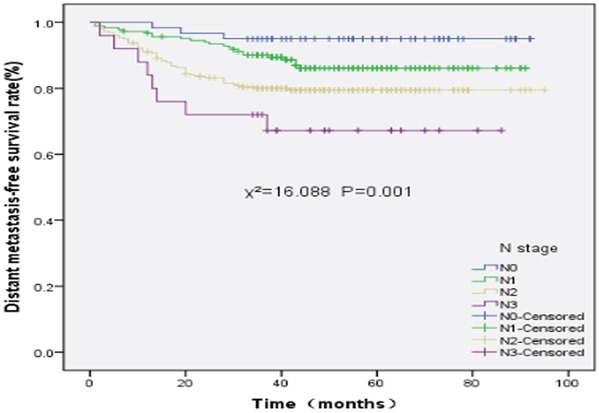
Intensity-modulated radiotherapy (IMRT) has replaced the conventional radiotherapy (2D-RT) and improved clinical efficacy in Nasopharyngeal Carcinoma (NPC) patients. In the present study, we retrospectively analyzed the clinical characteristics of patients with NPC treated with IMRT to assess the long-term survival outcomes and failure patterns. Of the 527 patients, One hundred and twenty-one patients experienced treatment failure, 86 patients developed distant metastases, and 12 patients developed a second primary tumor. The local and regional recurrence rates were 31.4% and 14.0%, respectively. The 5-year overall survival (OS), progression-free survival (PFS), local recurrence-free survival (LRFS), regional relapse-free survival (RRFS), and distant metastatic relapse-free survival (DMFS) rates were 80.9%, 75.6%, 91.7%, 96.2%, and 83.0%, respectively. The 5-year LRFS rates of Stage T1-4 patients were 100.0%, 93.1%, 92.0%, and 85.8%, respectively. The 5-year DMFS rates of Stage N0-3 patients were 95.0%, 86.1%, 79.5%, and 67.2%, respectively. Multivariate analysis showed age and T-stage were independent predictors of OS, T-stage was an independent predictor of LRFS, and age and N-stage were independent predictors of PFS and DMFS.In summary, the improved treatment results with IMRT are primarily due to the achievement of a higher local tumor control rate and OS in NPC patients. However, distant metastasis was the most commonly observed failure pattern after treatment. These results provide deep insights about the value of IMRT in the treatment and prognosis of NPC patients.
Keywords: failure pattern; intensity-modulated radiotherapy; long-term outcome; nasopharyngeal carcinoma; retrospective analysis.
Conflict of interest statement
The authors have no actual or potential conflicts of interest to declare.
Figures
References
-
- Lee AW, Sze WM, Au JS, Leung SF, Leung TW, Chua DT, Zee BC, Law SC, Teo PM, Tung SY, Kwong DL, Lau WH. Treatment results for nasopharyngeal carcinoma in the modern era: the Hong Kong experience. Int J Radiat Oncol Biol Phys. 2005;61:1107–1116. - PubMed
-
- Lee AW, Ng WT, Chan LL, Hung WM, Chan CC, Sze HC, Chan OS, Chang AT, Yeung RM. Evolution of treatment for nasopharyngeal cancer--success and setback in the intensity-modulated radiotherapy era. Radiother Oncol. 2014;110:377–384. - PubMed
-
- Sun X, Su S, Chen C, Han F1, Zhao C1, Xiao W1, Deng X1, Huang S1, Lin C1, Lu T3. Long-term outcomes of intensity-modulated radiotherapy for 868 patients with nasopharyngeal carcinoma: an analysis of survival and treatment toxicities. Radiother Oncol. 2014;110:398–403. - PubMed
-
- Zhu XJS. Multivariate Logistic Regression Analysis of the Prognostic Factors for 840 Patients with Nasopharyngeal Carcinoma. Chinese Journal of Clinical Oncology. 2008;17:961–966.
-
- Yi JL, Gao L, Huang XD, Li SY, Luo JW, Cai WM, Xiao JP, Xu GZ. Nasopharyngeal carcinoma treated by radical radiotherapy alone: Ten-year experience of a single institution. Int J Radiat Oncol Biol Phys. 2006;65:161–168. - PubMed
MeSH terms
LinkOut - more resources
Full Text Sources
Other Literature Sources
Research Materials