. 2016 Nov 28;16(1):285.
doi: 10.1186/s12866-016-0896-z.

Small proteins in cyanobacteria provide a paradigm for the functional analysis of the bacterial micro-proteome

Affiliations

Small proteins in cyanobacteria provide a paradigm for the functional analysis of the bacterial micro-proteome

Desiree Baumgartner et al. BMC Microbiol. .

Abstract

Background: Despite their versatile functions in multimeric protein complexes, in the modification of enzymatic activities, intercellular communication or regulatory processes, proteins shorter than 80 amino acids (μ-proteins) are a systematically underestimated class of gene products in bacteria. Photosynthetic cyanobacteria provide a paradigm for small protein functions due to extensive work on the photosynthetic apparatus that led to the functional characterization of 19 small proteins of less than 50 amino acids. In analogy, previously unstudied small ORFs with similar degrees of conservation might encode small proteins of high relevance also in other functional contexts.

Results: Here we used comparative transcriptomic information available for two model cyanobacteria, Synechocystis sp. PCC 6803 and Synechocystis sp. PCC 6714 for the prediction of small ORFs. We found 293 transcriptional units containing candidate small ORFs ≤80 codons in Synechocystis sp. PCC 6803, also including the known mRNAs encoding small proteins of the photosynthetic apparatus. From these transcriptional units, 146 are shared between the two strains, 42 are shared with the higher plant Arabidopsis thaliana and 25 with E. coli. To verify the existence of the respective μ-proteins in vivo, we selected five genes as examples to which a FLAG tag sequence was added and re-introduced them into Synechocystis sp. PCC 6803. These were the previously annotated gene ssr1169, two newly defined genes norf1 and norf4, as well as nsiR6 (nitrogen stress-induced RNA 6) and hliR1(high light-inducible RNA 1) , which originally were considered non-coding. Upon activation of expression via the Cu2+.responsive petE promoter or from the native promoters, all five proteins were detected in Western blot experiments.

Conclusions: The distribution and conservation of these five genes as well as their regulation of expression and the physico-chemical properties of the encoded proteins underline the likely great bandwidth of small protein functions in bacteria and makes them attractive candidates for functional studies.

Keywords: Cyanobacteria; Nitrogen deprivation; Photosynthesis; Small proteins; Synechocystis.


Figures
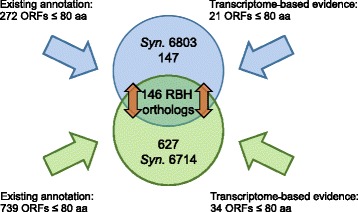
Fig. 1
Fig. 1
Scheme of computational prediction of small ORFs in cyanobacteria. Small ORFs were detected based on the transcriptome information for expressed intergenic regions [–22] and their coding potential evaluated with RNAcode [40]. This information was merged with the pre-existing annotation [32]. Orthologs between the two small ORF populations were detected when they were identified as reciprocal best hits (RBH) by blastP with e ≤ 1e−2
Fig. 2
Fig. 2
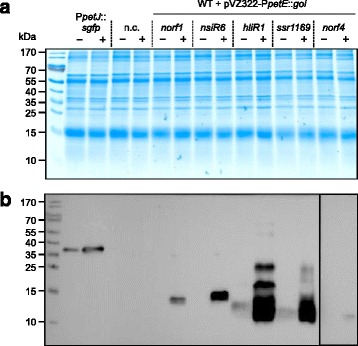
Western blot detection of small proteins. Recombinant Synechocystis 6803 cells carrying the genes of interest (goi) under control of the petE promoter on pVZ322 vector were collected before (−) or 24 h after induction of gene expression (+) for the extraction of total proteins. FLAG-tagged superfolder GFP (sfGFP) under the control of the petJ promoter [37] served as positive control, a WT strain carrying an empty pVZ322 vector was used as negative control (n.c.). Theoretical protein masses are listed in Table 3. Two gels were run in parallel. a Proteins (30 μg) were separated on a 15% (w/v) SDS polyacrylamide gel and subjected to colloidal Coomassie G-250 staining as a loading control. b Immunoblot with the same loading order probed with specific ANTI-FLAG® M2-Peroxidase (HRP) antibody
Fig. 3
Fig. 3
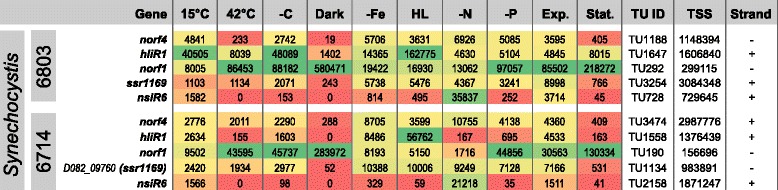
Heatmap indicating the expression of the genes encoding the five investigated small proteins in Synechocystis strains PCC 6803 and PCC 6714 under 10 different growth conditions: exponential (Exp.) and stationary growth phase (Stat.); cold (15 °C) and heat (42 °C) stress for 30 min each; depletion of inorganic carbon (−C), cells were washed 3 times with carbon-free BG11 and cultivated further for 20 h; dark, no light for 12 h; Fe2+ limitation (−Fe), addition of iron-specific chelator desferrioxamine B (DFB) and further cultivation for 24 h; high light (HL), 470 μmol photons m−2s−1 for 30 min; nitrogen depletion (−N), cells were washed 3 times with nitrogen-free BG11 and cultivated further for 12 h; phosphate depletion (−P), cells were washed 3 times with phosphate-free BG11 and further incubated for 12 h. Data derived from previous genome-wide expression analysis by differential RNA-Seq [20, 21]. Values indicate sequencing read counts for the primary 5′ end (= transcriptional start site [TSS]) of the corresponding transcriptional unit (TU). The TSS positions are given for the Synechocystis genomes available under accession numbers BA000022 and CP007542. The colour varies from red (no expression) to yellow (intermediate expression) to green (high expression)
Fig. 4
Fig. 4
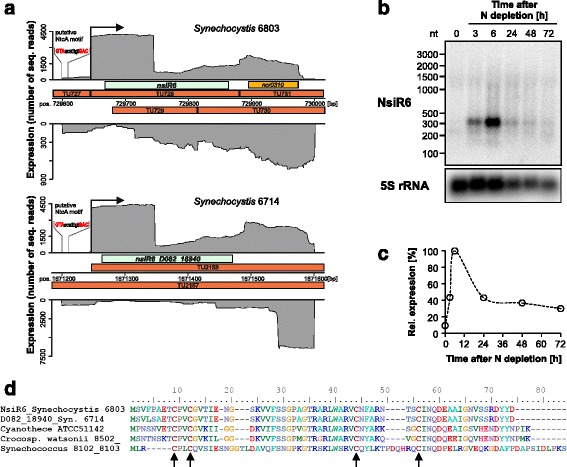
The NsiR6 peptide. a Transcriptomic datasets indicated high read coverage in a region without annotation in Synechocystis 6803 [21], which contains the here defined nsiR6 gene. The homolog in Synechocystis 6714 is D082_18940 [20]. Shown is the read coverage (grey) resulting from previous transcriptome analysis, including the respective transcriptional units (TU) defined in that work [20, 21] and a putative NtcA binding site, centered 42 nt upstream the transcription initiation site in both strains. Relevant transcription initiation sites appear as steep increase in read coverage and are labelled by a black arrow. The length of the 5’-UTRs is 26 nt in both strains. Other non-coding TUs are colored orange. There is transcription in antisense orientation in both strains but with much lower coverage. b Northern blot showing the nitrogen stress-induced transcript accumulation of the NsiR6 mRNA in Synechocystis 6803 over 72 h. Time point 0 refers to the nitrogen-replete condition. c Time course of NsiR6 mRNA accumulation after normalization to 5S rRNA. The data are presented as relative to the signal at 6 h after diminishing N (=100%). d Sequence comparison of NsiR6 homologs from the two Synechocystis strains, Cyanothece ATCC 51142, Crocosphaera watsonii WH 8502 and the two marine Synechococcus strains WH 8102 and WH 8103 which harbor an identical protein. Four conserved cysteine residues are highlighted by arrows. These are conserved in all 63 homologs detected throughout the cyanobacterial phylum
Fig. 5
Fig. 5
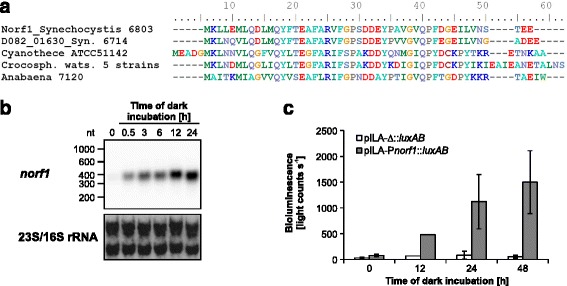
Sequence comparison and regulated expression of the norf1 gene. a Sequence comparison of Norf1 homologs from the two Synechocystis strains, Cyanothece ATCC 51142, 5 different strains of Crocosphaera encoding an identical protein and Anabaena (Nostoc) sp. PCC 7120. b Expression of norf1 in Synechocystis 6803 is strongly upregulated after transfer to darkness. c Bioluminescence of a Synechocystis 6803 reporter strain harboring a transcriptional fusion of Pnorf1 (−328 to +137, TSS at +1) and luxAB genes in response to transfer to darkness. Representative bioluminescence dataset indicating means ± SD of measurements for two biological replicates (= independent transformants). A strain carrying a promoterless luxAB was used as a negative control (measured in two independent cultures each)
Fig. 6
Fig. 6
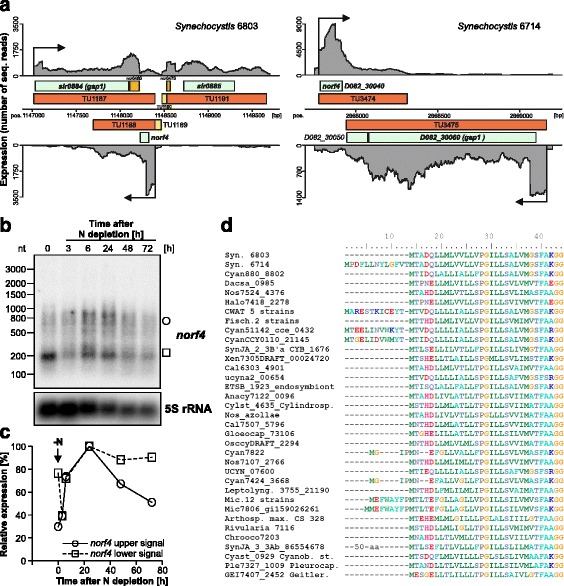
The Norf4 peptide. a Datasets from the previously performed primary transcriptome analysis showed that Norf4 expression responded positively to nitrogen depletion in both Synechocystis 6803 [21] and Synechocystis 6714 [20], when 11 different growth conditions were tested. The mRNAs of norf4 and gap1 are co-regulated and overlap by several hundred nt. The previously mapped transcriptional start sites are labelled by black arrows. b Northern blot analysis of norf4 mRNA accumulation in a time course experiment up to 72 h after the removal of nitrogen. The same RNA samples were used as in Fig. 4. c The signals obtained from the Northern blots (panel b) were evaluated densitometrically after normalization by the level of 5S rRNA. The relative norf4 expression is shown with respect to the maximum expression after transfer to nitrogen-free conditions (24 h = 100%). The bands at 200 nt (filled circles) and at 800 nt (empty circles) were analyzed separately from each other. d Multiple sequence alignment of 35 homologs from 51 different cyanobacterial genome sequences (homologs are identical among 12 Microcystis, five Crocosphaera watsonii and two Fischerella genome sequences)
Fig. 7
Fig. 7
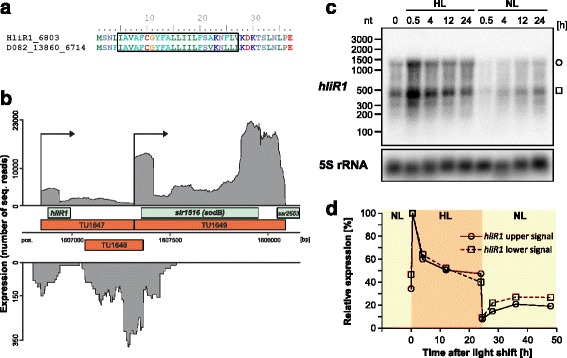
The HliR1 peptide in Synechocystis 6803. a Pairwise sequence alignment of the HliR1 peptides from Synechocystis 6803 and Synechocystis 6714. A predicted transmembrane region is boxed. b Data replotted from the primary transcriptome analysis of Synechocystis 6803 suggest that HliR1 expression is induced by high light and that transcripts may extend into the subsequent TU1649 covering the sodB gene [21]. c Northern analysis of hliR1 mRNA accumulation upon transfer to high light (HL) or normal light (NL). d Quantification of the hliR1 mRNA accumulation shown in panel c after normalization to the 5S rRNA level. Relative values refer to the maximum level at 0.5 h after HL shift (=100%)
Fig. 8
Fig. 8
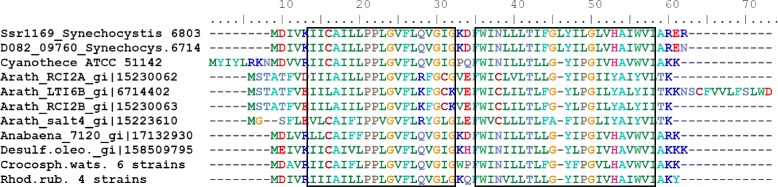
Sequence alignment of Ssr1169 homologs from cyanobacteria with those from Arabidopsis thaliana, Desulfococcus oleovorans Hxd3, and identical proteins in 4 strains of Rhodospirillum rubrum. Putative transmembrane domains were predicted using TMHMM v. 2.0 [41] and are boxed
Fig. 9
Fig. 9
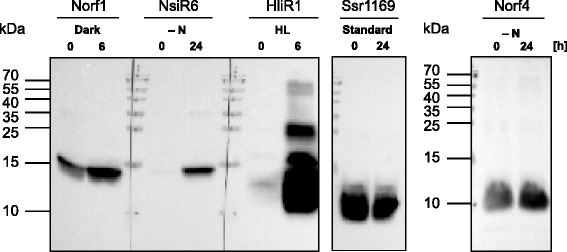
Detection of μ-proteins upon expression from their native promoters and 5′ UTRs. Recombinant Synechocystis 6803 cells carrying the respective genes under control of their own promoters and 5′UTRs on vector pVZ322 were collected from cultures grown at standard conditions (0) and after transfer to the respective inducing condition at indicated time points (6 or 24 h) or in case of Ssr1169 after 24 h at standard condition. The Western blot was probed with specific ANTI-FLAG® M2-Peroxidase (HRP) antibody. All samples were separated on the same gel and transferred to the same membrane but the part probed for Norf4 had to be exposed longer because of its lower expression. Prestained Protein Ladder (10–170 kDa, Fermentas) was used as molecular weight marker

References

    1. Lluch-Senar M, Delgado J, Chen W-H, Lloréns-Rico V, O’Reilly FJ, Wodke JA, et al. Defining a minimal cell: essentiality of small ORFs and ncRNAs in a genome-reduced bacterium. Mol Syst Biol. 2015;11:780. doi: 10.15252/msb.20145558. - DOI - PMC - PubMed
    1. Thoendel M, Kavanaugh JS, Flack CE, Horswill AR. Peptide signaling in the Staphylococci. Chem Rev. 2011;111:117–51. doi: 10.1021/cr100370n. - DOI - PMC - PubMed
    1. Alix E, Blanc-Potard A-B. Hydrophobic peptides: novel regulators within bacterial membrane. Mol Microbiol. 2009;72:5–11. doi: 10.1111/j.1365-2958.2009.06626.x. - DOI - PubMed
    1. Jean-Francois FL, Dai J, Yu L, Myrick A, Rubin E, Fajer PG, et al. Binding of MgtR, a Salmonella transmembrane regulatory peptide, to MgtC, a Mycobacterium tuberculosis virulence factor: a structural study. J Mol Biol. 2014;426:436–46. doi: 10.1016/j.jmb.2013.10.014. - DOI - PMC - PubMed
    1. Choi E, Lee K-Y, Shin D. The MgtR regulatory peptide negatively controls expression of the MgtA Mg2+ transporter in Salmonella enterica serovar Typhimurium. Biochem Biophys Res Commun. 2012;417:318–23. doi: 10.1016/j.bbrc.2011.11.107. - DOI - PubMed

MeSH terms

LinkOut - more resources