


Cognitive Processing in Non-Communicative Patients: What Can Event-Related Potentials Tell Us?
- PMID: 27895567
- PMCID: PMC5107572
- DOI: 10.3389/fnhum.2016.00569
Cognitive Processing in Non-Communicative Patients: What Can Event-Related Potentials Tell Us?
Abstract
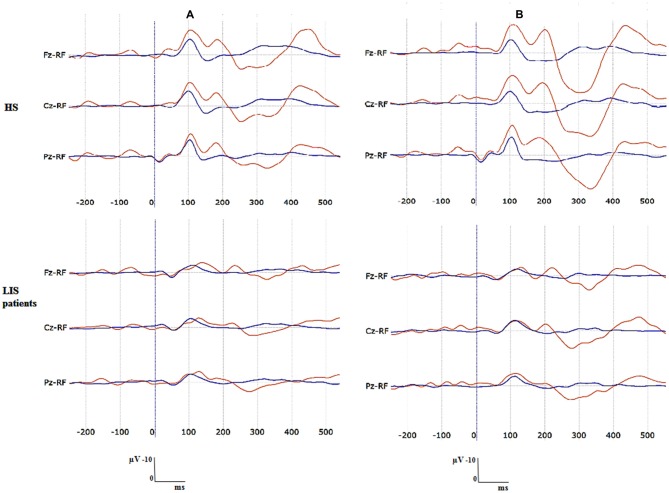
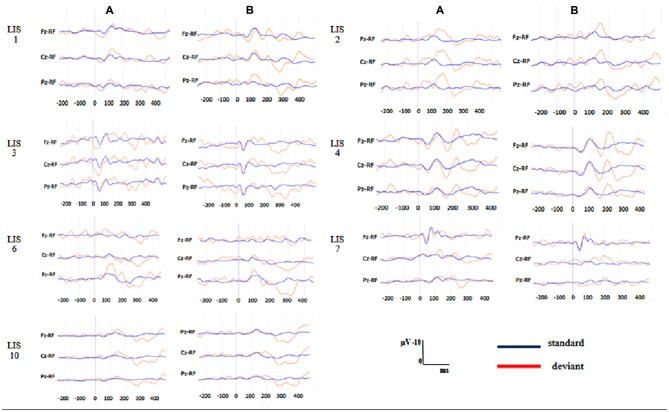
Event-related potentials (ERP) have been proposed to improve the differential diagnosis of non-responsive patients. We investigated the potential of the P300 as a reliable marker of conscious processing in patients with locked-in syndrome (LIS). Eleven chronic LIS patients and 10 healthy subjects (HS) listened to a complex-tone auditory oddball paradigm, first in a passive condition (listen to the sounds) and then in an active condition (counting the deviant tones). Seven out of nine HS displayed a P300 waveform in the passive condition and all in the active condition. HS showed statistically significant changes in peak and area amplitude between conditions. Three out of seven LIS patients showed the P3 waveform in the passive condition and five of seven in the active condition. No changes in peak amplitude and only a significant difference at one electrode in area amplitude were observed in this group between conditions. We conclude that, in spite of keeping full consciousness and intact or nearly intact cortical functions, compared to HS, LIS patients present less reliable results when testing with ERP, specifically in the passive condition. We thus strongly recommend applying ERP paradigms in an active condition when evaluating consciousness in non-responsive patients.
Keywords: P300; event-related potentials; locked-in syndrome; minimally conscious state; unresponsive wakefulness syndrome; vegetative state.
Figures
References
-
- Benjamini Y., Hochberg Y. (1995). Controlling the false discovery rate: a practical and powerful approach to multiple testing. J. R. Stat. Soc. Ser. B 57, 289–300.
-
- Bianchi L., Quitadamo L. R., Abbafati M., Marciani M. G., Saggio G. (2009). “Introducing NPXlab 2010: a tool for the analysis and optimization of P300 based brain-computer interfaces,” in Proceeding of the 2nd International Symposium on Applied Sciences in Biomedical and Communication Technologies, ISABEL. (Bratislava, Slovakia).
LinkOut - more resources
Full Text Sources
Other Literature Sources
Miscellaneous
