. 2016 Nov 15:7:1713.
doi: 10.3389/fpls.2016.01713. eCollection 2016.

ALA-Induced Flavonols Accumulation in Guard Cells Is Involved in Scavenging H2O2 and Inhibiting Stomatal Closure in Arabidopsis Cotyledons

Affiliations

ALA-Induced Flavonols Accumulation in Guard Cells Is Involved in Scavenging H2O2 and Inhibiting Stomatal Closure in Arabidopsis Cotyledons

Yuyan An et al. Front Plant Sci. .

Abstract

5-aminolevulinic acid (ALA), a new plant growth regulator, can inhibit stomatal closure by reducing H2O2 accumulation in guard cells. Flavonols are a main kind of flavonoids and have been proposed as H2O2 scavengers in guard cells. 5-aminolevulinic acid can significantly improve flavonoids accumulation in plants. However, whether ALA increases flavonols content in guard cells and the role of flavonols in ALA-regulated stomatal movement remains unclear. In this study, we first demonstrated that ALA pretreatment inhibited ABA-induced stomatal closure by reducing H2O2 accumulation in guard cells of Arabidopsis seedlings. This result confirms the inhibitory effect of ALA on stomatal closure and the important role of decreased H2O2 accumulation in this process. We also found that ALA significantly improved flavonols accumulation in guard cells using a flavonol-specific dye. Furthermore, using exogenous quercetin and kaempferol, two major components of flavonols in Arabidopsis leaves, we showed that flavonols accumulation inhibited ABA-induced stomatal movement by suppressing H2O2 in guard cells. Finally, we showed that the inhibitory effect of ALA on ABA-induced stomatal closure was largely impaired in flavonoid-deficient transparent testa4 (tt4) mutant. In addition, exogenous flavonols recovered stomatal responses of tt4 to the wild-type levels. Taken together, we conclude that ALA-induced flavonol accumulation in guard cells is partially involved in the inhibitory effect of ALA on ABA-induced H2O2 accumulation and stomatal closure. Our data provide direct evidence that ALA can regulate stomatal movement by improving flavonols accumulation, revealing new insights into guard cell signaling.

Keywords: 5-aminolevulinic acid (ALA); abscisic acid (ABA); flavonol; hydrogen peroxide; stomatal opening.


Figures
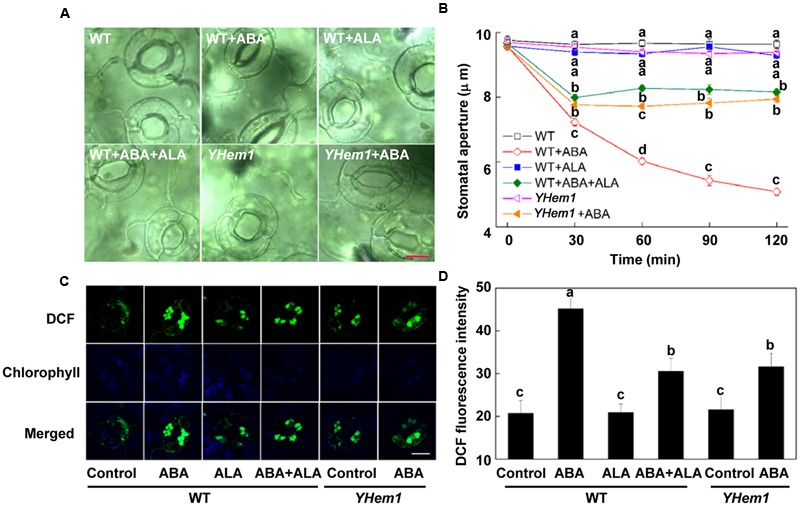
FIGURE 1
FIGURE 1
ALA pretreatment inhibits ABA-induced stomatal closure by reducing H2O2 accumulation in guard cells. (A,B) ALA pretreatment inhibits ABA-induced stomatal aperture. Two-week-old wild-type Arabidopsis pretreated with exogenous 0.5 mg L-1 ALA under light (240 μmol m-2 s-1) for 4 h and YHem1-transgenic Arabidopsis incubated under the same light condition for 4 h were immersed in opening buffer (50 mM KCl, 10 mM MES, and 0.1 mM CaCl2, pH 6.2) alone or containing 10 μM ABA for 2 h under light (240 μmol m-2 s-1). The cotyledons were picked with tweezers at 30-min intervals for 2 h for the record of guard cell images and determination of stomatal apertures. (A) Images of guard cell after 1 h of different treatments. Scale bar: 10 μm. (B) Time courses of stomatal responses in WT and YHem1 to different treatments. Values are the means of 90 measurements ± SE from three independent experiments. Different letters on the same time point indicate significant differences at P = 0.05 level. (C,D) ALA pretreatment reduces ABA-induced H2O2 accumulation in guard cells. The cotyledons of the above treated seedlings were picked with tweezers at 1 h of treatment and loaded with 50 μM H2DCF-DA for 30 min in darkness at 25°C. Fluorescence of the cotyledons (C) was observed using a confocal microscope. For each treatment, DCF fluorescence is shown in green and chlorophyll autofluorescence is shown in blue in separate channels. Scale bar: 15 μm. (D) DCF intensity in guard cells of each treatment. Values are the means of 15 measurements ± SE from three independent experiments. Different letters indicate significant differences at P = 0.05 level.
FIGURE 2
FIGURE 2
ALA pretreatment increases flavonols accumulation in guard cells. Two-week-old wild-type (WT) Arabidopsis pretreated with exogenous 0.5 mg L-1 ALA under light (240 μmol m-2 s-1) for 4 h and YHem1-transgenic Arabidopsis incubated under the same light condition for 4 h were loaded with 2.52 mg mL-1 diphenylboric acid 2-aminoethyl ester (DPBA) for 30 min in darkness at 25°C. The cotyledons were then picked with tweezers and their fluorescence (A) was observed using a confocal microscope. For each treatment, DPBA bound to flavonols is shown in yellow and chlorophyll autofluorescence is shown in blue in separate channels. Scale bar: 15 μm. (B) DPBA intensity values in guard cells of each treatment. Values are the means of 15 measurements ± SE from three independent experiments. ∗∗ indicates significant differences between treatments at P = 0.01 level.
FIGURE 3
FIGURE 3
Flavonols inhibit ABA-induced stomatal closure. (A,B) Exogenous flavonols increase endogenous flavonols accumulation in guard cells. Two-week-old wild-type Arabidopsis were immersed in opening buffer (50 mM KCl, 10 mM MES, and 0.1 mM CaCl2, pH 6.2) alone or containing 1–100 μM quercetin or kaempferol for 1 h under light (240 μmol m-2 s-1) and then loaded with 2.52 mg mL-1 DPBA for 30 min in darkness at 25°C. The cotyledons were then picked with tweezers and their fluorescence (A) was observed using a confocal microscope. For each treatment, DPBA bound to flavonols is shown in yellow and chlorophyll autofluorescence is shown in blue in separate channels. Scale bar: 15 μm. (B) DPBA intensity in guard cells of each treatment. Values are the means of 15 measurements ± SE from three independent experiments. The same letters indicate no significant differences at P = 0.05 level. (C,D) Flavonols inhibit ABA-induced stomatal closure. Two-week-old wild-type Arabidopsis pretreated with exogenous 10 μM quercetin or kaempferol for 1 h under light (240 μmol m-2 s-1) were immersed in opening buffer (50 mM KCl, 10 mM MES, and 0.1 mM CaCl2, pH 6.2) alone or containing 10 μM ABA for 2 h under light (240 μmol m-2 s-1). The cotyledons were picked with tweezers at 30-min intervals for 2 h for the record of guard cell images and determination of stomatal apertures. (C) Images of guard cell after 1 h of different treatments. Scale bar: 10 μm. (D) Time courses of stomatal responses to different treatments. Values are the means of 90 measurements ± SE from three independent experiments. Different letters on the same time point indicate significant differences at P = 0.05 level.
FIGURE 4
FIGURE 4
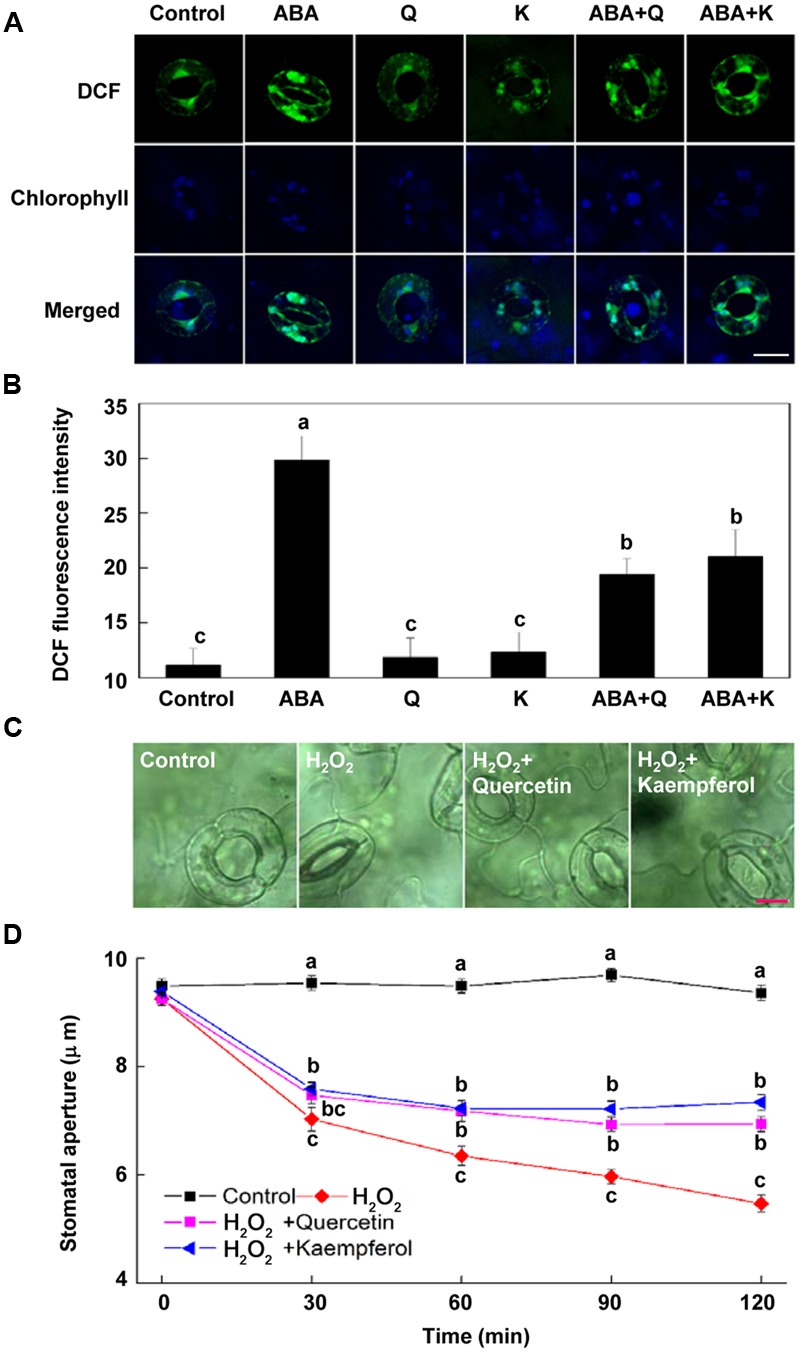
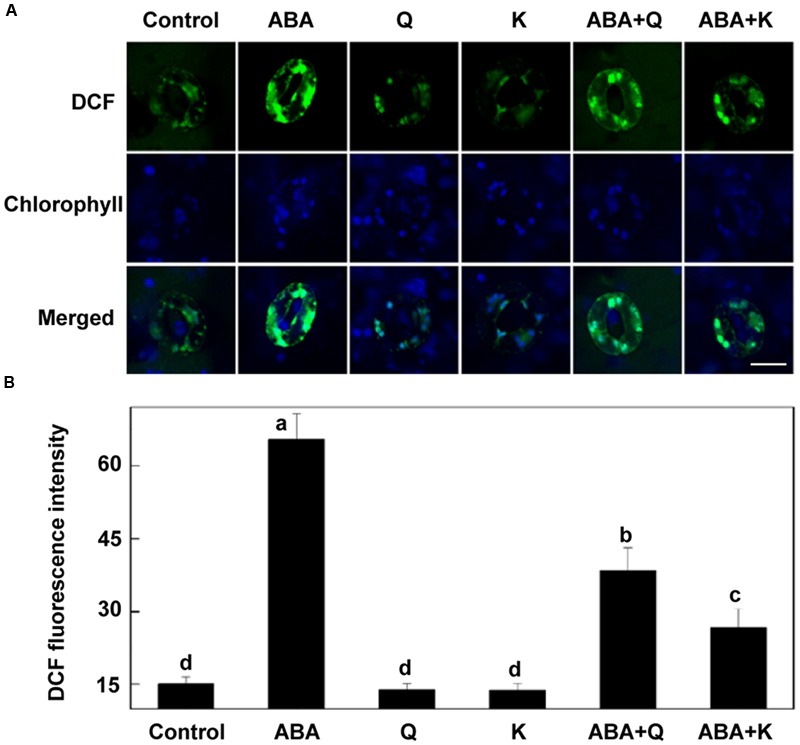
Flavonols reduce H2O2 accumulation in guard cells. (A,B) Flavonols reduce ABA-induced H2O2 accumulation in guard cells. Two-week-old wild-type Arabidopsis pretreated with exogenous 10 μM quercetin (Q) or kaempferol (K) for 1 h under light (240 μmol m-2 s-1) were immersed in opening buffer (50 mM KCl, 10 mM MES, and 0.1 mM CaCl2, pH 6.2) alone or containing 10 μM ABA for 1 h under light (240 μmol m-2 s-1), and then loaded with 50 μM H2DCF-DA for 30 min in darkness at 25°C. The cotyledons were picked with tweezers and their fluorescence (A) was observed using a confocal microscope. For each treatment, DCF fluorescence is shown in green and chlorophyll autofluorescence is shown in blue in separate channels. Scale bar: 15 μm. (B) DCF intensity in guard cells of each treatment. Values are the means of 15 measurements ± SE from three independent experiments. Different letters indicate significant differences at P = 0.05 level. (C,D) Flavonols inhibit H2O2-induced stomatal closure. Two-week-old Arabidopsis pretreated with exogenous 10 μM quercetin or kaempferol for 1 h under light (240 μmol m-2 s-1) were immersed in opening buffer (50 mM KCl, 10 mM MES, and 0.1 mM CaCl2, pH 6.2) alone or containing 200 μM H2O2 for 2 h under light (240 μmol m-2 s-1). The cotyledons were picked with tweezers at 30-min intervals for 2 h for the record of guard cell images and determination of stomatal apertures. (C) Images of guard cell after 1 h of different treatments. Scale bar: 10 μm. (D) Time courses of stomatal responses to different treatments. Values are the means of 90 measurements ± SE from three independent experiments. Different letters on the same time point indicate significant differences at P = 0.05 level.
FIGURE 5
FIGURE 5
The inhibitory effect of ALA on ABA-induced stomatal closure is impaired in tt4 mutant. (A,B) Flavonols accumulation is absent in tt4 mutant pretreated with or without ALA. Two-week-old wild-type and tt4 Arabidopsis pretreated with exogenous 0.5 mg L-1 ALA under light (240 μmol m-2 s-1) for 2 h or 4 h were loaded with 2.52 mg mL-1 DPBA for 30 min in darkness at 25°C. The cotyledons were then picked with tweezers and their fluorescence (A) was observed using a confocal microscope. For each treatment, DPBA bound to flavonols is shown in yellow and chlorophyll autofluorescence is shown in blue in separate channels. Scale bar: 15 μm. (B) DPBA intensity in guard cells of each treatment. Values are the means of 15 measurements ± SE from three independent experiments. Different letters indicate significant differences at P = 0.01 level. (C,D) The inhibition of ABA-induced stomatal closure by ALA is impaired in tt4 mutant. Two-week-old wild-type and tt4 Arabidopsis pretreated with exogenous 0.5 mg L-1 ALA under light (240 μmol m-2 s-1) for 4 h were immersed in opening buffer (50 mM KCl, 10 mM MES, and 0.1 mM CaCl2, pH 6.2) alone or containing 10 μM ABA for 2 h under light (240 μmol m-2 s-1). The cotyledons were picked with tweezers at 30-min intervals for 2 h for the record of guard cell images and determination of stomatal apertures. (C) Images of guard cell after 1 h of different treatments. Scale bar: 10 μm. (D) Time courses of stomatal responses in WT and tt4 to different treatments. Values are the means of 90 measurements ± SE from three independent experiments. Different letters on the same time point indicate significant differences at P = 0.05 level. (E,F) The inhibition of ABA-induced H2O2 accumulation in guard cells by ALA is impaired in tt4 mutant. The cotyledons of the seedlings treated as shown in Figures C and D were picked at 1 h of treatment and loaded with 50 μM H2DCF-DA for 30 min in darkness at 25°C. Fluorescence of the cotyledons (E) was observed using a confocal microscope. For each treatment, DCF fluorescence is shown in green and chlorophyll autofluorescence is shown in blue in separate channels. Scale bar: 15 μm. (F) DCF intensity in guard cells of each treatment. Values are the means of 15 measurements ± SE from three independent experiments. Different letters indicate significant differences at P = 0.05 level.
FIGURE 6
FIGURE 6
Stomatal response of tt4 to ABA is recovered by exogenous flavonols. (A,B) Flavonols accumulation in tt4 is recovered to the WT level by exogenous flavonols. Two-week-old wild-type and tt4 Arabidopsis pretreated with or without exogenous 10 μM quercetin (Q) or kaempferol (K) under light (240 μmol m-2 s-1) for 1 h were loaded with 2.52 mg mL-1 DPBA for 30 min in darkness at 25°C. The cotyledons were then picked with tweezers and their fluorescence (A) was observed using a confocal microscope. For each treatment, DPBA bound to flavonols is shown in yellow and chlorophyll autofluorescence is shown in blue in separate channels. Scale bar: 15 μm. (B) DPBA intensity in guard cells of each treatment. Values are the means of 15 measurements ± SE from three independent experiments. Different letters indicate significant differences at P = 0.01 level. (C) Stomatal response of tt4 to ABA is recovered by exogenous flavonols. Two-week-old tt4 Arabidopsis pretreated with exogenous 10 μM quercetin (Q) or kaempferol (K) under light (240 μmol m-2 s-1) for 1 h were immersed in opening buffer (50 mM KCl, 10 mM MES, and 0.1 mM CaCl2, pH 6.2) alone or containing 10 μM ABA for 2 h under light (240 μmol m-2 s-1). The cotyledons were picked with tweezers at 30-min intervals for 2 h for the record of guard cell images and determination of stomatal apertures. Values are the means of 90 measurements ± SE from three independent experiments. Different letters on the same time point indicate significant differences at P = 0.05 level.
FIGURE 7
FIGURE 7
H2O2 accumulation in tt4 under ABA treatment is recovered by exogenous flavonols. Two-week-old tt4 mutants pretreated with or without exogenous 10 μM quercetin (Q) or kaempferol (K) under light (240 μmol m-2 s-1) for 1 h were loaded with 50 μM H2DCF-DA for 30 min in darkness at 25°C. The cotyledons were then picked with tweezers and their fluorescence (A) was observed using a confocal microscope. For each treatment, DCF fluorescence is shown in green and chlorophyll autofluorescence is shown in blue in separate channels. Scale bar: 15 μm. (B) DCF intensity in guard cells of each treatment. Values are the means of 15 measurements ± SE from three independent experiments. Different letters indicate significant differences at P = 0.01 level.

References

    1. Agati G., Tattini M. (2010). Multiple functional roles of flavonoids in photoprotection. New Phytol. 186 786–793. 10.1111/j.1469-8137.2010.03269.x - DOI - PubMed
    1. Akram N. A., Ashraf M. (2013). Regulation in plant stress tolerance by a potential plant growth regulator, 5-aminolevulinic acid. J. Plant Growth Regul. 32 663–679. 10.1007/s00344-013-9325-9 - DOI
    1. Ali B., Huang C. R., Qi Z. Y., Ali S., Daud M. K., Geng X. X., et al. (2013a). 5-Aminolevulinic acid ameliorates cadmium-induced morphological, biochemical, and ultrastructural changes in seedlings of oilseed rape. Environ. Sci. Pollut. Res. Int. 20 7256–7267. 10.1007/s11356-013-1735-5 - DOI - PubMed
    1. Ali B., Wang B., Ali S., Ghani M. A., Hayat M. T., Yang C., et al. (2013b). 5-Aminolevulinic acid ameliorates the growth, photosynthetic gas exchange capacity, and ultrastructural changes under cadmium stress in Brassica napus L. J. Plant Growth Regul. 32 604–614. 10.1007/s00344-013-9328-6 - DOI
    1. Ali B., Xu X., Gill R. A., Yang S., Ali S., Tahir M., et al. (2014). Promotive role of 5-aminolevulinic acid on mineral nutrients and antioxidative defense system under lead toxicity in Brassica napus. Ind. Crop. Prod. 52 617–626. 10.1016/j.indcrop.2013.11.033 - DOI

LinkOut - more resources