. 2016 Sep;28(3):131-137.

Efficacy of a low-cost bubble CPAP system in treatment of respiratory distress in a neonatal ward in Malawi

Affiliations

Efficacy of a low-cost bubble CPAP system in treatment of respiratory distress in a neonatal ward in Malawi

Kondwani Kawaza et al. Malawi Med J. 2016 Sep.

Abstract

Background: Respiratory failure is a leading cause of neonatal mortality in the developing world. Bubble continuous positive airway pressure (bCPAP) is a safe, effective intervention for infants with respiratory distress and is widely used in developed countries. Because of its high cost, bCPAP is not widely utilized in low-resource settings. We evaluated the performance of a new bCPAP system to treat severe respiratory distress in a low resource setting, comparing it to nasal oxygen therapy, the current standard of care.

Methods: We conducted a non-randomized convenience sample study to test the efficacy of a low-cost bCPAP system treating newborns with severe respiratory distress in the neonatal ward of Queen Elizabeth Central Hospital, in Blantyre, Malawi. Neonates weighing >1,000 g and presenting with severe respiratory distress who fulfilled inclusion criteria received nasal bCPAP if a device was available; if not, they received standard care. Clinical assessments were made during treatment and outcomes compared for the two groups.

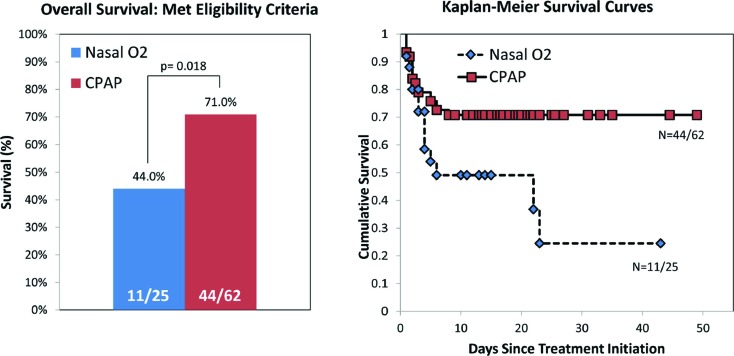
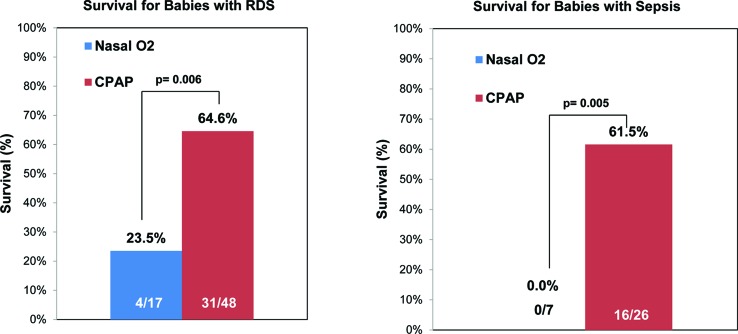
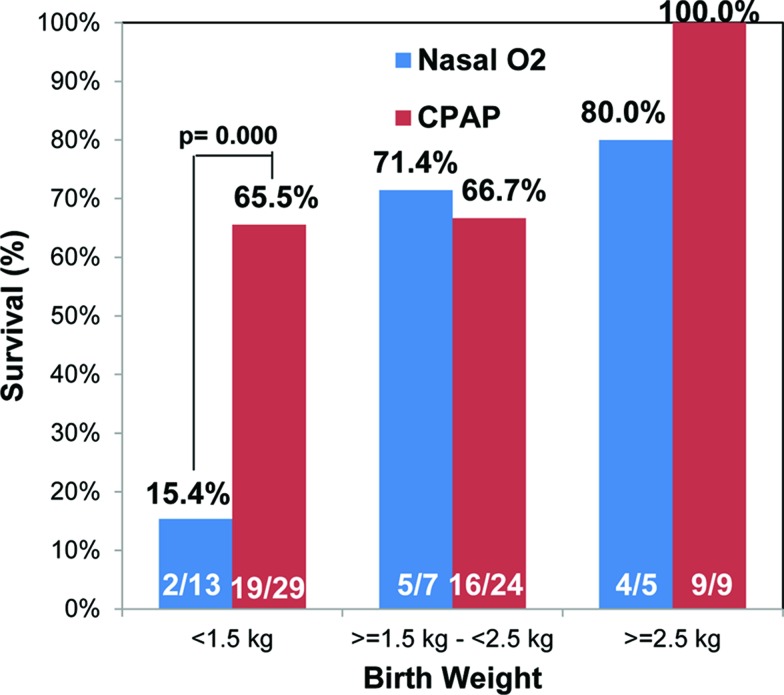
Findings: 87 neonates (62 bCPAP, 25 controls) were recruited. Survival rate for neonates receiving bCPAP was 71.0% (44/62) compared with 44.0% (11/25) for controls. 65.5% (19/29) of very low birth weight neonates receiving bCPAP survived to discharge compared to 15.4% (1/13) of controls. 64.6% (31/48) of neonates with respiratory distress syndrome (RDS) receiving bCPAP survived to discharge, compared to 23.5% (4/17) of controls. 61.5% (16/26) of neonates with sepsis receiving bCPAP survived to discharge, while none of the seven neonates with sepsis in the control group survived.

Interpretation: Use of a low-cost bCPAP system to treat neonatal respiratory distress resulted in 27% absolute improvement in survival. The beneficial effect was greater for neonates with very low birth weight, RDS, or sepsis. Implementing appropriate bCPAP devices could reduce neonatal mortality in developing countries.


Figures
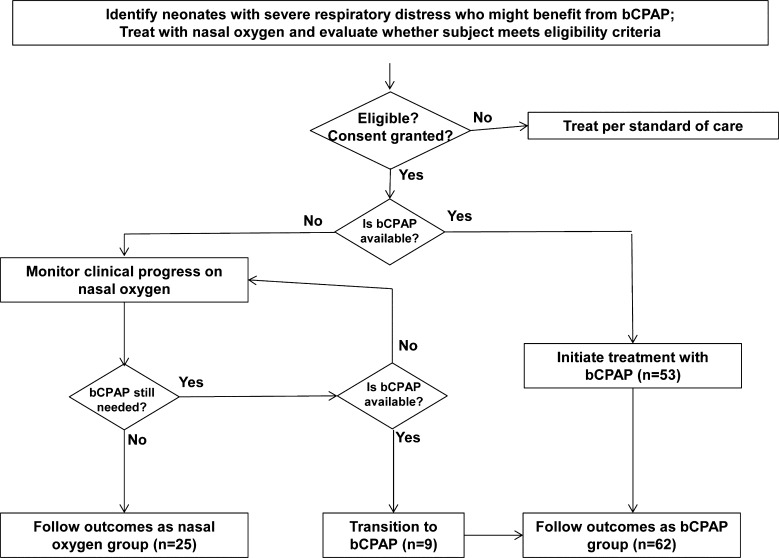
Figure 1
Figure 1
Flow chart summarizing study procedure and outcome groups. doi:10.1371/journal.pone.0086327.g001
Figure 2
Figure 2
Overall survival of eligible study participants receiving nasal oxygen vs. bCPAP. (Left) Fraction of eligible study participants who survived to discharge and received nasal oxygen or bCPAP. When treated with bCPAP, the survival rate of infants with severe respiratory distress is significantly higher than for those treated with nasal oxygen (p = 0.018). Without adjustment, bCPAP is associated with a 3.1-fold increase in odds of survival (confidence interval 1.2–8.1, significance = 0.02). (Right) Kaplan-Meier survival curves showing cumulative survival vs. days since treatment initiation for infants with severe respiratory distress treated with bCPAP (n = 62) and those treated with nasal oxygen (n = 25). doi:10.1371/journal.pone.0086327.g002
Figure 3
Figure 3
Survival of participants with RDS and sepsis receiving nasal oxygen vs. bCPAP. (Left) Fraction of eligible study subjects with a primary diagnosis of respiratory distress syndrome (RDS) who survived to discharge and received nasal oxygen or bCPAP. (Right) Fraction of eligible study subjects with a co-morbidity of sepsis who survived to discharge and received nasal oxygen or bCPAP. doi:10.1371/journal.pone.0086327.g003
Figure 4
Figure 4
Survival of participants by birthweight receiving nasal oxygen vs. bCPAP. Fraction of eligible study subjects who survived to discharge and received nasal oxygen or bCPAP, stratified by birth weight. Results are reported for subjects with very low birth weight (>= 1.0 kg to <1.5 kg), low birth weight (>= 1.5 kg to <2.5 kg) and birth weights greater than or equal to2.5 kg. doi:10.1371/journal.pone.0086327.g004
Figure S1
Figure S1
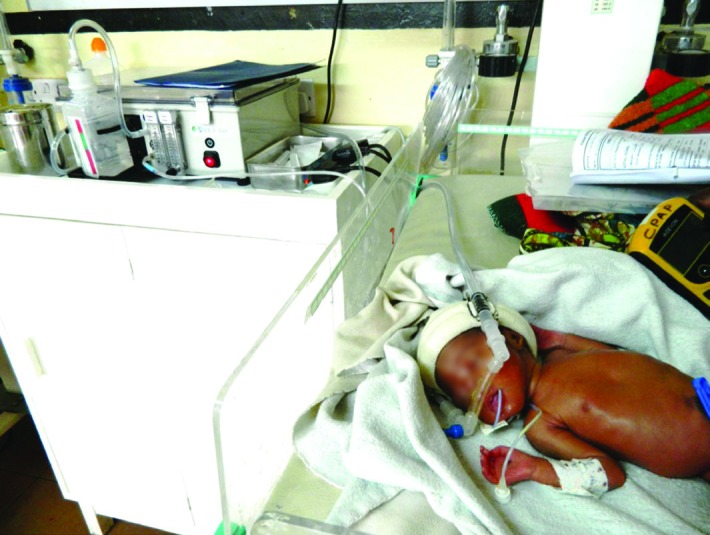
Photograph showing bubble CPAP device used in the study. bCPAP was delivered using Hudson prongs secured to a stretchy hat with safety pins and elastic bands. The bCPAP delivered a blended mix of air and oxygen from an oxygen concentrator at flow rates varying from 0–10 L/min and pressures ranging from 5–8 cm H2O.

Republished from

References

    1. Lawn JE, Kerber K, Enweronu-Laryea C, Cousens S. 3.6 Million Neonatal Deaths-What Is Progressing and What Is Not? Seminars in Perinatology. 2010;34:371–386. - PubMed
    1. St Clair C, Norwitz ER, Woensdregt K, Cackovic M, Shaw JA, et al. The probability of neonatal respiratory distress syndrome as a function of gestational age and lecithin/sphingomyelin ratio. Am J Perinatol. 2008;25:473–480. - PMC - PubMed
    1. Duke T. Neonatal pneumonia in developing countries. Archives of Disease in Childhood-Fetal and Neonatal Edition. 2005;90:211–219. - PMC - PubMed
    1. Gnanaratnem J, Finer NN. Neonatal acute respiratory failure. Curr Opin Pediatr. 2000;12:227–232. - PubMed
    1. Kamath BD, MacGuire ER, McClure EM, Goldenberg RL, Jobe AH. Neonatal Mortality From Respiratory Distress Syndrome: Lessons for Low-Resource Countries. Pediatrics. 2011;127:1139–1146. - PMC - PubMed

Publication types

LinkOut - more resources