


Cerebral blood flow is decoupled from blood pressure and linked to EEG bursting after resuscitation from cardiac arrest
- PMID: 27896005
- PMCID: PMC5119605
- DOI: 10.1364/BOE.7.004660
Cerebral blood flow is decoupled from blood pressure and linked to EEG bursting after resuscitation from cardiac arrest
Abstract
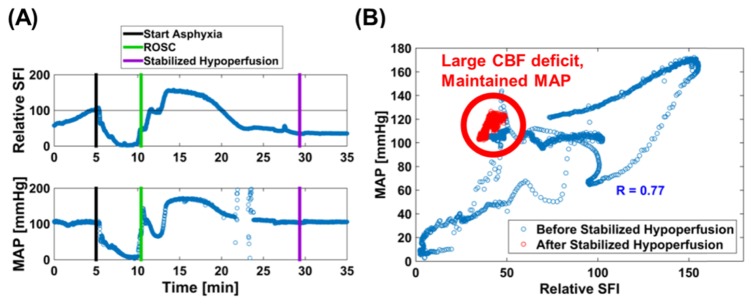
In the present study, we have developed a multi-modal instrument that combines laser speckle imaging, arterial blood pressure, and electroencephalography (EEG) to quantitatively assess cerebral blood flow (CBF), mean arterial pressure (MAP), and brain electrophysiology before, during, and after asphyxial cardiac arrest (CA) and resuscitation. Using the acquired data, we quantified the time and magnitude of the CBF hyperemic peak and stabilized hypoperfusion after resuscitation. Furthermore, we assessed the correlation between CBF and MAP before and after stabilized hypoperfusion. Finally, we examined when brain electrical activity resumes after resuscitation from CA with relation to CBF and MAP, and developed an empirical predictive model to predict when brain electrical activity resumes after resuscitation from CA. Our results show that: 1) more severe CA results in longer time to stabilized cerebral hypoperfusion; 2) CBF and MAP are coupled before stabilized hypoperfusion and uncoupled after stabilized hypoperfusion; 3) EEG activity (bursting) resumes after the CBF hyperemic phase and before stabilized hypoperfusion; 4) CBF predicts when EEG activity resumes for 5-min asphyxial CA, but is a poor predictor for 7-min asphyxial CA. Together, these novel findings highlight the importance of using multi-modal approaches to investigate CA recovery to better understand physiological processes and ultimately improve neurological outcome.
Keywords: (110.6150) Speckle imaging; (120.5475) Pressure measurement; (170.1610) Clinical applications; (170.2655) Functional monitoring and imaging; (170.3880) Medical and biological imaging; (170.5380) Physiology.
Figures




References
-
- Mozaffarian D., Benjamin E. J., Go A. S., Arnett D. K., Blaha M. J., Cushman M., De Ferranti S., Després J. P., Fullerton H. J., Howard V. J., Huffman M. D., Judd S. E., Kissela B. M., Lackland D. T., Lichtman J. H., Lisabeth L. D., Liu S., Mackey R. H., Matchar D. B., McGuire D. K., Mohler E. R., Moy C. S., Muntner P., Mussolino M. E., Nasir K., Neumar R. W., Nichol G., Palaniappan L., Pandey D. K., Reeves M. J., Rodriguez C. J., Sorlie P. D., Stein J., Towfighi A., Turan T. N., Virani S. S., Willey J. Z., Woo D., Yeh R. W., Turner M. B., Heart Disease and Stroke Statistics-2015 Update : A Report from the American Heart Association (2015), Vol. 131. - PubMed
-
- Lee J. K., Brady K. M., Mytar J. O., Kibler K. K., Carter E. L., Hirsch K. G., Hogue C. W., Easley R. B., Jordan L. C., Smielewski P., Czosnyka M., Shaffner D. H., Koehler R. C., “Cerebral blood flow and cerebrovascular autoregulation in a swine model of pediatric cardiac arrest and hypothermia,” Crit. Care Med. 39(10), 2337–2345 (2011).10.1097/CCM.0b013e318223b910 - DOI - PMC - PubMed
Grants and funding
LinkOut - more resources
Full Text Sources
Other Literature Sources