


Oral health status and need for oral care of care-dependent indwelling elderly: from admission to death
- PMID: 27896484
- PMCID: PMC5559562
- DOI: 10.1007/s00784-016-2011-0
Oral health status and need for oral care of care-dependent indwelling elderly: from admission to death
Abstract
Objectives: The objective of this study is to assess oral health and oral status of elderly patients newly admitted to a nursing home from admission until death.
Materials and methods: Oral health, oral status, need for dental care, cooperation with dental treatment, and given dental care were assessed by two geriatric dentists in all new long-stay patients (n = 725) admitted to a nursing home between January 2009 and December 2013. All patients were followed from admission until death or until they left the nursing home.
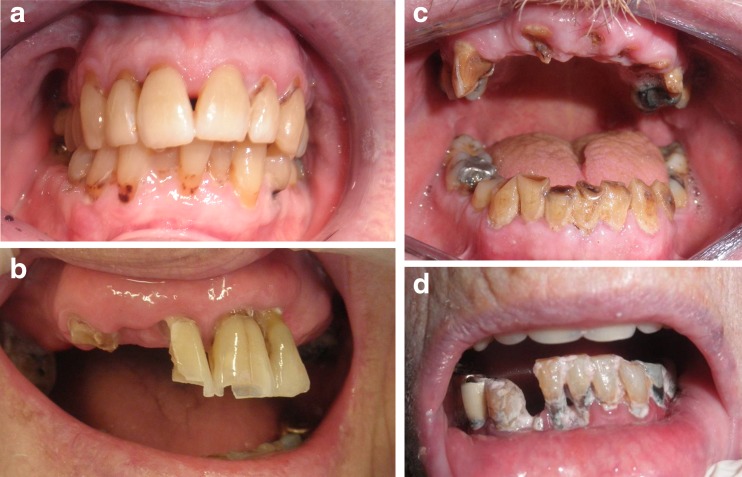
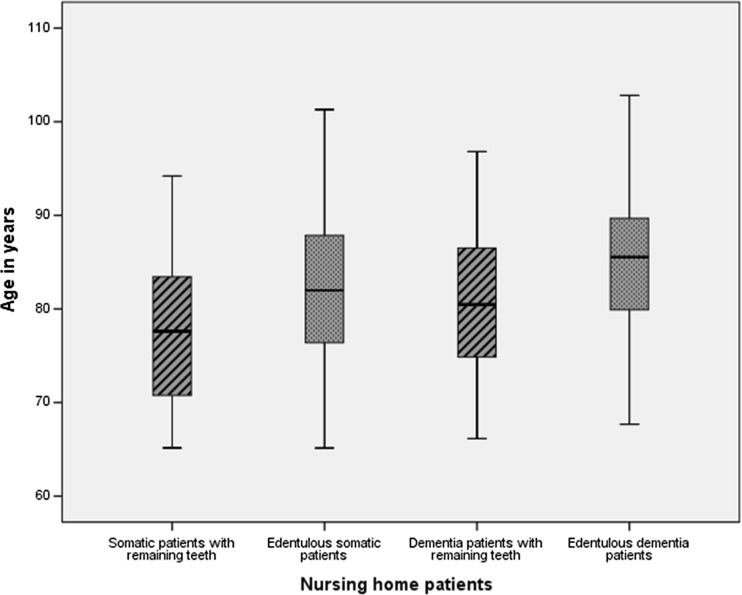
Results: At admission, dementia patients were significantly older than somatic patients; median [IQR] ages were, respectively, 85 [79-89] and 81 [76-87] (p = 0.001). In addition, edentulous patients were significantly older than patients with remaining teeth, 83 [79-89] versus 80 [74-86] (p = 0.001) years. Thirty percent of the admitted patients died within 12 months after admission. A small minority (20%) of the patients had their own teeth. In this group, poor oral hygiene (72%), caries (70%), and broken teeth (62%) were frequently observed. Edentulous patients were significantly more cooperative with treatment than patients with remaining teeth (64 versus 27%). Finally, significantly less professional dental care was given to edentulous patients when compared to patients with remaining teeth (median 90 [IQR 60-180] versus 165 [75-375] min).
Conclusion: When compared to edentulous elderly patients, patients with remaining teeth were younger at admittance, were more often non-cooperative, and had a poorer oral health and higher need for dental care.
Clinical relevance: It is important that health care workers ensure adequate oral health and dental care to frail elderly, especially for elderly with remaining teeth.
Keywords: Care-dependent; Cooperation; Dental implants; Elderly; Nursing home; Oral health status.
Conflict of interest statement
Conflict of interest
The authors declare that they have no conflict of interest.
Funding
The work was funded by the Stichting Nederlands Tijdschrift voor Tandheelkunde (Dutch Dental Journal) with an unrestricted grant for studying the dental needs in indwelling elderly. Next, it was supported by the Department of Oral and Maxillofacial Surgery of the University Medical Center Groningen of the University of Groningen, the Netherlands.
Ethical approval
This article does not contain any studies with human participants or animals performed by any of the authors. The ethics review board of the University Medical Center Groningen provided a waiver that this is not an experimental study with test subjects as stated in the Medical Research Involving Human Subject Act as the dental screening and oral care was part of the care as usual (Letter M13.133088).
Informed consent
For this type of study, formal consent is not required.
Figures
References
-
- Garssen J (2011) Demografie van de vergrijzing. CBS 2011 (Dutch central agency for statistics). http://www.cbs.nl/NR/rdonlyres/D7D8F678-F22B-445F-8A6F-A635D376A344/0/20... Accessed April 26, 2013
MeSH terms
Grants and funding
LinkOut - more resources
Full Text Sources
Other Literature Sources
Medical
