. 2016 Nov 29:6:37831.
doi: 10.1038/srep37831.

Structural insight for chain selection and stagger control in collagen

Affiliations

Structural insight for chain selection and stagger control in collagen

Sergei P Boudko et al. Sci Rep. .

Abstract

Collagen plays a fundamental role in all known metazoans. In collagens three polypeptides form a unique triple-helical structure with a one-residue stagger to fit every third glycine residue in the inner core without disturbing the poly-proline type II helical conformation of each chain. There are homo- and hetero-trimeric types of collagen consisting of one, two or three distinct chains. Thus there must be mechanisms that control composition and stagger during collagen folding. Here, we uncover the structural basis for both chain selection and stagger formation of a collagen molecule. Three distinct chains (α1, α2 and α3) of the non-collagenous domain 2 (NC2) of type IX collagen are assembled to guide triple-helical sequences in the leading, middle and trailing positions. This unique domain opens the door for generating any fragment of collagen in its native composition and stagger.


Figures
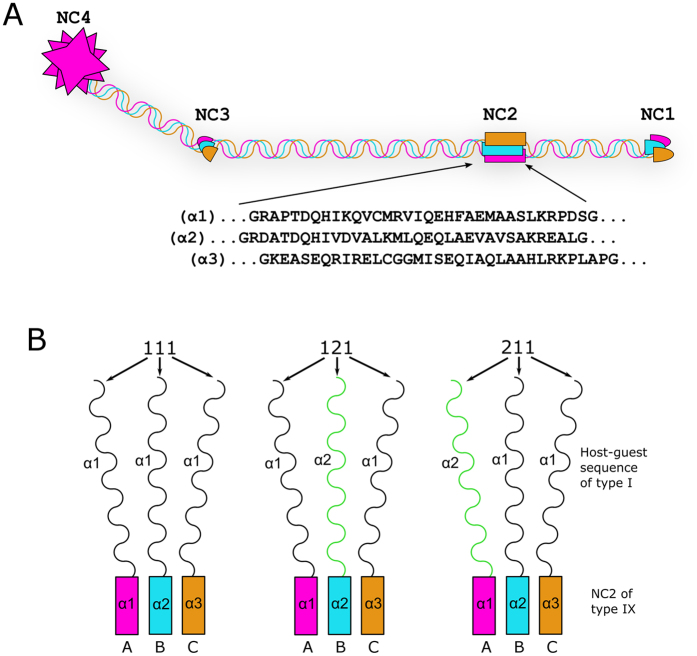
Figure 1
Figure 1. Domain organization of type IX collagen and design of chimeric constructs.
(A) Four non-collagenous domains (NC1-4) are historically numbered starting from the C-terminus. Sequences of the NC2 domain studied here are shown. (B) The three constructs used in this study.
Figure 2
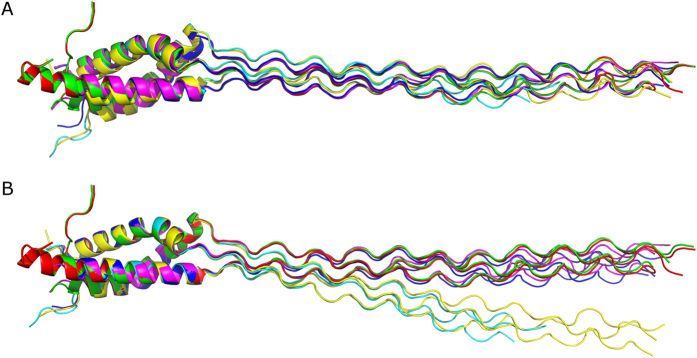
Figure 2. Superimpositions of structures.
(A) Overall superimposition of six structures (121nat, 121sm, two trimers of 111sm and two trimers of 211sm). (B) Superimposition of the same structures within the NC2 domain core.
Figure 3
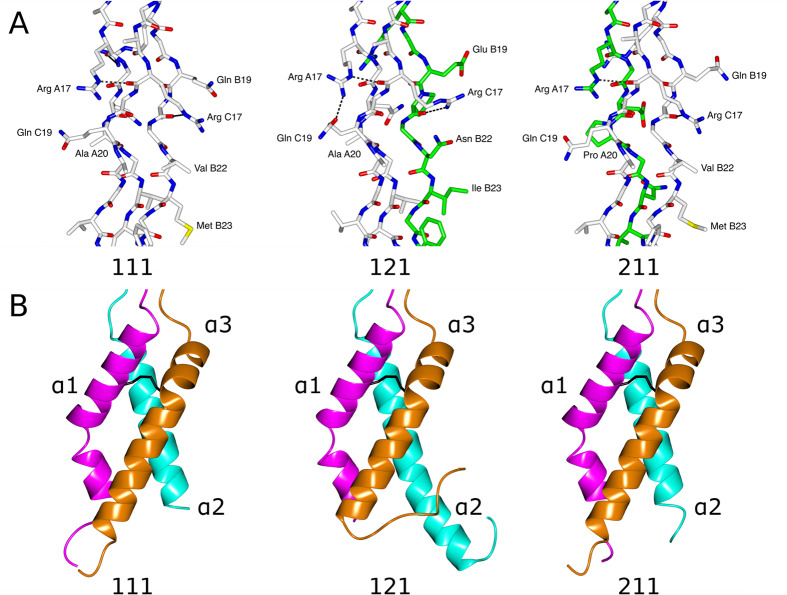
Figure 3. Close-up views.
(A) The triple helical region of the type I collagen guest sequences. (B) The NC2 domain comparison. The disulfide bond between the α1 and α3 chains is shown as cylinders in black. Chain A (α1) – magenta, chain B (α2) – cyan, chain C (α3) – dark orange.
Figure 4
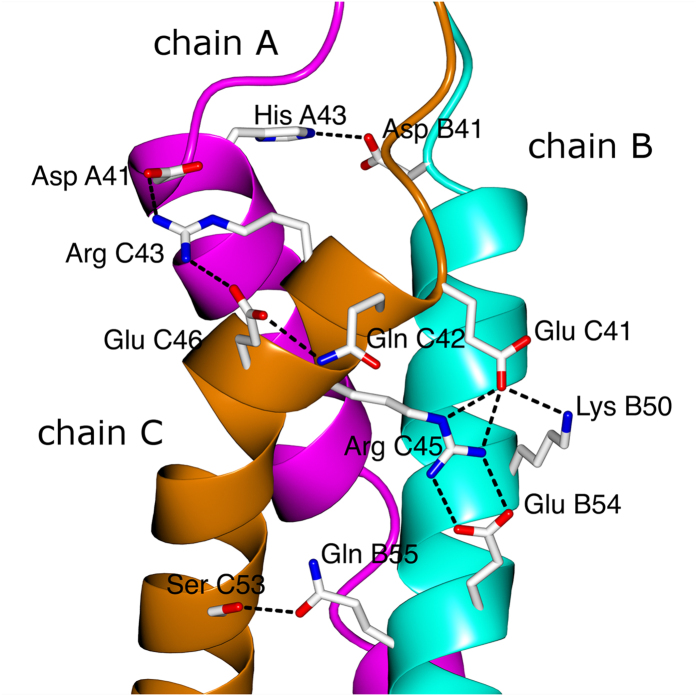
Figure 4. Non-covalent inter-chain bonding within the NC2 domain (shown 121sm).
Chain A (α1) – magenta, chain B (α2) – cyan, chain C (α3) – dark orange.
Figure 5
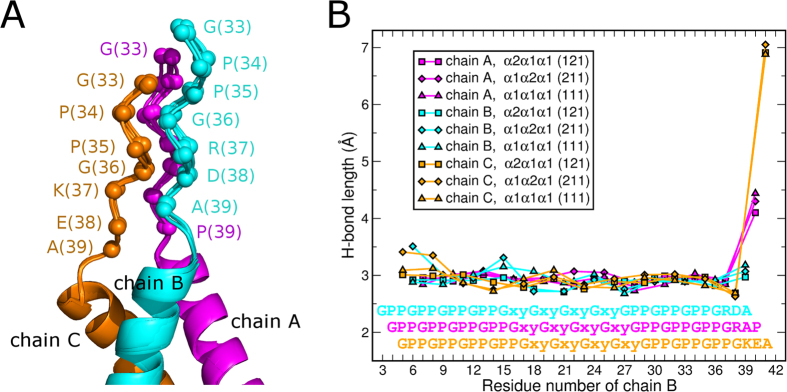
Figure 5. Triple helix – NC2 domain interface.
(A) Four structures (121nat, 121sm, 111sm and 211sm) are superimposed within the NC2 domain core. Cα-positions of residues 33–39 are shown as spheres. (B) Inter-chain hydrogen bond lengths within the triple-helix and the interface. Chain A (α1 of NC2) – magenta, chain B (α2 of NC2) – cyan, chain C (α3 of NC2) – dark orange.
Figure 6
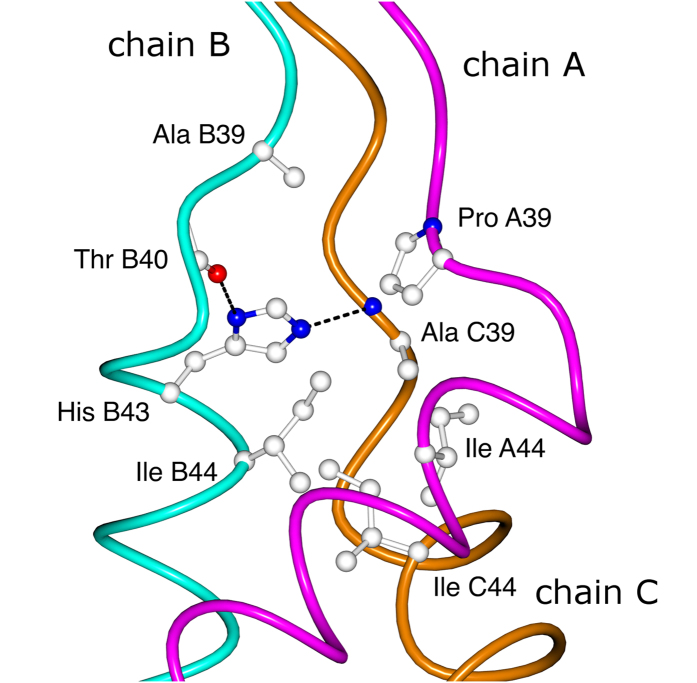
Figure 6. The core residues at the interface between the triple-helix and the NC2 domain (shown 121sm).
Chain A (α1 of NC2) – magenta, chain B (α2 of NC2) – cyan, chain C (α3 of NC2) – dark orange.

References

    1. Bella J. Collagen structure: new tricks from a very old dog. Biochem J 473, 1001–25 (2016). - PubMed
    1. Hohenester E., Sasaki T., Giudici C., Farndale R. W. & Bächinger H. P. Structural basis of sequence-specific collagen recognition by SPARC. Proc Natl Acad Sci USA 105, 18273–7 (2008). - PMC - PubMed
    1. Lisman T. et al. A single high-affinity binding site for von Willebrand factor in collagen III, identified using synthetic triple-helical peptides. Blood 108, 3753–6 (2006). - PubMed
    1. Brondijk T. H., Bihan D., Farndale R. W. & Huizinga E. G. Implications for collagen I chain registry from the structure of the collagen von Willebrand factor A3 domain complex. Proc Natl Acad Sci USA 109, 5253–8 (2012). - PMC - PubMed
    1. Carafoli F., Hamaia S. W., Bihan D., Hohenester E. & Farndale R. W. An activating mutation reveals a second binding mode of the integrin alpha2 I domain to the GFOGER motif in collagens. PLoS ONE 8, e69833 (2013). - PMC - PubMed

Publication types

Substances

LinkOut - more resources