. 2016 Nov 25;17(12):1971.
doi: 10.3390/ijms17121971.

Limb Remote Ischemic Postconditioning Reduces Ischemia-Reperfusion Injury by Inhibiting NADPH Oxidase Activation and MyD88-TRAF6-P38MAP-Kinase Pathway of Neutrophils

Affiliations

Limb Remote Ischemic Postconditioning Reduces Ischemia-Reperfusion Injury by Inhibiting NADPH Oxidase Activation and MyD88-TRAF6-P38MAP-Kinase Pathway of Neutrophils

Gangling Chen et al. Int J Mol Sci. .

Abstract

Limb remote ischemic postconditioning (LRIP) has been confirmed to reduce the ischemia-reperfusion injury but its mechanisms are still not clear. This study clarified the mechanism of LRIP based on the nicotinamide-adenine dinucleotide phosphate (NADPH) oxidase and Myeloid differentiation factor 88 (MyD88)-Tumor necrosis factor (TNF) receptor-associated factor 6 (TRAF6)-P38 pathway of neutrophils. Rat middle cerebral artery occlusion (MCAO) model was used in this study. Ischemia-reperfusion injury was carried out by MCAO 1.5 h followed by 24 h reperfusion. LRIP operation was performed to the left femoral artery at 0, 1 or 3 h after reperfusion. Behavioral testing, including postural reflex test, vibrissae-elicited forelimb placing test and tail hang test, showed that LRIP operated at 0 h of reperfusion could significantly ameliorate these behavioral scores. Pathological examinations, infarct size, Myeloperoxidase (MPO) activity showed that LRIP operated at 0 h of reperfusion could significantly ameliorate the pathological scores, reduce the infarct size and MPO activity in the brain and increase the MPO activity in the left leg. By using Neutrophil counting, immunofluorescence and real-time PCR techniques, we found that LRIP operated at 0 h of reperfusion could reduce neutrophil counts in the peripheral blood and downregulate the activation of neutrophil in the peripheral blood and rat brain. Western blots revealed that MyD88, TRAF6, p38 mitogen-activated protein kinase (p38-MAPK) in neutrophils and the phosphorylation of p47phox (Ser 304 and Ser 345) in neutrophil could be downregulated by LRIP. Our study suggests that LRIP inhibits the number and activation of neutrophils in the rat brain and peripheral blood linked to down-regulating the activation of NADPH oxidase in neutrophils by MyD88/TRAF6/p38-MAPK pathway.

Keywords: MyD88/TRAF6/p38-MAPK pathway; NADPH oxidase; ischemic stroke; limb; neutrophil; reperfusion injury.


Conflict of interest statement

The authors declare no conflict of interest.

Figures
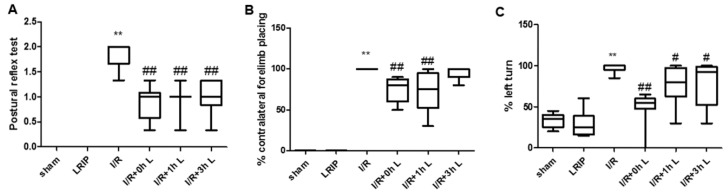
Figure 1
Figure 1
Effects of limb remote ischemic postconditioning (LRIP) on neurobehavioral testing scores assessed at 24 h after reperfusion. LRIP operation was carried out by three cycles of 5 min occlusion/5 min release of the left femoral artery at 0, 1 or 3 h after reperfusion, respectively: (A) postural reflex test; (B) vibrissae-elicited forelimb placing test; and (C) tail hang test. Data are expressed as mean ± SD, n = 6, ** p < 0.01 vs. sham group, ## p < 0.01 vs. Ischemia-reperfusion (I/R) group, # p < 0.05 vs. I/R group.
Figure 2
Figure 2
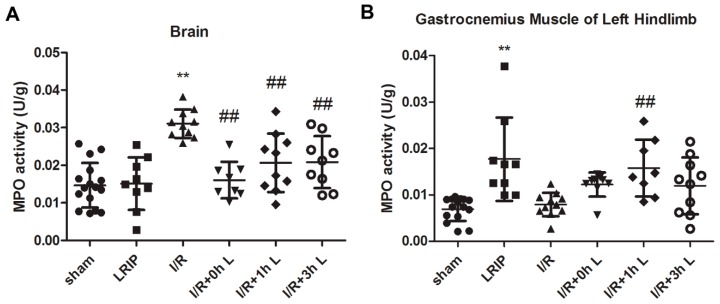
Effects of LRIP on neutrophil infiltration in the brain and left hindlimb gastrocnemius muscle: Myeloperoxidase (MPO) activities in: the brain (A); and left hindlimb gastrocnemius muscle (B) were assessed at 24 h after reperfusion. Data are expressed as mean ± SD, n = 6, ** p < 0.01 vs. sham group, ## p < 0.01 vs. I/R group.
Figure 3
Figure 3
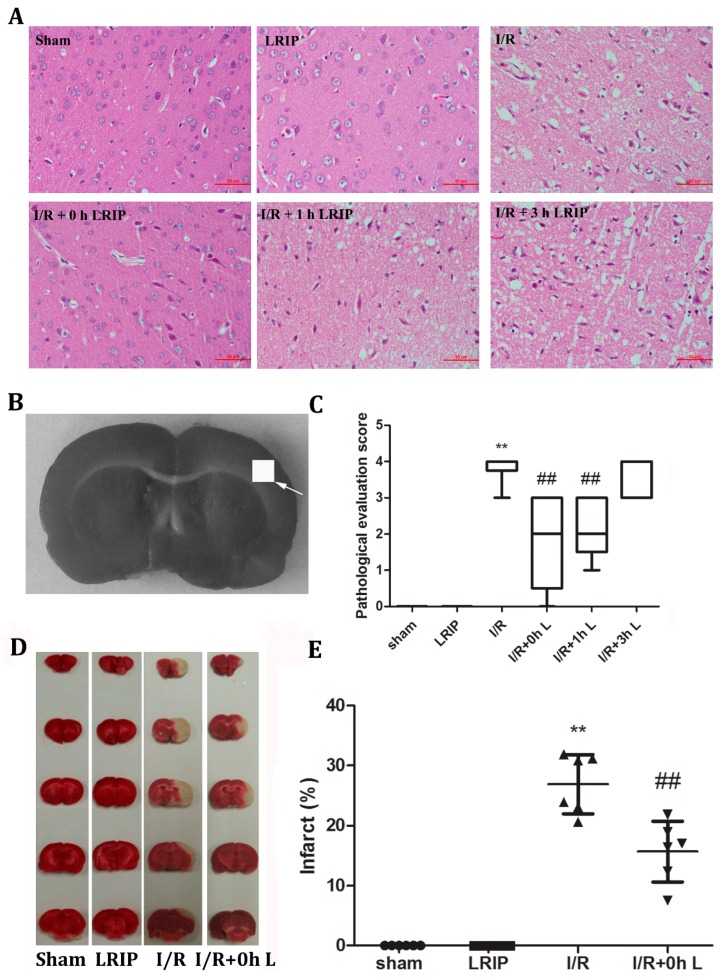
LRIP ameliorated histopathological changes and infarct size of the brain. (A) Brain sections of rats in different groups were stained by Hematoxylin and Eosin and then examined using a light microscope. Representative photomicrographs of ischemic cortices from the sham, LRIP, I/R, I/R + 0 h, I/R + 1 h, and I/R + 3 h groups were established. The most significant reversal of injury was observed in the I/R + 0 h group. The magnification was 400×. Scale bar = 50 µm; n = 6; (B) rat brain slices were obtained by making a coronal cut through the optic chiasma. Tissue corresponding to the square icon was used for Hematoxylin and Eosin Staining; (C) histopathological scores of paraffin sections of the rat brain; (D) representative infarcts stained by 2,3,5-triphenyhetrazolium chloride (TTC); (E) bar graphs show the average infarct size of the five slices. Data are expressed as mean ± SD, n = 6, ** p < 0.01 vs. sham group, ## p < 0.01 vs. I/R group.
Figure 4
Figure 4
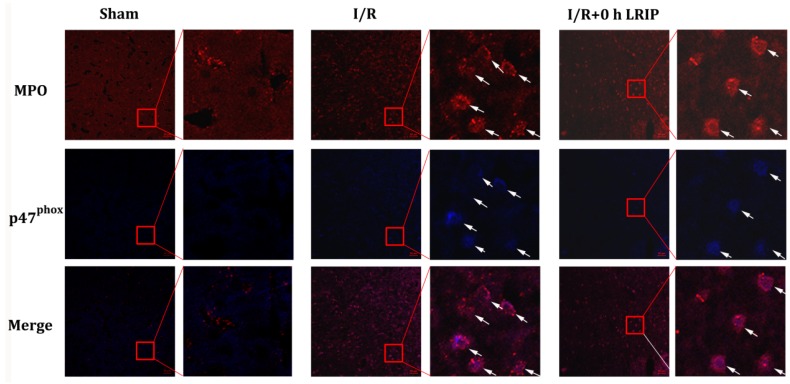
LRIP reduced the infiltration and p47phox membrane translocation of neutrophil. Representative immunofluorescence microscopeimages of p47phox (blue) in neutrophils with the marker MPO (red). Scale bar = 50 μm in 200× images and 20 μm in 600× images. Infiltration of neutrophils was increased in the I/R group and the expression and membrane translocation of its p47phox were augmented. These phenomena were attenuated in the I/R + 0 h LRIP group.
Figure 5
Figure 5
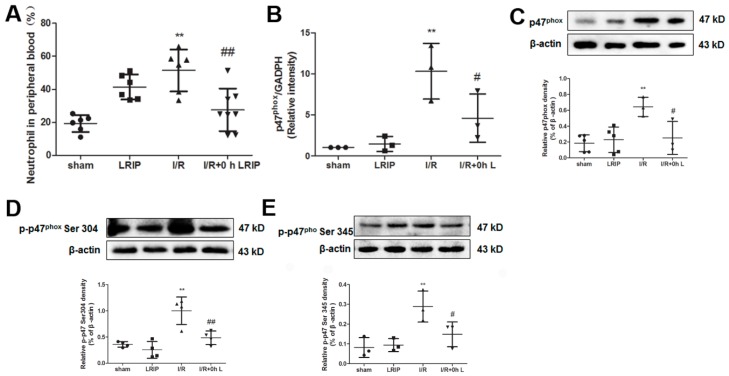
Effect of LRIP on the number of neutrophil and nicotinamide-adenine dinucleotide phosphate (NADPH) oxidase activation of peripheral blood: (A) Neutrophil count in the peripheral blood. Data are expressed as percentage of neutrophil in the peripheral blood (n = 6); (B) qPCR result showing the mRNA expression change of p47phox in the Sham, LRIP, I/R, and I/R + 0 h LRIP groups. Glyceraldehyde-3-phosphate dehydrogenase (GAPDH) is used as the internal control (n = 3); (CE) Western blot assessment of p47phox and its phosphorylationat Ser 304 and Ser 345 in neutrophils from the peripheral blood were performed after 24 h reperfusion (n = 3). Data are expressed as mean ± SD, ** p < 0.01 vs. sham group, # p < 0.05 vs. I/R group, ## p < 0.01 vs. I/R group.
Figure 6
Figure 6
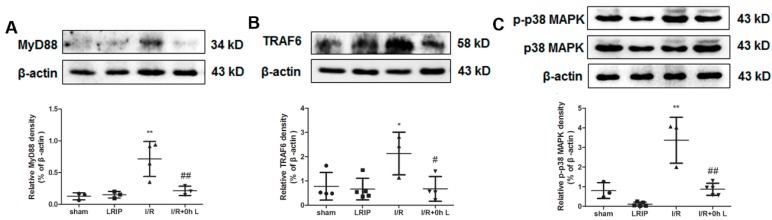
The Myeloid differentiation factor 88 (MyD88)/Tumor necrosis factor (TNF) receptor-associated factor 6 (TRAF6)/p38 mitogen-activated protein kinase (p38-MAPK) signaling pathway is involved in the mechanism through with LRIP protects against I/R injury. Representative images of Western blot assessments and the quantitative analysis of the ratio of: MyD88 (A); TRAF6 (B); and p-p38 MAPK (C). Data are expressed as mean ± SD, n = 3, * p < 0.05 vs. sham group, ** p < 0.01 vs. sham group, # p < 0.05 vs. I/R group, ## p < 0.01 vs. I/R group.

References

    1. Barber P.A., Krishnamurthi R., Parag V., Anderson N.E., Ranta A., Kilfoyle D., Wong E., Green G., Arroll B., Bennett D.A., et al. Incidence of Transient Ischemic Attack in Auckland, New Zealand, in 2011 to 2012. Stroke. 2016;47:2183–2188. doi: 10.1161/STROKEAHA.116.014010. - DOI - PubMed
    1. Gomes F., Hookway C., Weekes C.E., Royal College of Physicians Intercollegiate Stroke Working Party Royal College of Physicians Intercollegiate Stroke Working Party evidence-based guidelines for the nutritional support of patients who have had a stroke. J. Hum. Nutr. Diet. 2014;27:107–121. doi: 10.1111/jhn.12185. - DOI - PubMed
    1. Myint P.K., Hellkamp A.S., Fonarow G.C., Reeves M.J., Schwamm L.H., Schulte P.J., Xian Y., Suter R.E., Bhatt D.L., Saver J.L., et al. Prior Antithrombotic Use Is Associated With Favorable Mortality and Functional Outcomes in Acute Ischemic Stroke. Stroke. 2016;47:2066–2074. doi: 10.1161/STROKEAHA.115.012414. - DOI - PubMed
    1. Campbell B.C. Thrombolysis and Thrombectomy for Acute Ischemic Stroke: Strengths and Synergies. Semin. Thromb. Hemost. 2016 doi: 10.1055/s-0036-1585078. - DOI - PubMed
    1. Kerendi F., Kin H., Halkos M.E., Jiang R., Zatta A.J., Zhao Z.Q., Guyton R.A., Vinten-Johansen J. Remote postconditioning. Brief renal ischemia and reperfusion applied before coronary artery reperfusion reduces myocardial infarct size via endogenous activation of adenosine receptors. Basic Res. Cardiol. 2005;100:404–412. doi: 10.1007/s00395-005-0539-2. - DOI - PubMed

MeSH terms

Substances

LinkOut - more resources