


Ribosome-Inactivating Proteins from Plants: A Historical Overview
- PMID: 27898041
- PMCID: PMC6273060
- DOI: 10.3390/molecules21121627
Ribosome-Inactivating Proteins from Plants: A Historical Overview
Abstract
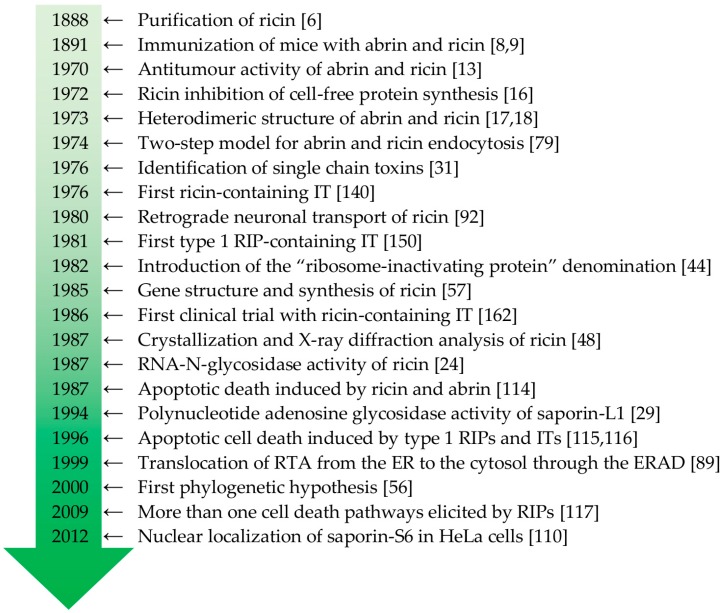
This review provides a historical overview of the research on plant ribosome-inactivating proteins (RIPs), starting from the first studies at the end of eighteenth century involving the purification of abrin and ricin, as well as the immunological experiments of Paul Erlich. Interest in these plant toxins was revived in 1970 by the observation of their anticancer activity, which has given rise to a large amount of research contributing to the development of various scientific fields. Biochemistry analyses succeeded in identifying the enzymatic activity of RIPs and allowed for a better understanding of the ribosomal machinery. Studies on RIP/cell interactions were able to detail the endocytosis and intracellular routing of ricin, thus increasing our knowledge of how cells handle exogenous proteins. The identification of new RIPs and the finding that most RIPs are single-chain polypeptides, together with their genetic sequencing, has aided in the development of new phylogenetic theories. Overall, the biological properties of these proteins, including their abortifacient, anticancer, antiviral and neurotoxic activities, suggest that RIPs could be utilized in agriculture and in many biomedical fields, including clinical drug development.
Keywords: anticancer drugs; antiviral proteins; immunotoxins; plant lectins; plant toxins; ribosome-inactivating proteins; ricin; science history.
Conflict of interest statement
The authors declare no conflict of interest.
Figures
References
-
- Dixon T. Ricinus communis. Aust. Med. Gaz. 1887;6:137–138.
-
- Martin S. The proteins of the seeds of Abrus precatorius. Proc. R. Soc. 1887;42:3331–3333. doi: 10.1098/rspl.1887.0067. - DOI
Publication types
MeSH terms
Substances
LinkOut - more resources
Full Text Sources
Other Literature Sources
Miscellaneous
