. 2016 Nov 29;7(6):e01664-16.
doi: 10.1128/mBio.01664-16.

Bacillus subtilis Early Colonization of Arabidopsis thaliana Roots Involves Multiple Chemotaxis Receptors

Affiliations

Bacillus subtilis Early Colonization of Arabidopsis thaliana Roots Involves Multiple Chemotaxis Receptors

Rosalie Allard-Massicotte et al. mBio. .

Abstract

Colonization of plant roots by Bacillus subtilis is mutually beneficial to plants and bacteria. Plants can secrete up to 30% of their fixed carbon via root exudates, thereby feeding the bacteria, and in return the associated B. subtilis bacteria provide the plant with many growth-promoting traits. Formation of a biofilm on the root by matrix-producing B. subtilis is a well-established requirement for long-term colonization. However, we observed that cells start forming a biofilm only several hours after motile cells first settle on the plant. We also found that intact chemotaxis machinery is required for early root colonization by B. subtilis and for plant protection. Arabidopsis thaliana root exudates attract B. subtilis in vitro, an activity mediated by the two characterized chemoreceptors, McpB and McpC, as well as by the orphan receptor TlpC. Nonetheless, bacteria lacking these chemoreceptors are still able to colonize the root, suggesting that other chemoreceptors might also play a role in this process. These observations suggest that A. thaliana actively recruits B. subtilis through root-secreted molecules, and our results stress the important roles of B. subtilis chemoreceptors for efficient colonization of plants in natural environments. These results demonstrate a remarkable strategy adapted by beneficial rhizobacteria to utilize carbon-rich root exudates, which may facilitate rhizobacterial colonization and a mutualistic association with the host.

Importance: Bacillus subtilis is a plant growth-promoting rhizobacterium that establishes robust interactions with roots. Many studies have now demonstrated that biofilm formation is required for long-term colonization. However, we observed that motile B. subtilis mediates the first contact with the roots. These cells differentiate into biofilm-producing cells only several hours after the bacteria first contact the root. Our study reveals that intact chemotaxis machinery is required for the bacteria to reach the root. Many, if not all, of the B. subtilis 10 chemoreceptors are involved in the interaction with the plant. These observations stress the importance of root-bacterium interactions in the B. subtilis lifestyle.


Figures

FIG 1
FIG 1
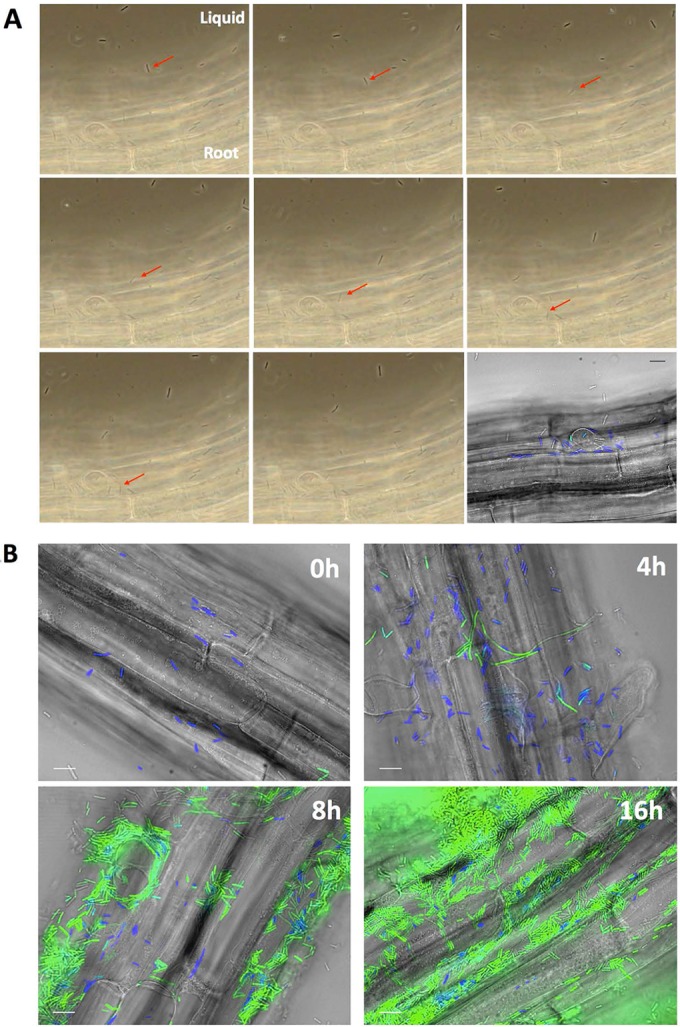
(A) Sequential phase-contrast pictures of an A. thaliana root inoculated with B. subtilis NCIB 3610 cells harboring PtapA-yfp and Phag-cfp reporters. The medium used was MSNg, and imaging started immediately after the inoculation. The red arrow points to a cell swimming toward the root and settling on it. Magnification, ×60. Each picture is separated by 0.5 s; the complete movie can be found in Movie S1 in the supplemental material. The last image is a fluorescence picture of the same frame with overlays of fluorescence (false-colored green for YFP and blue for CFP) and transmitted light (gray) images. (B) When B. subtilis cells colonize A. thaliana roots, they first express motility genes, followed by matrix genes. NCIB3610 cells harboring PtapA-yfp and Phag-cfp were coincubated with A. thaliana seedlings and imaged at 0, 4, 8, and 16 h postinoculation. Shown are overlays of fluorescence (false-colored green for YFP and blue for CFP) and transmitted light (gray) images. Pictures are representative of at least 12 independent roots. Bars, 10 μm.
FIG 2
FIG 2
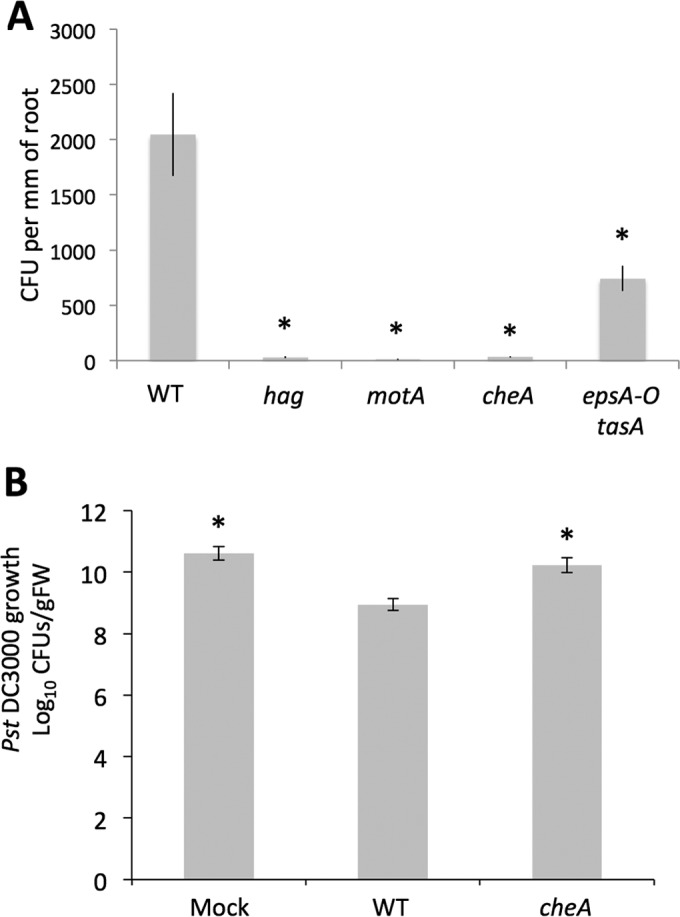
(A) Quantification of root colonization by B. subtilis and various mutants 4 h postinoculation. One-week-old A. thaliana seedlings were coincubated with either WT or mutant B. subtilis strains in MSNg. After 4 h of incubation, the roots were collected, measured, washed in PBS, and sonicated to disperse the bacteria. CFU were evaluated after overnight culture on LB agar. For each strain, the bar represents the mean and standard deviation of four biological replicates. (B) Protection of A. thaliana against P. syringae pv. tomato DC3000 conferred by WT B. subtilis or a chemotaxis mutant. Three-week-old A. thaliana Col-0 plants were rhizo-inoculated with a mock control, WT NCIB3610 B. subtilis, or a cheA mutant and infiltrated with strain DC3000. After 72 h of infection, strain DC3000 growth in leaves was quantified by CFU counts. For each strain, the bar represents the mean and standard deviation of at least nine biological replicates. Bars marked with an asterisk indicate a significant difference from the WT result.
FIG 3
FIG 3
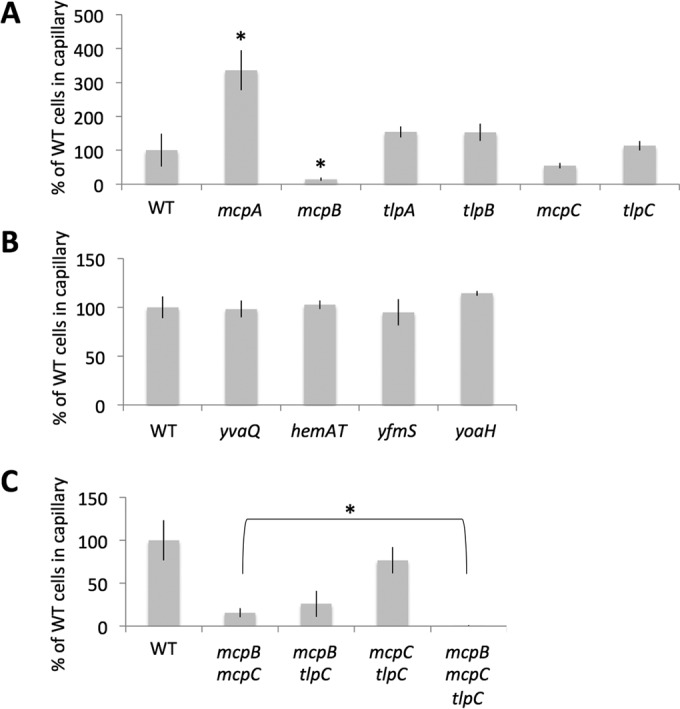
Chemotaxis toward root exudates by various chemoreceptor deletion mutants. Attraction of various B. subtilis strains toward A. thaliana root exudates was measured via a capillary assay (see Materials and Methods). After incubation, the number of CFU in the capillaries was evaluated from an overnight culture on LB agar; numbers are relative to the number of CFU for the WT B. subtilis strain. (A and B) Results for single-deletion mutants; (C) results for combinatorial mutants. For each strain, the bar represents the mean and standard deviation of three biological replicates. In panel A, bars marked with an asterisk were significantly different from the WT result; in panel C, bars marked with an asterisk indicate that results for the mutant strains differed significantly from each other.
FIG 4
FIG 4
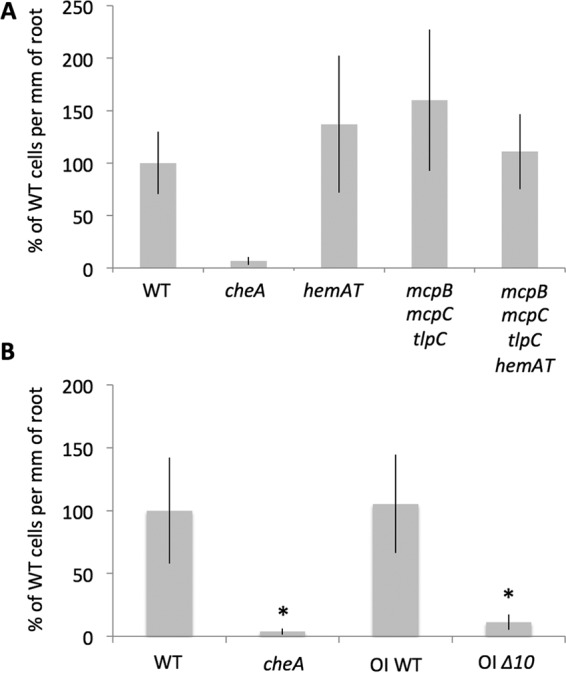
Root colonization assay with chemoreceptor deletion mutants. One-week-old A. thaliana seedlings were coincubated with either WT or mutant B. subtilis strains in MSNg. After 4 h, roots were collected, measured, washed in PBS, and sonicated to disperse the bacteria. CFU were evaluated after overnight culture on LB agar, and numbers are reported relative to the CFU per millimeter of root for WT B. subtilis. For each strain, the bar represents the mean and standard deviation of four biological replicates; bars marked with a asterisk indicate the result differed significantly from that for the WT.
FIG 5
FIG 5
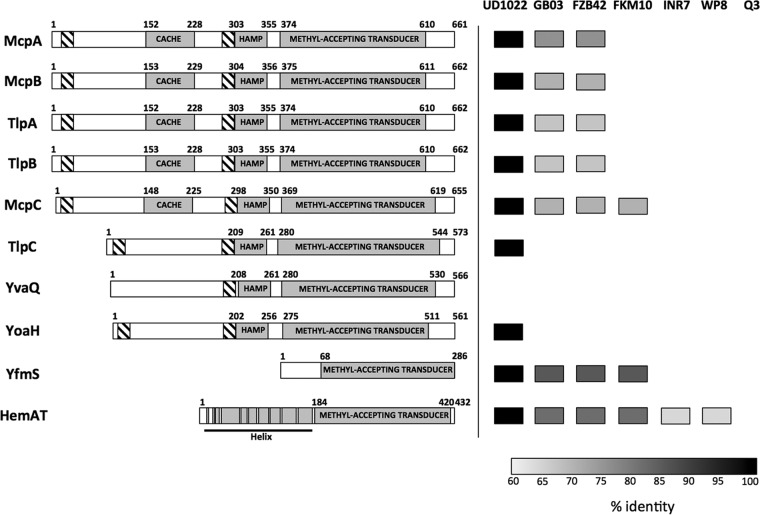
B. subtilis NCIB3610 chemoreceptors and conservation in other PGPR Bacillus spp. Predicted domains of B. subtilis chemoreceptors, according to information on the UniProt website (http://www.uniprot.org), are depicted. Hatched boxes represent the transmembrane domains, while other domains are shown in gray; CACHE domains are predicted to have a role in small-molecule recognition; HAMP domains are composed of an α-helix forming a coiled-coil frequently found in signaling proteins, and methyl-accepting transducer domains are the signaling domains of chemoreceptors. On the right is a depiction of the full-length conservation of each chemoreceptor in different plant-colonizing Bacillus strains, namely, B. subtilis UD1022 (40), B. amyloliquefaciens GB03 and FZB42 (41, 42), B. methylotrophicus FKM10 (43), B. pumilus INR7 and WP8 (44, 45), and B. megaterium Q3 (46).

References

    1. Szurmant H, Ordal GW. 2004. Diversity in chemotaxis mechanisms among the bacteria and archaea. Microbiol Mol Biol Rev 68:301–319. doi:10.1128/MMBR.68.2.301-319.2004. - DOI - PMC - PubMed
    1. Hazelbauer GL. 2012. Bacterial chemotaxis: the early years of molecular studies. Annu Rev Microbiol 66:285–303. doi:10.1146/annurev-micro-092611-150120. - DOI - PMC - PubMed
    1. Garrity LF, Ordal GW. 1995. Chemotaxis in Bacillus subtilis: how bacteria monitor environmental signals. Pharmacol Ther 68:87–104. doi:10.1016/0163-7258(95)00027-5. - DOI - PubMed
    1. Krell T, Lacal J, Muñoz-Martínez F, Reyes-Darias JA, Cadirci BH, García-Fontana C, Ramos JL. 2011. Diversity at its best: bacterial taxis. Environ Microbiol 13:1115–1124. doi:10.1111/j.1462-2920.2010.02383.x. - DOI - PubMed
    1. Gaworzewska ET, Carlile MJ. 1982. Positive chemotaxis of Rhizobium leguminosarum and other bacteria towards root exudates from legumes and other plants. Microbiology 128:1179–1188. doi:10.1099/00221287-128-6-1179. - DOI

Publication types

MeSH terms

LinkOut - more resources