. 2017 Jan 4;45(D1):D819-D826.
doi: 10.1093/nar/gkw1139. Epub 2016 Nov 29.

The dbGaP data browser: a new tool for browsing dbGaP controlled-access genomic data

Affiliations

The dbGaP data browser: a new tool for browsing dbGaP controlled-access genomic data

Kira M Wong et al. Nucleic Acids Res. .

Abstract

The database of Genotypes and Phenotypes (dbGaP) Data Browser (https://www.ncbi.nlm.nih.gov/gap/ddb/) was developed in response to requests from the scientific community for a resource that enable view-only access to summary-level information and individual-level genotype and sequence data associated with phenotypic features maintained in the controlled-access tier of dbGaP. Until now, the dbGaP controlled-access environment required investigators to submit a data access request, wait for Data Access Committee review, download each data set and locally examine them for potentially relevant information. Existing unrestricted-access genomic data browsing resources (e.g. http://evs.gs.washington.edu/EVS/, http://exac.broadinstitute.org/) provide only summary statistics or aggregate allele frequencies. The dbGaP Data Browser serves as a third solution, providing researchers with view-only access to a compilation of individual-level data from general research use (GRU) studies through a simplified controlled-access process. The National Institutes of Health (NIH) will continue to improve the Browser in response to user feedback and believes that this tool may decrease unnecessary download requests, while still facilitating responsible genomic data-sharing.


Figures

Figure 1.
Figure 1.
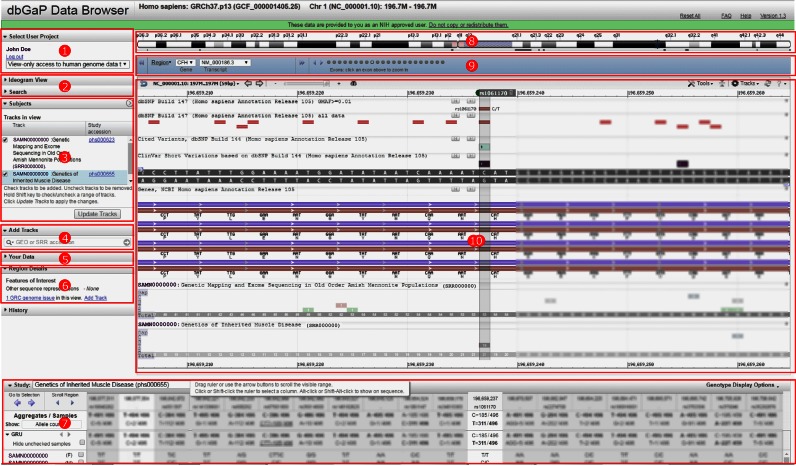
The dbGaP Browser web page displays individual level sequence and genotype data in genome context. Component widgets are indicated by red boxes. Numbers are keyed to the feature descriptions. Some information in the figure has been intentionally blurred for publication.
Figure 2.
Figure 2.
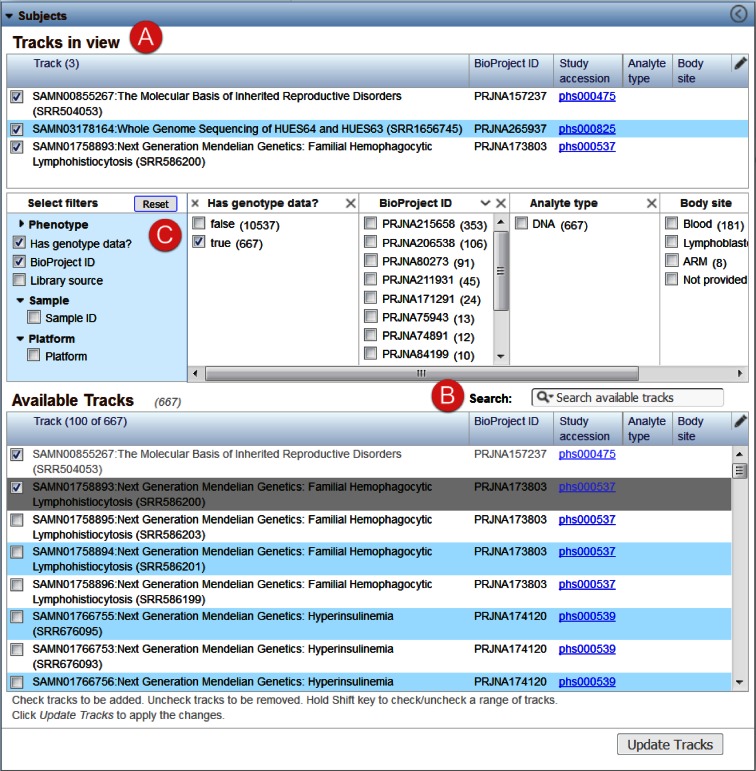
Subjects Widget, expanded view. The widget is used to add and remove alignment tracks from the sequence view. It is comprised of three parts: (A) Table of tracks currently displayed in the DDB sequence view; (B) Searchable table of all available tracks for the specified user project; and (C) filters used to restrict the tracks shown in B. Columns in A and B can be edited using the pencil icon in the upper right of each table. Selecting a filter from the expandable lists in the first column of C adds a column for the corresponding filter to this section that displays the filter values and counts. Selecting filter values in these additional columns updates the table in B.
Figure 3.
Figure 3.
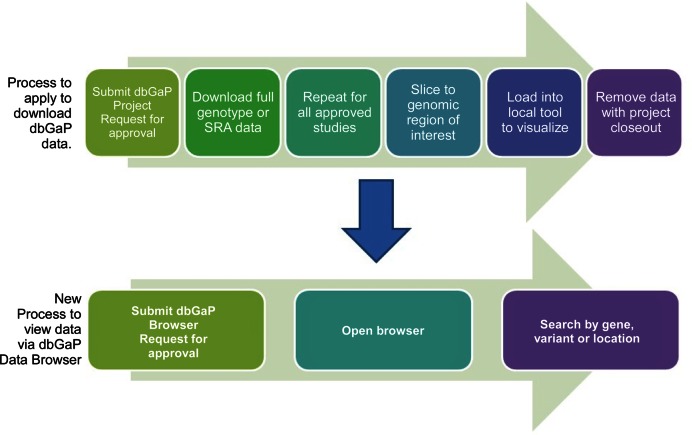
The dbGaP Data Browser offers a streamlined request process to view dbGaP data. Users submit a dbGaP Data Browser Request using their existing eRA, institutional or NIH credentials. Once they are approved by their signing official and the NIH Central Data Access Committee (CDAC), they can open the Browser and immediately visualize data. In contrast, gaining download access to dbGaP data requires users to submit a dbGaP Project Request for approval for each individual data set, wait to be approved for each, download them individually to their local computer, and then load the data set into a local tool for visualization.
Figure 4.
Figure 4.
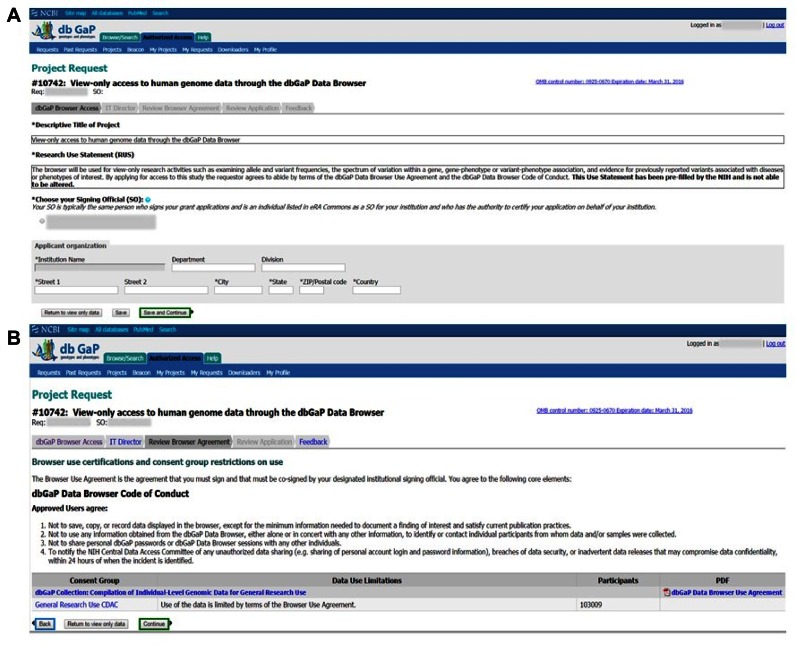
(A) The Descriptive Title of Project and Research Use Statement are pre-filled in the browser request form. (B) Users must agree to the dbGaP Data Browser Code of Conduct and Browser Use Agreement in order to complete the browser request.
Figure 5.
Figure 5.
To access the dbGaP Data Browser, users must request access annually. The Request form is a streamlined version of the normal dbGaP request form, with a pre-filled Research Use Statement. Each qualified Browser Request will be approved by the NIH CDAC.

References

    1. Mailman M.D., Feolo M., Jin Y., Kimura M., Tryka K., Bagoutdinov R., Hao L., Kiang A., Paschall J., Phan L., et al. The NCBI dbGaP database of genotypes and phenotypes. Nat Genet. 2007;39:1181–1186. - PMC - PubMed
    1. Tryka K.A., Hao L., Sturcke A., Jin Y., Wang Z.Y., Ziyabari L., Lee M., Popova N., Sharopova N., Kimura M., et al. NCBI's Database of genotypes and phenotypes: dbGaP. Nucleic Acids Res. 2014;42:D975–D979. - PMC - PubMed
    1. Homer N., Szelinger S., Redman M., Duggan D., Tembe W., Muehling J., Pearson J.V., Stephan D.A., Nelson S.F., Craig D.W. Resolving individuals contributing trace amounts of DNA to highly complex mixtures using high-density SNP genotyping microarrays. PLoS Genet. 2008;4:e1000167. - PMC - PubMed
    1. Ramos E.M., Hoffman D., Junkins H.A., Maglott D., Phan L., Sherry S.T., Feolo M., Hindorff L.A. Phenotype-genotype integrator (PheGenI): synthesizing genome-wide association study (GWAS) data with existing genomic resources. Eur. J. Hum. Genet. 2014;1:144–147. - PMC - PubMed
    1. Barrett T., Wilhite S.E., Ledoux P., Evangelista C., Kim I.F., Tomashevsky M., Marshall K.A., Phillippy K.H., Sherman P.M., Holko M., et al. NCBI GEO: archive for functional genomics data sets–update. Nucleic Acids Res. 2013;41:D991–D995. - PMC - PubMed

Publication types