Review
. 2017 Apr;93(1098):215-220.
doi: 10.1136/postgradmedj-2016-134279. Epub 2016 Nov 29.

High-risk periodontal pathogens contribute to the pathogenesis of atherosclerosis

Affiliations
Review

High-risk periodontal pathogens contribute to the pathogenesis of atherosclerosis

Bradley Field Bale et al. Postgrad Med J. 2017 Apr.

Abstract

Periodontal disease (PD) is generated by microorganisms. These microbes can enter the general circulation causing a bacteraemia. The result can be adverse systemic effects, which could promote conditions such as cardiovascular disease. Level A evidence supports that PD is independently associated with arterial disease. PD is a common chronic condition affecting the majority of Americans 30 years of age and older. Atherosclerosis remains the largest cause of death and disability. Studies indicate that the adverse cardiovascular effects from PD are due to a few putative or high-risk bacteria: Aggregatibacter actinomycetemcomitans, Porphyromonas gingivalis, Tannerella forsythia, Treponema denticola or Fusobacterium nucleatum There are three accepted essential elements in the pathogenesis of atherosclerosis: lipoprotein serum concentration, endothelial permeability and binding of lipoproteins in the arterial intima. There is scientific evidence that PD caused by the high-risk pathogens can influence the pathogenesis triad in an adverse manner. With this appreciation, it is reasonable to state PD, due to high-risk pathogens, is a contributory cause of atherosclerosis. Distinguishing this type of PD as causal provides a significant opportunity to reduce arterial disease.

Keywords: endothelium; intimal binding; lipoprotein; pathogenesis; periodontal disease.


Conflict of interest statement

Competing interests: None declared.

Figures

Figure 1
Figure 1
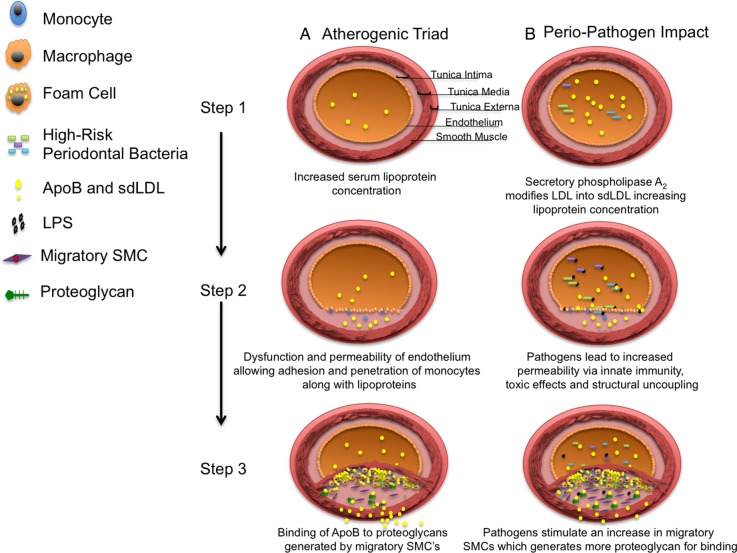
Atherogenic triad in the presence and absence of high-risk periodontal pathogens. Column A: Illustration of the atherogenic triad. (1) Lipoprotein concentration in the serum, with each lipoprotein containing ApoB. (2) Dysfunction and permeability of the endothelium which allow monocytes to adhere to the endothelium and to penetrate into the intima along with lipoproteins. (3) Binding of ApoB to proteoglycans derived from migratory SMCs, as well as conversion of monocytes to macrophages, which become foam cells. Column B: Illustration of how high-risk periodontal pathogens adversely enhance each of the three elements causing greater atherogenesis. (1) In the presence of high-risk pathogens, the concentration of ApoB is increased. (2) In the presence of high-risk pathogens, the endothelial dysfunction and permeability are enhanced by LPS. (3) In the presence of high-risk pathogens, the binding of lipoproteins is enhanced by increased migratory SMCs, which enrich the intima with proteoglycans. ApoB, apolipoprotein B; LDL, low-density lipoprotein; LPS, lipopolysaccharides; sdLDL, small dense LDL; SMCs, smooth muscle cells.

References

    1. Cobe HM. Transitory bacteremia. Oral Surg Oral Med Oral Pathol 1954;7:609–15. 10.1016/0030-4220(54)90071-7 - DOI - PubMed
    1. Li X, Kolltveit KM, Tronstad L, et al. Systemic diseases caused by oral infection. Clin Microbiol Rev 2000;13:547–58. 10.1128/CMR.13.4.547-558.2000 - DOI - PMC - PubMed
    1. Gaetti-Jardim E Jr, Marcelino SL, Feitosa AC, et al. Quantitative detection of periodontopathic bacteria in atherosclerotic plaques from coronary arteries. J Med Microbiol 2009;58(Pt 12):1568–75. 10.1099/jmm.0.013383-0 - DOI - PubMed
    1. Figuero E, Sánchez-Beltrán M, Cuesta-Frechoso S, et al. Detection of periodontal bacteria in atheromatous plaque by nested polymerase chain reaction. J Periodontol 2011;82:1469–77. 10.1902/jop.2011.100719 - DOI - PubMed
    1. Lockhart PB, Bolger AF, Papapanou PN, et al. Periodontal disease and atherosclerotic vascular disease: does the evidence support an independent association?: a scientific statement from the American Heart Association. Circulation 2012;125:2520–44. 10.1161/CIR.0b013e31825719f3 - DOI - PubMed

MeSH terms