


Does vaginal delivery mitigate or strengthen the intergenerational association of overweight and obesity? Findings from the Boston Birth Cohort
- PMID: 27899809
- PMCID: PMC5380521
- DOI: 10.1038/ijo.2016.219
Does vaginal delivery mitigate or strengthen the intergenerational association of overweight and obesity? Findings from the Boston Birth Cohort
Abstract
Background/objectives: The intergenerational association of obesity may be driven by mother-to-newborn transmission of microbiota at birth. Yet cesarean delivery circumvents newborn acquisition of vaginal microbiota, and has been associated with greater childhood adiposity. Here we examined the independent and joint associations of maternal pre-pregnancy body mass index (BMI; kg m-2) and delivery mode with childhood overweight or obesity.
Subjects/methods: We prospectively followed 1441 racially and ethnically diverse mother-child dyads in the Boston Birth Cohort until age 5 years (range: 2.0-8.0 years). We used logistic regression to examine the independent and joint associations of delivery mode (cesarean and vaginal delivery) and pre-pregnancy BMI with childhood overweight or obesity (age-sex-specific BMI ⩾85th percentile).
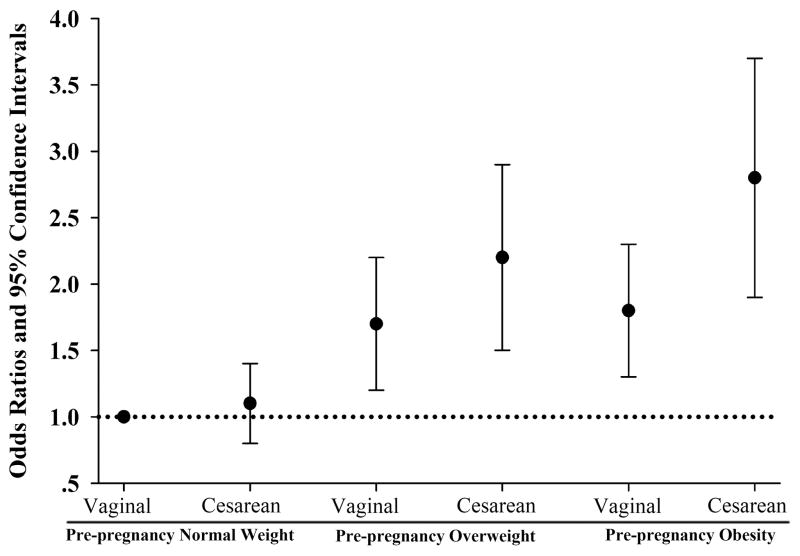
Results: Of 1441 mothers, 961 delivered vaginally and 480 by cesarean. Compared with vaginally delivered children, cesarean delivered children had 1.4 (95% confidence interval (CI) 1.1-1.8) times greater odds of becoming overweight or obese in childhood, after adjustment for maternal age at delivery, race/ethnicity, education, air pollution exposure, pre-pregnancy BMI, pregnancy weight gain and birth weight. Compared with children born vaginally to normal weight mothers, after multivariable adjustment, odds of childhood overweight or obesity were highest in children born by cesarean delivery to obese mothers (odds ratio (OR): 2.8; 95% CI: 1.9-4.1), followed by children born by cesarean delivery to overweight mothers (OR: 2.2; 95% CI: 1.5-3.2), then children born vaginally to obese mothers (OR: 1.8; 95% CI: 1.3-2.6) and finally children born vaginally to overweight mothers (OR: 1.7; 95% CI: 1.2-2.3).
Conclusions: In our racially and ethnically diverse cohort, cesarean delivery and pre-pregnancy overweight and obesity were associated with childhood overweight or obesity. Needed now are prospective studies that integrate measures of the maternal and infant microbiome, and other potentially explanatory covariates, to elucidate the mechanisms driving this association and to explore whether exposure to vaginal microbiota in cesarean delivered newborns may be an innovative strategy to combat the intergenerational cycle of obesity.
Conflict of interest statement
The authors have no conflicts of interest to declare.
Figures
References
-
- Barros FC, Victora CG. Maternal-child health in Pelotas, Rio Grande do Sul State, Brazil: major conclusions from comparisons of the 1982, 1993, and 2004 birth cohorts. Cad Saude Publica. 2008;24(Suppl 3):S461–467. - PubMed
-
- Whitaker RC. Predicting preschooler obesity at birth: the role of maternal obesity in early pregnancy. Pediatrics. 2004;114:e29–36. - PubMed
Publication types
MeSH terms
Grants and funding
LinkOut - more resources
Full Text Sources
Other Literature Sources
Medical
