Review
. 2016 Nov;55(Suppl 2):25-43.
doi: 10.1007/s00394-016-1345-3. Epub 2016 Nov 30.

Controversies about sugars: results from systematic reviews and meta-analyses on obesity, cardiometabolic disease and diabetes

Affiliations
Review

Controversies about sugars: results from systematic reviews and meta-analyses on obesity, cardiometabolic disease and diabetes

Tauseef A Khan et al. Eur J Nutr. 2016 Nov.

Abstract

Fructose-containing sugars are a focus of attention as a public health target for their putative role in obesity and cardiometabolic disease including diabetes. The fructose moiety is singled out to be the primary driver for the harms of sugars due to its unique endocrine signal and pathophysiological role. However, this is only supported by ecological studies, animal models of overfeeding and select human intervention studies with supraphysiological doses or lack of control for energy. The highest level of evidence from systematic reviews and meta-analyses of controlled trials has not shown that fructose-containing sugars behave any differently from other forms of digestible carbohydrates. Fructose-containing sugars can only lead to weight gain and other unintended harms on cardiometabolic risk factors insofar as the excess calories they provide. Prospective cohort studies, which provide the strongest observational evidence, have shown an association between fructose-containing sugars and cardiometabolic risk including weight gain, cardiovascular disease outcomes and diabetes only when restricted to sugar-sweetened beverages and not for sugars from other sources. In fact, sugar-sweetened beverages are a marker of an unhealthy lifestyle and their drinkers consume more calories, exercise less, smoke more and have a poor dietary pattern. The potential for overconsumption of sugars in the form of sugary foods and drinks makes targeting sugars, as a source of excess calories, a prudent strategy. However, sugar content should not be the sole determinant of a healthy diet. There are many other factors in the diet-some providing excess calories while others provide beneficial nutrients. Rather than just focusing on one energy source, we should consider the whole diet for health benefits.

Keywords: Cardiovascular disease; Diabetes; Fructose; Obesity; Overweight; Review; Sugars.


Conflict of interest statement

Compliance with ethical standardsConflict of interestJLS has received research support from the Canadian Institutes of health Research (CIHR), Canadian Diabetes Association (CDA), PSI Foundation, Calorie Control Council, Banting and Best Diabetes Centre (BBDC), American Society for Nutrition (ASN), Dr. Pepper Snapple Group (investigator initiated, unrestricted donation), INC International Nut and Dried Fruit Council, and The Tate and Lyle Nutritional Research Fund at the University of Toronto. He has received travel reimbursement, speaker fees, and/or honoraria from the Canadian Diabetes Association (CDA), Canadian Nutrition Society (CNS), University of Alabama at Birmingham, Abbott Laboratories, Canadian Sugar Institute, Dr. Pepper Snapple Group, The Coca-Cola Company, Dairy Farmers of Canada, Nutrition Foundation of Italy (NFI), C3 Collaborating for Health, WhiteWave Foods, Rippe Lifestyle, mdBriefcase, Alberta Milk, FoodMinds LLC, Memac Ogilvy & Mather LLC, PepsiCo, and Pulse Canada. He has ad hoc consulting arrangements with Winston & Strawn LLP, Perkins Coie LLP, and Tate & Lyle. He is a member of the European Fruit Juice Association Scientific Expert Panel. He is on the Clinical Practice Guidelines Expert Committees of the Canadian Diabetes Association (CDA), European Association for the study of Diabetes (EASD), and Canadian Cardiovascular Society (CCS), as well as an expert writing panel of the American Society for Nutrition (ASN). He serves as an unpaid scientific advisor for the Food, Nutrition, and Safety Program (FNSP) and the Technical Committee on Carbohydrates of the International Life Science Institute (ILSI) North America. He is a member of the International Carbohydrate Quality Consortium (ICQC), Executive Board Member of the Diabetes and Nutrition Study Group (DNSG) of the EASD, and Director of the Toronto 3D Knowledge Synthesis and Clinical Trials foundation. His wife is an employee of Unilever Canada. TAK declares no conflicts of interest.

Figures
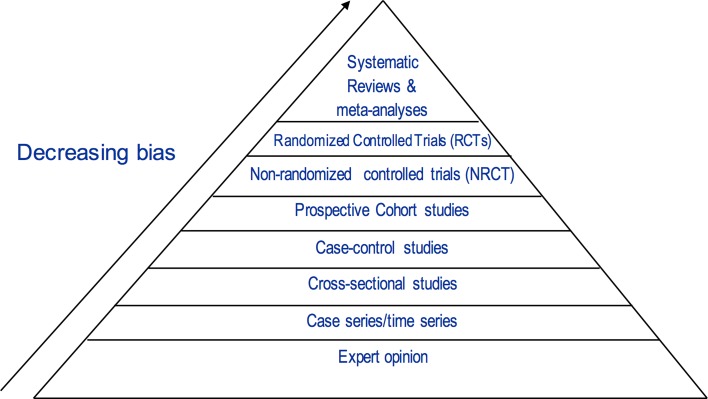
Fig. 1
Fig. 1
Hierarchy of evidence in evidence-based medicine
Fig. 2
Fig. 2
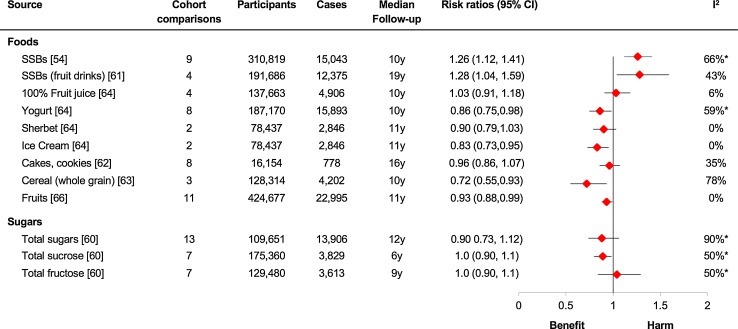
Sources of sugars and incident type 2 diabetes. Adapted from [68]. Summary estimates (diamonds) were derived from pooled risk ratios for comparison of extreme quantiles (the highest level of exposure compared with the lowest level of exposure). The one exception was for cakes and cookies, which compared the highest level of exposure with the middle level of exposure; the reference exposure that was associated with the lowest risk. Data are expressed as risk ratios with 95% CIs. Asterisks indicate significant interstudy heterogeneity as assessed by the Cochran Q statistic and quantified by the I 2 statistic at a significance level of P < .10. SSBs sugar-sweetened beverages
Fig. 3
Fig. 3
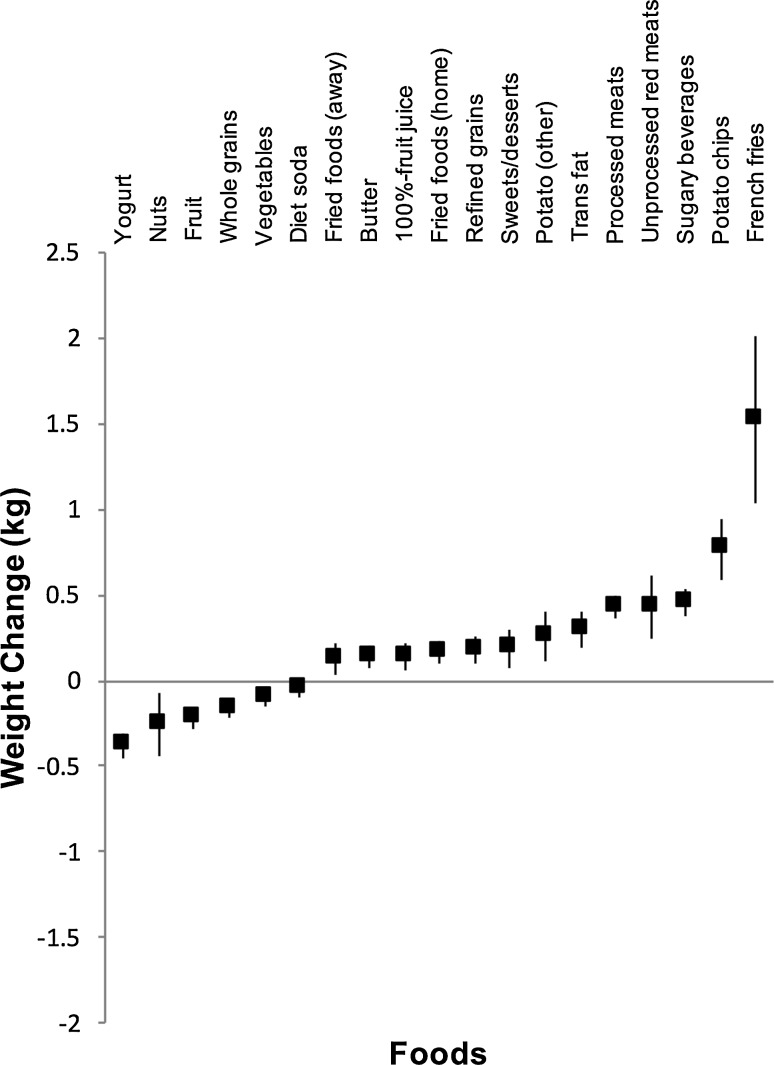
Bodyweight changes (kg) over a 4-year period associated with an increase in the consumption of different food items. Using data from the Nurses’ Health Study, the Nurses’ Health Study II and the Health Professionals Follow-up Study as reported by Mozaffarian et al. [105]. Increased consumption is based on servings/day for all items except trans fat (per cent total energy) and fried foods (servings/week). Data represent pooled mean changes with 95% confidence intervals adjusted for age, baseline body mass index at the start of each 4-year interval, sleep duration and changes in physical activity, smoking, alcohol use, television watching and each additional food item
Fig. 4
Fig. 4
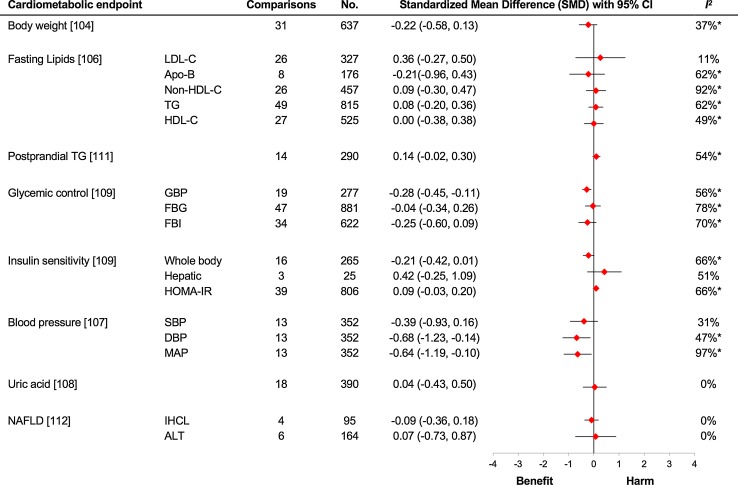
Substitution trials. The meta-analyses are of isocaloric substitution trials, in which fructose was exchanged for other carbohydrate sources under energy-matched conditions. Summary estimates (diamonds) were derived from pooled trial-level data. To allow the summary estimates for each endpoint to be displayed on the same axis, mean differences were transformed to standardized mean differences (SMDs). Pseudo-95% CIs for each transformed SMD were derived directly from the original mean difference and 95% CI. The scales were also flipped for high-density lipoprotein cholesterol (HDL-C), whole-body insulin sensitivity and hepatic insulin sensitivity so that the direction of the effect for benefit or harm was in the same direction as that for the other endpoints. Asterisks indicate significant interstudy heterogeneity as assessed by the Cochran Q statistic and quantified by the I 2 statistic at a significance level of P < .10 (the higher significance level was chosen owing to the poor sensitivity of the test). ALT alanine aminotransferase, Apo-B apolipoprotein B, DBP diastolic blood pressure, FBG fasting blood glucose, FBI fasting blood insulin, GBP glycated blood proteins, HOMA-IR homoeostatic model assessment-insulin resistance, IHCL intrahepatocellular lipid, LDL-C low-density lipoprotein cholesterol, MAP mean arterial pressure, SBP systolic blood pressure, TG triglycerides, No. total number of participants included in the meta-analysis of the controlled dietary trials
Fig. 5
Fig. 5
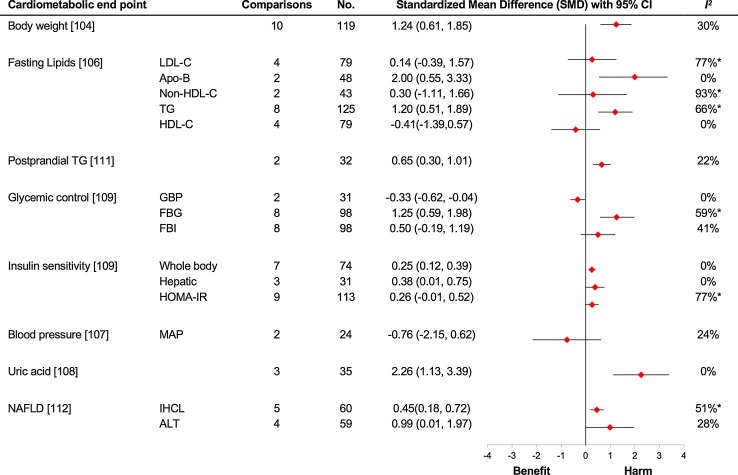
Addition trials. The meta-analyses are of hypercaloric addition trials, in which excess calories from fructose were added to a diet compared with the same diet without the excess calories. Summary estimates (diamonds) were derived from pooled trial-level data. To allow the summary estimates for each endpoint to be displayed on the same axis, mean differences were transformed to standardized mean differences (SMDs). Pseudo-95% CIs for each transformed SMD were derived directly from the original mean difference and 95% CI. The scales were also flipped for high-density lipoprotein cholesterol (HDL-C), whole-body insulin sensitivity and hepatic insulin sensitivity so that the direction of the effect for benefit or harm was in the same direction as that for the other endpoints. Asterisks indicate significant interstudy heterogeneity as assessed by the Cochran Q statistic and quantified by the I 2 statistic at a significance level of P < .10 (the higher significance level was chosen owing to the poor sensitivity of the test). ALT alanine aminotransferase, Apo-B apolipoprotein B, DBP diastolic blood pressure, FBG fasting blood glucose, FBI fasting blood insulin, GBP glycated blood proteins, HOMA-IR homoeostatic model assessment-insulin resistance, IHCL intrahepatocellular lipid, LDL-C low-density lipoprotein cholesterol, MAP mean arterial pressure, SBP systolic blood pressure, TG triglycerides, No. total number of participants included in the meta-analysis of the controlled dietary trials
Fig. 6
Fig. 6
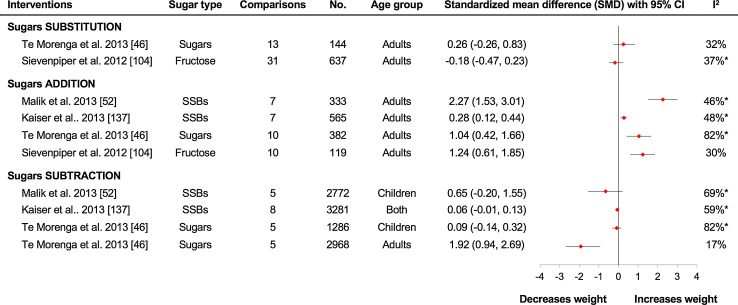
Fructose-containing sugars and weight change in controlled dietary trials. Forest plots of summary estimates from recent meta-analyses of the effect of different fructose-containing sugars interventions on indices of body weight in controlled dietary trials involving children and adults. The meta-analyses were grouped broadly based on the interventions in question: isocaloric sugar substitution interventions, in which sugars were exchanged for other carbohydrate sources under energy-matched conditions; sugar supplementation interventions, in which sugars supplement background diets providing excess energy compared with the background diets alone without the excess energy; and sugar reduction interventions, in which excess from sugars is reduced in background diets compared with the background diets still containing the sugars. Indices of body weight included body weight in Sievenpiper et al. [107], Kaiser et al. [140] and Te Morenga et al. [49]. For isocaloric sugar substitution only; body fatness in Te Morenga et al. [49] for all other comparisons; and BMI z scores in Malik et al. [55]. Summary estimates (diamonds) were derived from pooled trial-level data. To allow the summary estimates for each endpoint to be displayed on the same axis, mean differences (MDs) were transformed to standardized means differences (SMDs). Pseudo-95% confidence intervals (CI) for each transformed SMD were derived directly from the original MD and 95% CI. Asterisks indicate significant interstudy heterogeneity as assessed by the Cochran Q statistic and quantified by the I 2-statistic at a significance level of P < .10. SSBs sugar-sweetened beverages, No. total number of participants included in the meta-analysis of the controlled dietary trials

References

    1. Malhotra A. The dietary advice on added sugar needs emergency surgery. BMJ. 2013;346:f3199. doi: 10.1136/bmj.f3199. - DOI - PubMed
    1. Bray GA. Fructose and risk of cardiometabolic disease. Curr Atheroscler Rep. 2012;14(6):570–578. doi: 10.1007/s11883-012-0276-6. - DOI - PMC - PubMed
    1. Johnson RJ, Nakagawa T, Sanchez-Lozada LG, Shafiu M, Sundaram S, Le M, Ishimoto T, Sautin YY, Lanaspa MA. Sugar, uric acid, and the etiology of diabetes and obesity. Diabetes. 2013;62(10):3307–3315. doi: 10.2337/db12-1814. - DOI - PMC - PubMed
    1. Lustig RH. Response to “Metabolic improvement with fructose restriction: is it the fructose or the weight loss?”. Obesity. 2016 - PubMed
    1. World Health Organisation (2015) WHO calls on countries to reduce sugars intake among adults and children. http://who.int/mediacentre/news/releases/2015/sugar-guideline/en/. Accessed 15 Sep 2015