


Associations between follicular fluid high density lipoprotein particle components and embryo quality among in vitro fertilization patients
- PMID: 27900613
- PMCID: PMC5237431
- DOI: 10.1007/s10815-016-0826-x
Associations between follicular fluid high density lipoprotein particle components and embryo quality among in vitro fertilization patients
Abstract
Purpose: Follicular redox balance is likely to be important for embryo quality during in vitro fertilization (IVF), and the anti-oxidative high desity lipoprotein (HDL) particle is the sole lipoprotein measured in follicular fluid (FF). Therefore, we investigated FF HDL particle components as predictors of embryo quality during IVF.
Methods: Two research follicles collected from each participant were individually tracked, and 103 women having at least one developed embryo were included in the analysis. Concentrations of 15 non-cholesterol HDL particle components and 26 HDL-cholesterol (HDL-C) particle size subfractions were determined. Embryo quality was assessed for embryo cell number, embryo fragmentation, and embryo symmetry. Multivariable Poisson regression with a sandwich variance estimator was used to evaluate associations between HDL particle components and embryo quality, adjusted for covariates.
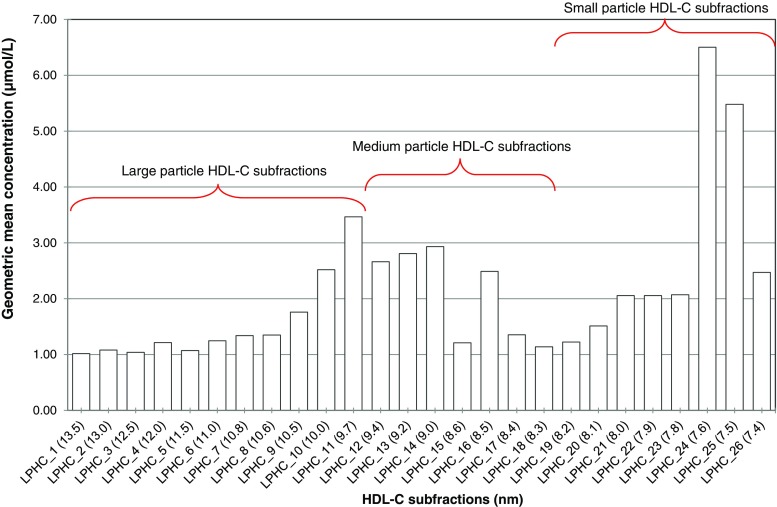
Results: Higher γ-tocopherol concentration was associated with less embryo fragmentation (relative risk [RR] = 4.43; 95 % confidence interval [CI] 1.78, 11.06), and higher apolipoprotein A-1 concentration was associated with full embryo symmetry (RR = 3.92; 95 % CI 1.56, 9.90). Higher concentrations of HDL-C subfractions in the large and medium particle size ranges were associated with poorer embryo quality.
Conclusions: FF HDL lipophilic micronutrients and protein components, as well as HDL-C particle size, may be important predictors of embryo quality during IVF.
Keywords: Embryo cell number (ECN); Embryo fragmentation score (EFS); Embryo symmetry score (ESS); Follicular fluid (FF); High density lipoprotein (HDL); in vitro fertilization (IVF).
Conflict of interest statement
Compliance with ethical standards Study funding Supported by the National Institutes of Health, National Institute on Aging (Grant R21 AG03957–01A2). Conflict of interest The authors declare that they have no conflicts of interest.
Figures
References
-
- Azhar S, Nomoto A, Leers-Sucheta S, Reaven E. Simultaneous induction of an HDL receptor protein (SR-BI) and the selective uptake of HDL-cholesteryl esters in a physiologically relevant steroidogenic cell model. J Lipid Res. 1998;39(8):1616–28. - PubMed
-
- Li XL, Peegel H, Menon KMJ. Regulation of high density lipoprotein receptor messenger ribonucleic acid expression and cholesterol transport in theca-interstitial cells by insulin and human chorionic gonadotropin. Endocrinology. 2001;142(1):174–81. - PubMed
-
- Ansell BJ, Navab M, Hama S, Kamranpour N, Fonarow G, Hough G, et al. Inflammatory/antiinflammatory properties of high-density lipoprotein distinguish patients from control subjects better than high-density lipoprotein cholesterol levels and are favorably affected by simvastatin treatment. Circulation. 2003;108(22):2751–56. doi: 10.1161/01.CIR.0000103624.14436.4B. - DOI - PubMed
MeSH terms
Substances
LinkOut - more resources
Full Text Sources
Other Literature Sources
