. 2016 Nov 30:6:38195.
doi: 10.1038/srep38195.

A SILAC-Based Method for Quantitative Proteomic Analysis of Intestinal Organoids

Affiliations

A SILAC-Based Method for Quantitative Proteomic Analysis of Intestinal Organoids

Alexis Gonneaud et al. Sci Rep. .

Abstract

Organoids have the potential to bridge 3D cell culture to tissue physiology by providing a model resembling in vivo organs. Long-term growing organoids were first isolated from intestinal crypt cells and recreated the renewing intestinal epithelial niche. Since then, this technical breakthrough was applied to many other organs, including prostate, liver, kidney and pancreas. We describe here how to apply a SILAC-based quantitative proteomic approach to measure protein expression changes in intestinal organoids under different experimental conditions. We generated SILAC organoid media that allow organoids to grow and differentiate normally, and confirmed the incorporation of isotopically labelled amino acids. Furthermore, we used a treatment reported to affect organoid differentiation to demonstrate the reproducibility of the quantification using this approach and to validate the identification of proteins that correlate with the inhibition of cellular growth and development. With the combined use of quantitative mass spectrometry, SILAC and organoid culture, we validated this approach and showed that large-scale proteome variations can be measured in an "organ-like" system.


Figures
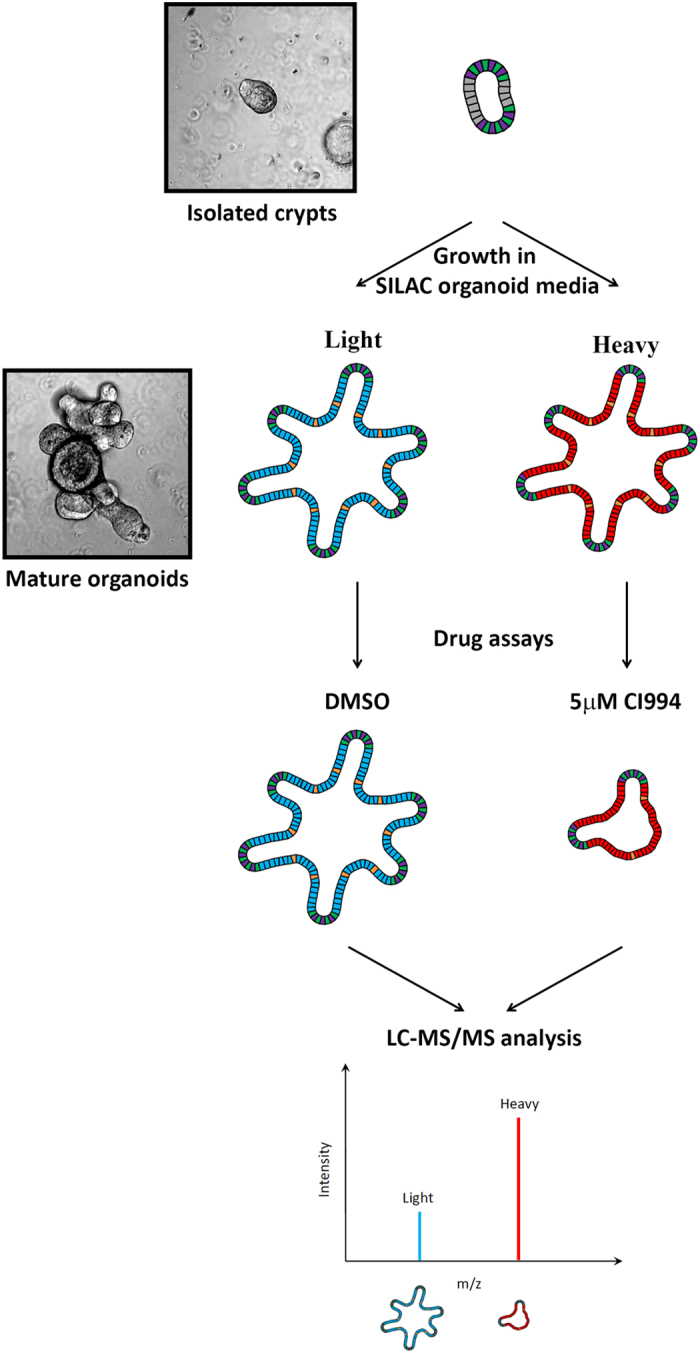
Figure 1
Figure 1. Experimental protocol of SILAC labelling of organoids and mass spectroscopy analysis.
Outline of the SILAC mass spectrometry experimental design for organoids. Intestinal organoids from isolated crypts were grown in different SILAC media for 20 days. Different drugs or treatment can then be used and SILAC allows quantification of changes in protein expression. The effect of a class I HDAC inhibitor, CI994, was used to validate the feasibility of this approach.
Figure 2
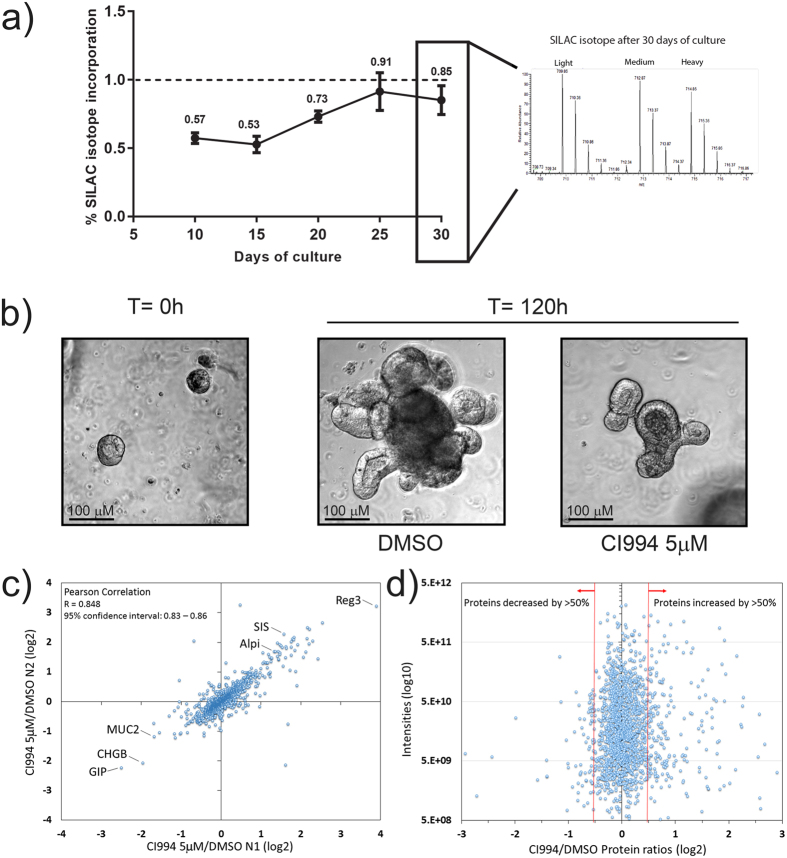
Figure 2. Incorporation of SILAC isotopes in organoid cultures and effect of the class I HDAC inhibitor CI994 on organoid growth and development.
(a) Organoids were grown continuously in SILAC medium containing arginine and lysine with light isotopes of carbon, hydrogen and nitrogen (i.e. 12C14N) (light), or with medium containing L-arginine-13C6-15N4 and L-lysine-13C6-15N2 (heavy). Intestinal organoids were amplified and split every five days. From days 10 to 30, levels of isotope incorporation were evaluated by mass spectrometry analysis by combining equal amounts of organoid lysates prior to sample processing, protein identification and quantification. (b) Micrograph of intestinal organoids before and after 5-day treatment with either DMSO or CI994 at 5 μM. Scale bars represent 100 μm. (c) Evaluation of reproducibility between the different assays: ratios from one experimental repeat (N1) CI994 5 μM/DMSO (x axis) versus the second repeat (N2) CI994 5 μM/DMSO (y axis) for identified proteins. A correlation between N1 and N2 CI994 5 μM/DMSO experiments was observed with Pearson correlation (R = 0.848).(d) The average CI994/DMSO ratios of proteins over the average peptide intensities, to identify proteins with an increase or decrease in expression following treatment with the HDAC inhibitor CI994.
Figure 3
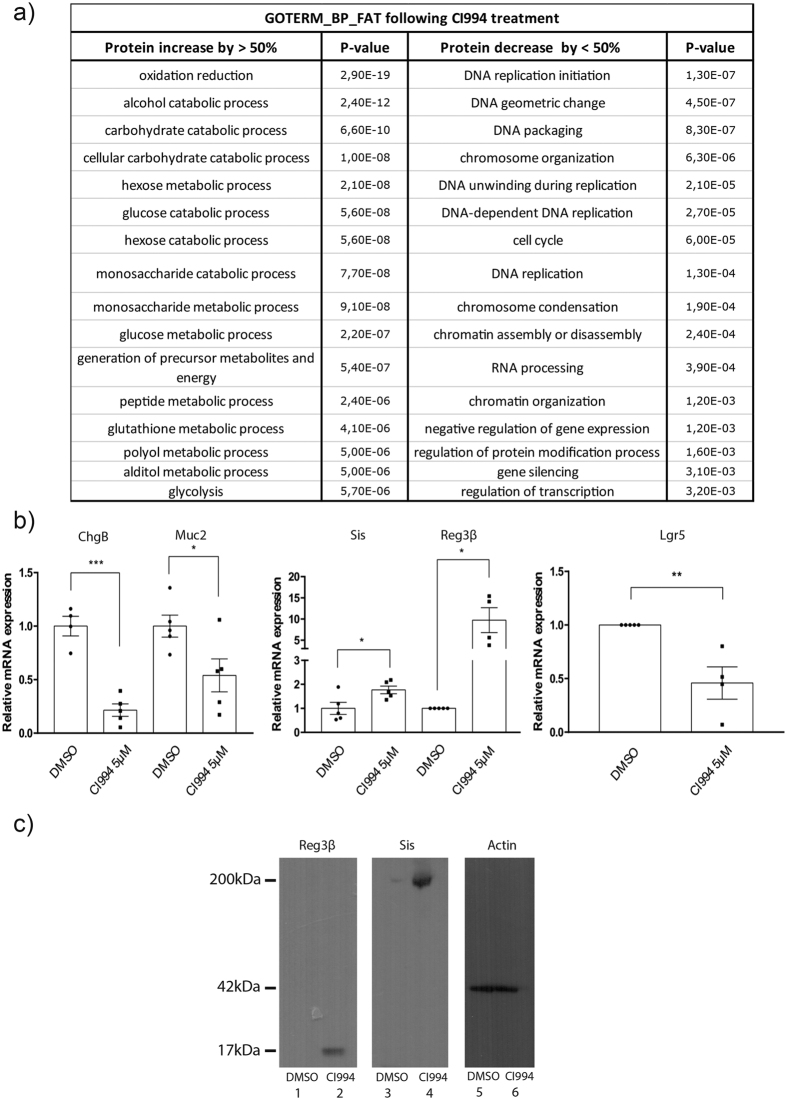
Figure 3. CI994 treatment affects organoid differentiation and development processes.
(a) Gene ontology term enrichment of biological processes for decreased and induced proteins (<50% and >50%) in CI994-treated organoids. Gene ontology analysis was done using the EASE Score from DAVID 2.0 (p-value ≤ 0.05). (b) Total RNAs were isolated from organoids treated with or without CI994. Expression levels of selected genes, namely ChgB, Muc2, Reg3β, Sis and Lgr5 were measured by qPCR in comparison to PBGD expression as a control. Results represent the mean ± S.E.M. (*P < 0.05). Statistical significance was determined by unpaired t tests. (c) Reg3β and Sis protein expression following CI994 treatment was monitored by Western blot analysis, with actin as a protein loading control.

References

    1. Mann M. Functional and quantitative proteomics using SILAC. Nature reviews. Molecular cell biology 7, 952–958, doi: 10.1038/nrm2067 (2006). - DOI - PubMed
    1. Bakalarski C. E. & Kirkpatrick D. S. A Biologist’s Field Guide to Multiplexed Quantitative Proteomics. Molecular & cellular proteomics: MCP 15, 1489–1497, doi: 10.1074/mcp.O115.056986 (2016). - DOI - PMC - PubMed
    1. Dedhia P. H., Bertaux-Skeirik N., Zavros Y. & Spence J. R. Organoid Models of Human Gastrointestinal Development and Disease. Gastroenterology 150, 1098–1112, doi: 10.1053/j.gastro.2015.12.042 (2016). - DOI - PMC - PubMed
    1. Clevers H. Modeling Development and Disease with Organoids. Cell 165, 1586–1597, doi: 10.1016/j.cell.2016.05.082 (2016). - DOI - PubMed
    1. Yin X. et al.. Niche-independent high-purity cultures of Lgr5+ intestinal stem cells and their progeny. Nature methods 11, 106–112, doi: 10.1038/nmeth.2737 (2014). - DOI - PMC - PubMed

Publication types