


Sequencing-based breast cancer diagnostics as an alternative to routine biomarkers
- PMID: 27901097
- PMCID: PMC5128815
- DOI: 10.1038/srep38037
Sequencing-based breast cancer diagnostics as an alternative to routine biomarkers
Abstract
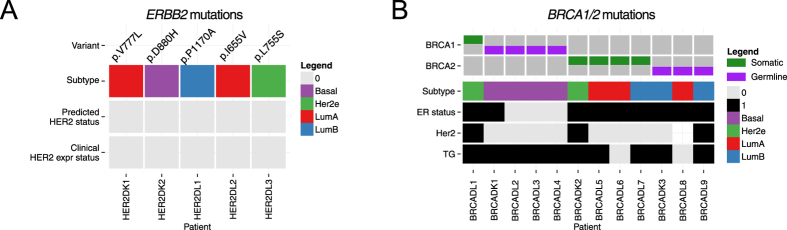
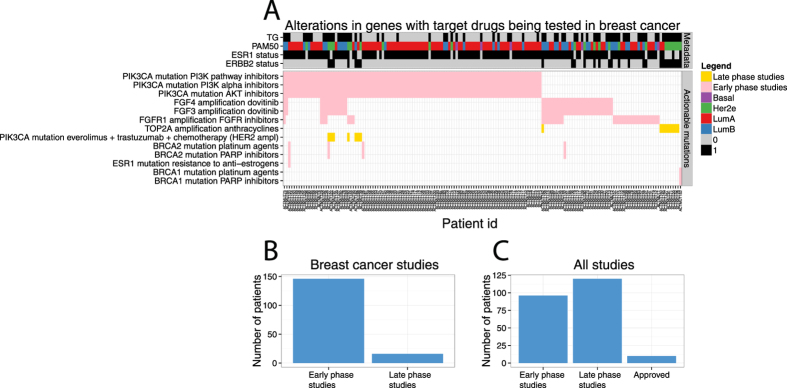
Sequencing-based breast cancer diagnostics have the potential to replace routine biomarkers and provide molecular characterization that enable personalized precision medicine. Here we investigate the concordance between sequencing-based and routine diagnostic biomarkers and to what extent tumor sequencing contributes clinically actionable information. We applied DNA- and RNA-sequencing to characterize tumors from 307 breast cancer patients with replication in up to 739 patients. We developed models to predict status of routine biomarkers (ER, HER2,Ki-67, histological grade) from sequencing data. Non-routine biomarkers, including mutations in BRCA1, BRCA2 and ERBB2(HER2), and additional clinically actionable somatic alterations were also investigated. Concordance with routine diagnostic biomarkers was high for ER status (AUC = 0.95;AUC(replication) = 0.97) and HER2 status (AUC = 0.97;AUC(replication) = 0.92). The transcriptomic grade model enabled classification of histological grade 1 and histological grade 3 tumors with high accuracy (AUC = 0.98;AUC(replication) = 0.94). Clinically actionable mutations in BRCA1, BRCA2 and ERBB2(HER2) were detected in 5.5% of patients, while 53% had genomic alterations matching ongoing or concluded breast cancer studies. Sequencing-based molecular profiling can be applied as an alternative to histopathology to determine ER and HER2 status, in addition to providing improved tumor grading and clinically actionable mutations and molecular subtypes. Our results suggest that sequencing-based breast cancer diagnostics in a near future can replace routine biomarkers.
Figures
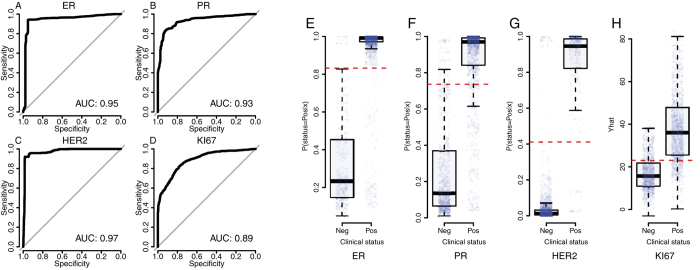
 ) Ki-67 score (% positively stained cells) given RNAseq expression profile data. Dotted red lines indicate optimal decision boundaries as determined by ROC analyses, corresponding to the point on the ROC curve with minimal distance to the top-left corner.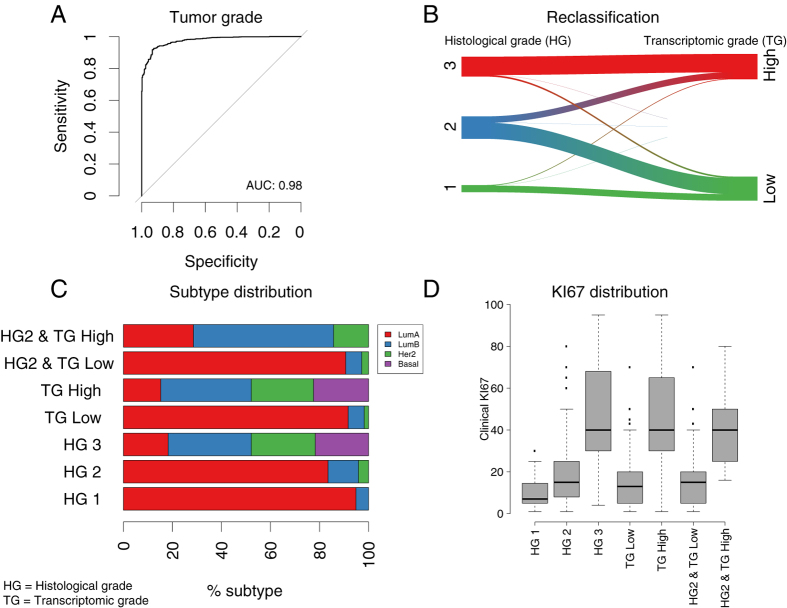
References
-
- Early Breast Cancer Trialists’ Collaborative, G. et al. Effect of radiotherapy after mastectomy and axillary surgery on 10-year recurrence and 20-year breast cancer mortality: meta-analysis of individual patient data for 8135 women in 22 randomised trials. Lancet 383, 2127–2135, doi: 10.1016/S0140-6736(14)60488-8 (2014). - DOI - PMC - PubMed
-
- Early Breast Cancer Trialists’ Collaborative, G. et al. Comparisons between different polychemotherapy regimens for early breast cancer: meta-analyses of long-term outcome among 100,000 women in 123 randomised trials. Lancet 379, 432–444, doi: 10.1016/S0140-6736(11)61625-5 (2012). - DOI - PMC - PubMed
-
- Coates A. S. et al. Tailoring therapies-improving the management of early breast cancer: St Gallen International Expert Consensus on the Primary Therapy of Early Breast Cancer 2015. Annals of oncology: official journal of the European Society for Medical Oncology/ESMO 26, 1533–1546, doi: 10.1093/annonc/mdv221 (2015). - DOI - PMC - PubMed
Publication types
MeSH terms
Substances
LinkOut - more resources
Full Text Sources
Other Literature Sources
Medical
Molecular Biology Databases
Research Materials
Miscellaneous
