


Total laparoscopic right hemicolectomy with 3-step stapled intracorporeal isoperistaltic ileocolic anastomosis for colon cancer: An evaluation of short-term outcomes
- PMID: 27902621
- PMCID: PMC5134775
- DOI: 10.1097/MD.0000000000005538
Total laparoscopic right hemicolectomy with 3-step stapled intracorporeal isoperistaltic ileocolic anastomosis for colon cancer: An evaluation of short-term outcomes
Abstract
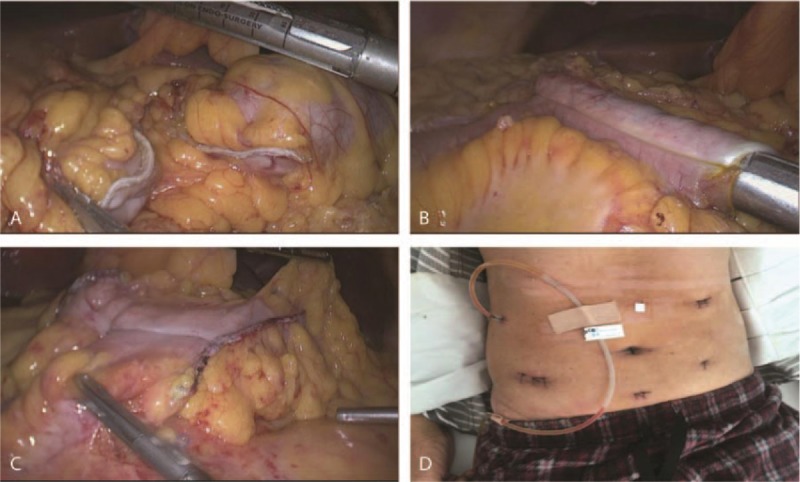
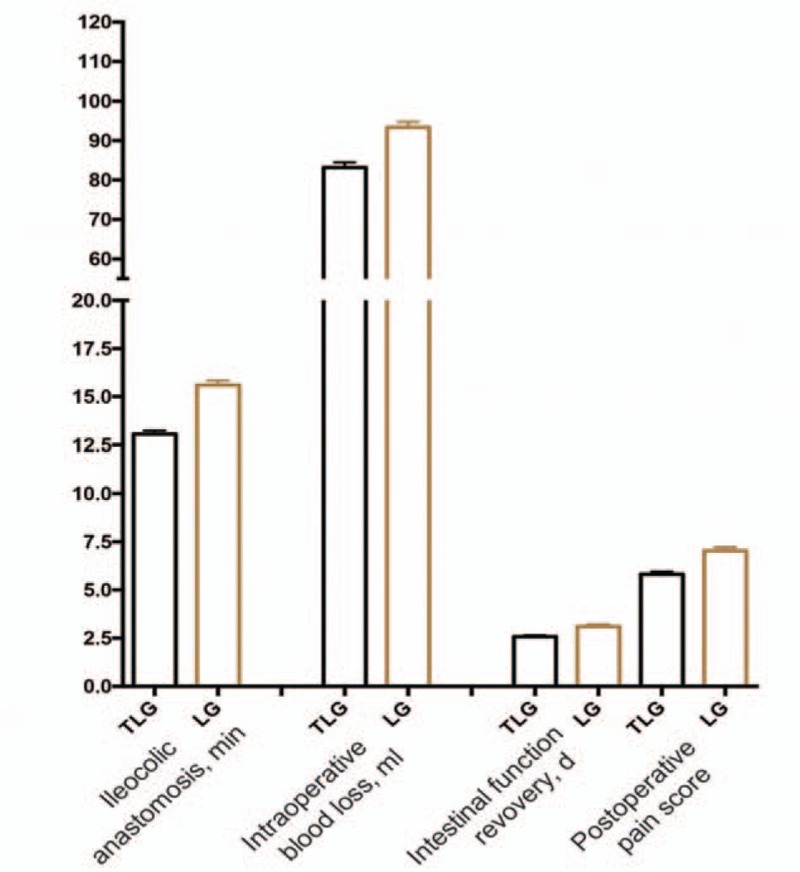
Laparoscopic right hemicolectomy with extracorporeal anastomosis is a widely used procedure; several authors have published their approach to intracorporeal anastomosis. In this paper, we present an approach developed by us and compare short-term outcomes with those of extracorporeal anastomosis in colon cancer patients.Retrospective review of colon cancer patients treated with laparoscopic right hemicolectomy either with intracorporeal anastomosis (TLG group) or extracorporeal anastomosis (LG group) at the Zhangjiagang Hospital Affiliated to Soochow University between January 2011 and October 2015. Operative and postoperative data are compared.Around 85 patients underwent laparoscopic hemicolectomy (56 TLG and 29 LG) during the reference period for this study. Age, gender, body mass index (BMI), stage of cancer, operation time, number of lymph nodes harvested, and length of hospital stay were comparable between the 2 groups. In the TLG group, the ileocolic anastomosis time was significantly shorter (9.9-15.5 minutes vs 13.5-18.2 minutes in LG; P < 0.001), the mean intraoperative blood loss was lower (83.2 mL [range, 56.5-100.5 mL] vs 93.3 mL [range, 75.8 - 110.3 mL]; P < 0.001), the recovery of bowel function was faster (P < 0.001), and the postoperative pain score was lower (P < 0.001) as compared to that in the LG group. Complications in the LG group included wound infection (4 patients), obstruction (1), and postoperative bleeding complications (1); however, only 1 patient developed complication (wound infection) in the TLG group.Total laparoscopic right hemicolectomy with 3-step stapled intracorporeal anastomosis for colon cancer is a safe and reliable procedure. Its advantages include short anastomosis time, less intraoperative blood loss, less postoperative pain, and early bowel function recovery.
Conflict of interest statement
The authors have no funding and conflicts of interest to disclose.
Figures
References
-
- Jacobs M, Verdeja JC, Goldstein HS. Minimally invasive colon resection (laparoscopic colectomy). Surg Laparosc Endosc 1991;1:144–50. - PubMed
-
- Lacy AM, Garcia-Valdecasas JC, Delgado S, et al. Laparoscopy-assisted colectomy versus open colectomy for treatment of non-metastatic colon cancer: a randomised trial. Lancet (London, England) 2002;359:2224–9. - PubMed
-
- Buunen M, Veldkamp R, Hop WC, et al. Survival after laparoscopic surgery versus open surgery for colon cancer: long-term outcome of a randomised clinical trial. Lancet Oncol 2009;10:44–52. - PubMed
-
- Veldkamp R, Kuhry E, Hop WC, et al. Laparoscopic surgery versus open surgery for colon cancer: short-term outcomes of a randomised trial. Lancet Oncol 2005;6:477–84. - PubMed
-
- Stein S, Stulberg J, Champagne B. Learning laparoscopic colectomy during colorectal residency: what does it take and how are we doing? Surg Endosc 2012;26:488–92. - PubMed
MeSH terms
LinkOut - more resources
Full Text Sources
Other Literature Sources
