


High prevalence of Strongyloides stercoralis in school-aged children in a rural highland of north-western Ethiopia: the role of intensive diagnostic work-up
- PMID: 27903301
- PMCID: PMC5131444
- DOI: 10.1186/s13071-016-1912-8
High prevalence of Strongyloides stercoralis in school-aged children in a rural highland of north-western Ethiopia: the role of intensive diagnostic work-up
Abstract
Background: Soil-transmitted helminthiases (hookworms, Ascaris lumbricoides and Trichuris trichiura) are extremely prevalent in school-aged children living in poor sanitary conditions. Recent epidemiological data suggest that Strongyloides stercoralis is highly unreported. However, accurate data are essential for conducting interventions aimed at introducing control and elimination programmes.
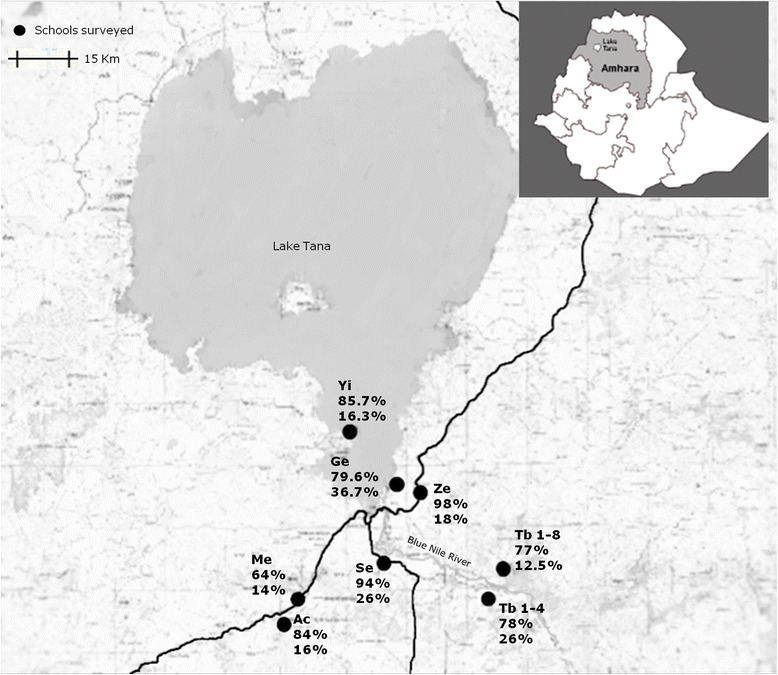
Methods: We conducted a cross-sectional survey of 396 randomly selected school-aged children in Amhara region in rural area in north-western Ethiopia, to assess the prevalence of S. stercoralis and other intestinal helminths. We examined stools using three techniques: conventional stool concentration; and two S. stercoralis-specific methods, i.e. the Baermann technique and polymerase chain reaction. The diagnostic accuracy of these three methods was then compared.
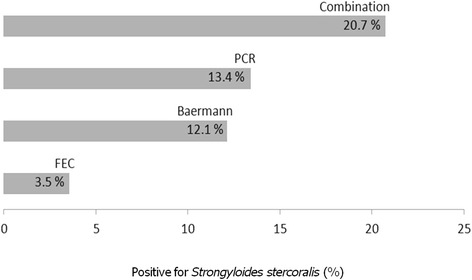
Results: There was an overall prevalence of helminths of 77.5%, with distribution differing according to school setting. Soil-transmitted helminths were recorded in 69.2%. Prevalence of S. stercoralis and hookworm infection was 20.7 and 54.5%, respectively, and co-infection was detected in 16.3% of cases. Schistosoma mansoni had a prevalence of 15.7%. Prevalence of S. stercoralis was shown 3.5% by the conventional method, 12.1% by the Baermann method, and 13.4% by PCR, which thus proved to be the most sensitive.
Conclusions: Our results suggest that S. stercoralis could be overlooked and neglected in Ethiopia, if studies of soil-transmitted helminths rely on conventional diagnostic techniques alone. A combination of molecular and stool microscopy techniques yields a significantly higher prevalence. In view of the fact that current control policies for triggering drug administration are based on parasite prevalence levels, a comprehensive diagnostic approach should instead be applied to ensure comprehensive control of helminth infections.
Keywords: Baermann technique; Ethiopia; Molecular techniques; Neglected; Soil-transmitted helminths; Strongyloides stercoralis.
Figures
References
-
- WHO . Investing to overcome the global impact of neglected tropical diseases: third WHO report on neglected tropical diseases. Geneva: World Health Organization; 2015.
-
- WHO . Accelerating work to overcome the global impact of neglected tropical diseases-A roadmap for implementation. Geneva: World Health Organization; 2012.
Publication types
MeSH terms
Supplementary concepts
LinkOut - more resources
Full Text Sources
Other Literature Sources
