


Assessment of cardiovascular risk in Tunisia: applying the Framingham risk score to national survey data
- PMID: 27903556
- PMCID: PMC5168513
- DOI: 10.1136/bmjopen-2015-009195
Assessment of cardiovascular risk in Tunisia: applying the Framingham risk score to national survey data
Abstract
Objective: This paper aims to assess the socioeconomic determinants of a high 10 year cardiovascular risk in Tunisia.
Setting: We used a national population based cross sectional survey conducted in 2005 in Tunisia comprising 7780 subjects. We applied the non-laboratory version of the Framingham equation to estimate the 10 year cardiovascular risk.
Participants: 8007 participants, aged 35-74 years, were included in the sample but effective exclusion of individuals with cardiovascular diseases and cancer resulted in 7780 subjects (3326 men and 4454 women) included in the analysis.
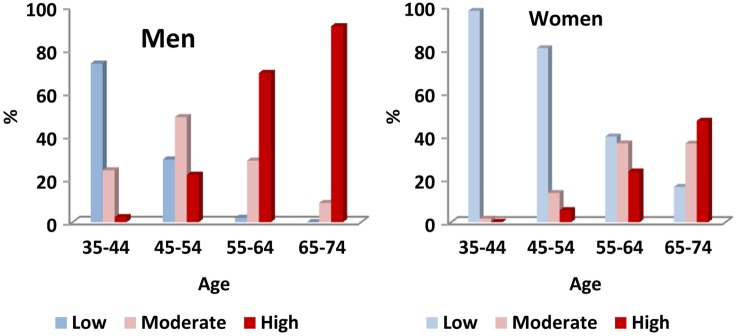
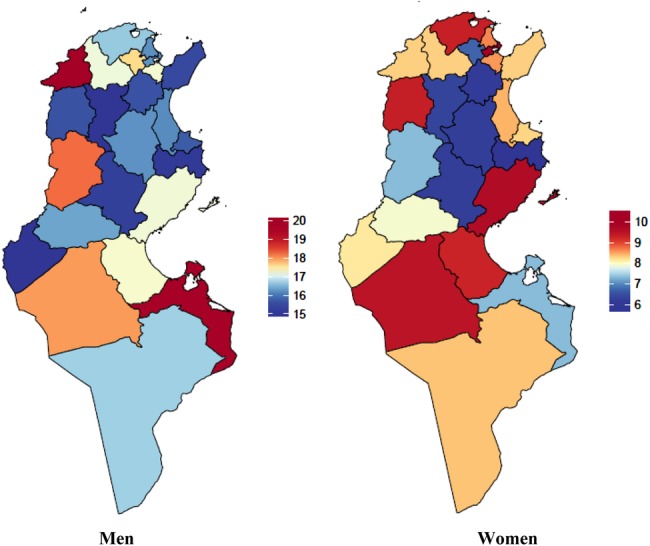
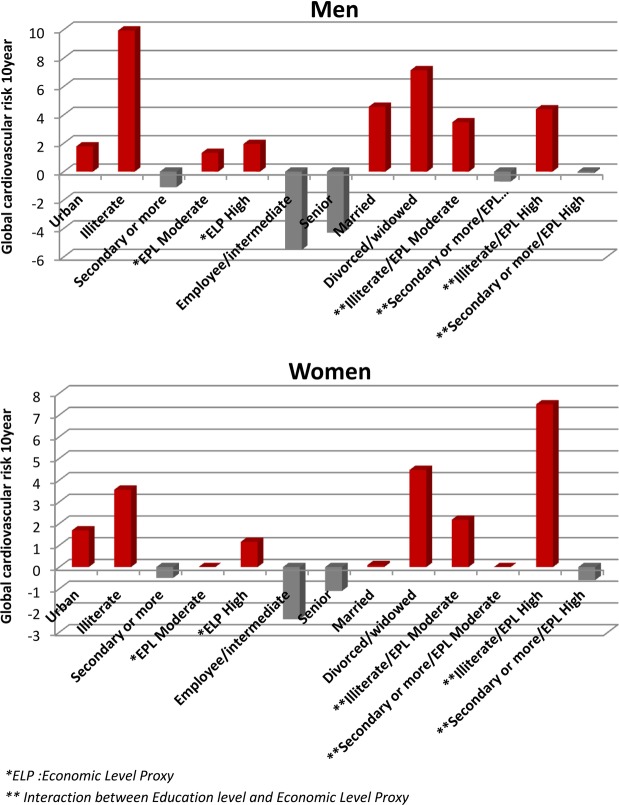
Results: Mean age was 48.7 years. Women accounted for 50.5% of participants. According to the Framingham equation, 18.1% (17.25-18.9%) of the study population had a high risk (≥20% within 10 years). The gender difference was striking and statistically significant: 27.2% (25.7-28.7%) of men had a high risk, threefold higher than women (9.7%; 8.8-10.5%). A higher 10 year global cardiovascular risk was associated with social disadvantage in men and women; thus illiterate and divorced individuals, and adults without a professional activity had a significantly higher risk of developing a cardiovascular event in 10 years. Illiterate men were at higher risk than those with secondary and higher education (OR=7.01; 5.49 to 9.14). The risk in illiterate women was more elevated (OR=13.57; 7.58 to 24.31). Those living in an urban area had a higher risk (OR=1.45 (1.19 to 1.76) in men and OR=1.71 (1.35 to 2.18) in women).
Conclusions: The 10 year global cardiovascular risk in the Tunisian population is already substantially high, affecting almost a third of men and 1 in 10 women, and concentrated in those more socially disadvantaged.
Keywords: 10-year global cardiovascular risk; CARDIOLOGY; EPIDEMIOLOGY; non–laboratory Framingham model; socio-economic determinants.
Published by the BMJ Publishing Group Limited. For permission to use (where not already granted under a licence) please go to http://www.bmj.com/company/products-services/rights-and-licensing/.
Conflict of interest statement
Conflicts of Interest: None declared.
Figures
Similar articles
-
Gender obesity inequities are huge but differ greatly according to environment and socio-economics in a North African setting: a national cross-sectional study in Tunisia.PLoS One. 2012;7(10):e48153. doi: 10.1371/journal.pone.0048153. Epub 2012 Oct 31. PLoS One. 2012. PMID: 23118943 Free PMC article.
-
Framingham-Based Cardiovascular Risk Estimates Among People With Episodic Migraine in the US Population: Results from the American Migraine Prevalence and Prevention (AMPP) Study.Headache. 2017 Nov;57(10):1507-1521. doi: 10.1111/head.13179. Epub 2017 Oct 9. Headache. 2017. PMID: 28990165
-
Persistent high prevalence of cardiovascular risk factors in the urban middle class in India: Jaipur Heart Watch-5.J Assoc Physicians India. 2012 Mar;60:11-6. J Assoc Physicians India. 2012. PMID: 22799108
-
Comparison of Nonblood-Based and Blood-Based Total CV Risk Scores in Global Populations.Glob Heart. 2016 Mar;11(1):37-46.e2. doi: 10.1016/j.gheart.2015.12.003. Glob Heart. 2016. PMID: 27102021
-
Cardio-metabolic risk factors in Tunisia: state of the art.Intern Emerg Med. 2020 Jun;15(4):537-542. doi: 10.1007/s11739-019-02164-7. Epub 2019 Aug 6. Intern Emerg Med. 2020. PMID: 31388892 Review.
Cited by
-
Cardiovascular risk factors in the Maghreb. A systematic review.Tunis Med. 2021 Jan;99(1):120-128. Tunis Med. 2021. PMID: 33899179 Free PMC article.
-
Explaining income-related inequalities in cardiovascular risk factors in Tunisian adults during the last decade: comparison of sensitivity analysis of logistic regression and Wagstaff decomposition analysis.Int J Equity Health. 2019 Nov 15;18(1):177. doi: 10.1186/s12939-019-1047-6. Int J Equity Health. 2019. PMID: 31730469 Free PMC article.
-
Implementation of the WHO Framework Convention on Tobacco Control in Tunisia: Progress and challenges.Tob Prev Cessat. 2020 Dec 22;6:72. doi: 10.18332/tpc/130476. eCollection 2020. Tob Prev Cessat. 2020. PMID: 33426382 Free PMC article.
-
Food consumption in Tunisian university students and its association with sociodemographic characteristics and lifestyle behaviours.Public Health Nutr. 2021 Oct;24(15):4949-4964. doi: 10.1017/S1368980020004942. Epub 2020 Dec 15. Public Health Nutr. 2021. PMID: 33317661 Free PMC article.
-
Sarcopenia in cancer survivors is associated with increased cardiovascular disease risk.Support Care Cancer. 2018 Jul;26(7):2313-2321. doi: 10.1007/s00520-018-4083-7. Epub 2018 Feb 6. Support Care Cancer. 2018. PMID: 29411130
References
-
- National Institute of Statistics. Yearly Statistics Report No 55. National Institute of Statistics: Tunisia, 2012.
-
- Ben Romdhane H, Khaldi R, Oueslati A et al. . Transition épidémiologique et transition alimentaire et nutritionnelle en Tunisie. Options Méditerranéennes 2002;41:278.
-
- National Public Health Institute. Deaths registry. Tunisia, 2013. http://www.insp.rns.tn/index.php?option=com_content&view=section&id=26&I...
-
- Ben Romdhane H. Coronary heart diseases: the epidemic and its determinants. In: vol I: the risk factors Tunis: National Public Health Institute Press, 2001.
Publication types
MeSH terms
LinkOut - more resources
Full Text Sources
Other Literature Sources
