Review
. 2016 Dec 12;213(13):2835-2840.
doi: 10.1084/jem.20161462. Epub 2016 Nov 30.

What does PD-L1 positive or negative mean?

Affiliations
Review

What does PD-L1 positive or negative mean?

Antoni Ribas et al. J Exp Med. .

Abstract

Expression of the programmed death-1 (PD-1) ligand 1 (PD-L1) is used to select patients and analyze responses to anti-PD-1/L1 antibodies. The expression of PD-L1 is regulated in different ways, which leads to a different significance of its presence or absence. PD-L1 positivity may be a result of genetic events leading to constitutive PD-L1 expression on cancer cells or inducible PD-L1 expression on cancer cells and noncancer cells in response to a T cell infiltrate. A tumor may be PD-L1 negative because it has no T cell infiltrate, which may be reversed with an immune response. Finally, a tumor that is unable to express PD-L1 because of a genetic event will always be negative for PD-L1 on cancer cells.


Figures

Figure 1.
Figure 1.
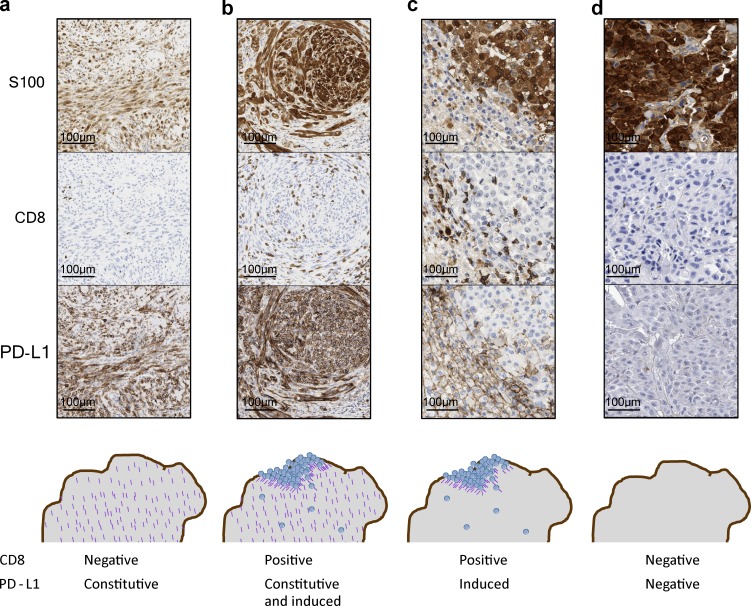
Examples of different mechanisms leading to PD-L1 positivity or negativity. (a) Constitutive PD-L1 expression but no T cell infiltrate, resulting in constitutive PD-L1 expression in all cancer cells. (b) Constitutive PD-L1 expression with additional inducible expression by a T cell infiltrate, resulting in both constitutive and inducible PD-L1 expression in cancer cells. (c) Adaptive immune resistance, leading to reactive PD-L1 expression induced in cells that are at the site of a CD8+ T cell infiltrate. (d) PD-L1–negative tumor caused by absent T cell infiltration. By IHC, a tumor with JAK1/2 loss of function mutations and genetically negative for inducible PD-L1 would look similar without a CD8 T cell infiltrate (because of a lack of chemokine production in response to interferon-γ) and no PD-L1 expression in the tumor.

References

    1. Akbay E.A., Koyama S., Carretero J., Altabef A., Tchaicha J.H., Christensen C.L., Mikse O.R., Cherniack A.D., Beauchamp E.M., Pugh T.J., et al. . 2013. Activation of the PD-1 pathway contributes to immune escape in EGFR-driven lung tumors. Cancer Discov. 3:1355–1363. 10.1158/2159-8290.CD-13-0310 - DOI - PMC - PubMed
    1. Ansell S.M., Lesokhin A.M., Borrello I., Halwani A., Scott E.C., Gutierrez M., Schuster S.J., Millenson M.M., Cattry D., Freeman G.J., et al. . 2015. PD-1 blockade with nivolumab in relapsed or refractory Hodgkin’s lymphoma. N. Engl. J. Med. 372:311–319. 10.1056/NEJMoa1411087 - DOI - PMC - PubMed
    1. Blank C., Brown I., Peterson A.C., Spiotto M., Iwai Y., Honjo T., and Gajewski T.F.. 2004. PD-L1/B7H-1 inhibits the effector phase of tumor rejection by T cell receptor (TCR) transgenic CD8+ T cells. Cancer Res. 64:1140–1145. 10.1158/0008-5472.CAN-03-3259 - DOI - PubMed
    1. Casey S.C., Tong L., Li Y., Do R., Walz S., Fitzgerald K.N., Gouw A.M., Baylot V., Gütgemann I., Eilers M., and Felsher D.W.. 2016. MYC regulates the antitumor immune response through CD47 and PD-L1. Science. 352:227–231. 10.1126/science.aac9935 - DOI - PMC - PubMed
    1. Cha E., Klinger M., Hou Y., Cummings C., Ribas A., Faham M., and Fong L.. 2014. Improved survival with T cell clonotype stability after anti-CTLA-4 treatment in cancer patients. Sci. Transl. Med. 6:238ra70 10.1126/scitranslmed.3008211 - DOI - PMC - PubMed

Publication types