Review
. 2016 Dec 1;219(Pt 23):3676-3683.
doi: 10.1242/jeb.140376.

A unified perspective on ankle push-off in human walking

Affiliations
Review

A unified perspective on ankle push-off in human walking

Karl E Zelik et al. J Exp Biol. .

Abstract

Muscle-tendon units about the ankle joint generate a burst of positive power during the step-to-step transition in human walking, termed ankle push-off, but there is no scientific consensus on its functional role. A central question embodied in the biomechanics literature is: does ankle push-off primarily contribute to leg swing, or to center of mass (COM) acceleration? This question has been debated in various forms for decades. However, it actually presents a false dichotomy, as these two possibilities are not mutually exclusive. If we ask either question independently, the answer is the same: yes! (1) Does ankle push-off primarily contribute to leg swing acceleration? Yes. (2) Does ankle push-off primarily contribute to COM acceleration? Yes. Here, we summarize the historical debate, then synthesize the seemingly polarized perspectives and demonstrate that both descriptions are valid. The principal means by which ankle push-off affects COM mechanics is by a localized action that increases the speed and kinetic energy of the trailing push-off limb. Because the limb is included in body COM computations, this localized segmental acceleration also accelerates the COM, and most of the segmental energy change also appears as COM energy change. Interpretation of ankle mechanics should abandon an either/or contrast of leg swing versus COM acceleration. Instead, ankle push-off should be interpreted in light of both mutually consistent effects. This unified perspective informs our fundamental understanding of the role of ankle push-off, and has important implications for the design of clinical interventions (e.g. prostheses, orthoses) intended to restore locomotor function to individuals with disabilities.

Keywords: Bipedal walking; Double support; Gait analysis; Joint kinetics; Leg swing; Work and energy.


Conflict of interest statement

The authors declare no competing or financial interests.

Figures
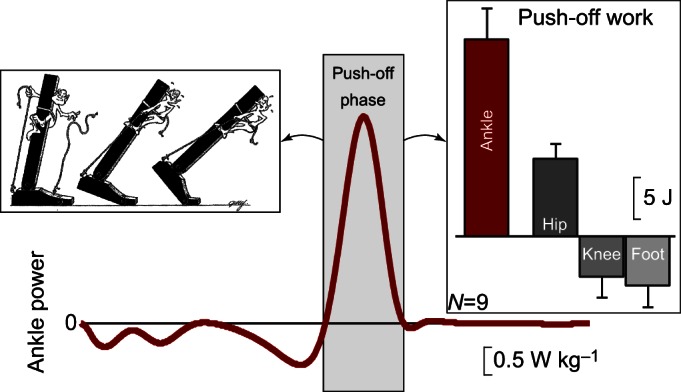
Fig. 1.
Fig. 1.
Ankle power and work. Ankle power for one leg plotted across a full stride cycle from foot contact to subsequent ipsilateral foot contact. Left inset: cartoon adapted from Inman et al. (1981) depicts ankle push-off behavior. Right inset: ankle push-off work versus the push-off work performed by other ipsilateral lower-limb joints and segments (hip, knee, foot). Work values were obtained by computing the time integral of power during push-off phase. Inter-subject power and work means, and work standard deviations are depicted for walking at 1.4 m s−1, based on 6-degree-of-freedom joint mechanics analysis (N=9; Zelik et al., 2015a).
Fig. 2.
Fig. 2.
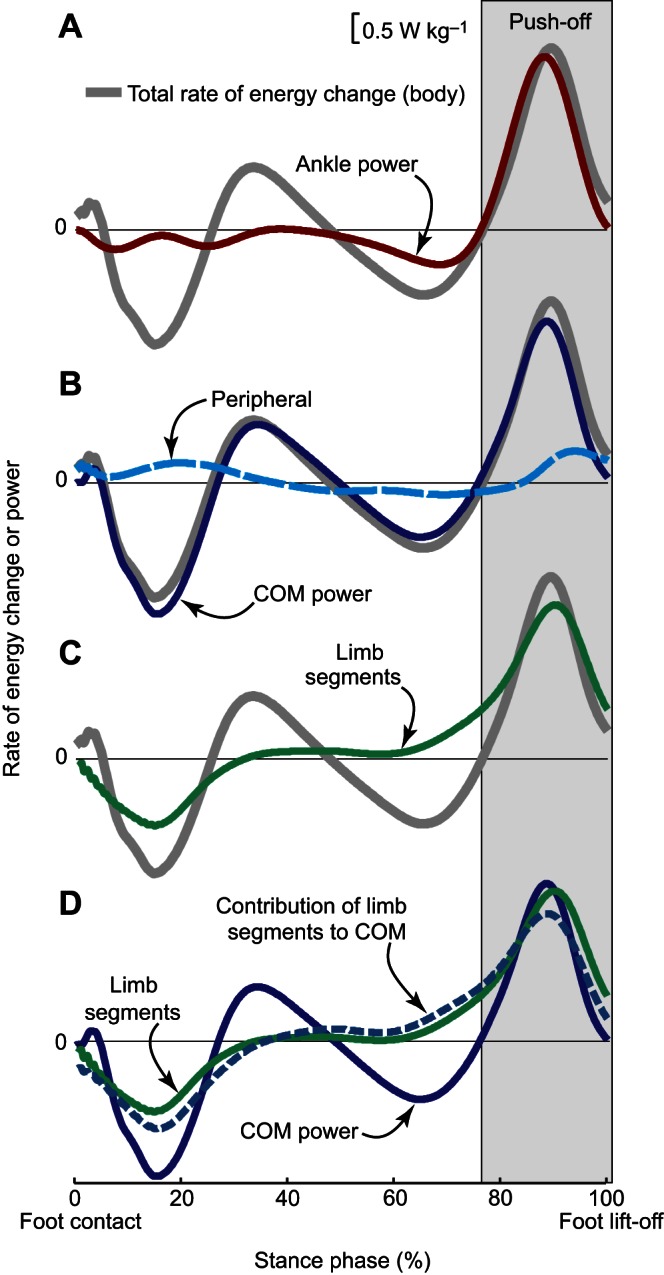
Rate of energy change (Ė) and power (work rate) estimates for an individual limb during human walking. The integrated area under each curve during Push-off (light gray box) represents the magnitude of Push-off work or energy change. (A) Ankle power (red line) overlaid on Total Ė [gray line, due to motion of and about the body's center of mass (COM)]. (B) The majority of Total Ė during Push-off is attributable to COM Ė (blue line, defined here as the rate of energy change due to push-off limb power production), and smaller contributions are from Peripheral Ė (due to segmental motion relative to the COM; dashed cyan line). (C) The majority of Total Ė during Push-off is also attributable to segmental Ė from the push-off limb (green line). (D) The contribution of limb segmental Ė (green line) to overall COM Ė (solid blue line) is shown here as a dashed blue line. During Push-off, the majority of the limb Ė goes into this contribution, which in turn accounts for the majority of COM Ė. Data depicted are inter-subject means at 1.4 m s−1 (N=9; Zelik et al., 2015a).

References

    1. Adamczyk P. G. and Kuo A. D. (2009). Redirection of center-of-mass velocity during the step-to-step transition of human walking. J. Exp. Biol. 212, 2668-2678. 10.1242/jeb.027581 - DOI - PMC - PubMed
    1. Adamczyk P. G. and Kuo A. D. (2013). Mechanical and energetic consequences of rolling foot shape in human walking. J. Exp. Biol. 216, 2722-2731. 10.1242/jeb.082347 - DOI - PMC - PubMed
    1. Adamczyk P. G. and Kuo A. D. (2015). Mechanisms of Gait Asymmetry Due to Push-Off Deficiency in Unilateral Amputees. IEEE Trans. Neural Syst. Rehabil. Eng. 23, 776-785. 10.1109/TNSRE.2014.2356722 - DOI - PMC - PubMed
    1. Adamczyk P. G., Collins S. H. and Kuo A. D. (2006). The advantages of a rolling foot in human walking. J. Exp. Biol. 209, 3953 10.1242/jeb.02455 - DOI - PubMed
    1. Baker R. (2007). The history of gait analysis before the advent of modern computers. Gait Posture 26, 331-342. 10.1016/j.gaitpost.2006.10.014 - DOI - PubMed

Publication types