. 2017 Jan 31;91(4):e02181-16.
doi: 10.1128/JVI.02181-16. Print 2017 Feb 15.

Inhibition of an Aquatic Rhabdovirus Demonstrates Promise of a Broad-Spectrum Antiviral for Use in Aquaculture

Affiliations

Inhibition of an Aquatic Rhabdovirus Demonstrates Promise of a Broad-Spectrum Antiviral for Use in Aquaculture

Bethany F Balmer et al. J Virol. .

Abstract

Many enveloped viruses cause devastating disease in aquaculture, resulting in significant economic impact. LJ001 is a broad-spectrum antiviral compound that inhibits enveloped virus infections by specifically targeting phospholipids in the lipid bilayer via the production of singlet oxygen (1O2). This stabilizes positive curvature and decreases membrane fluidity, which inhibits virus-cell membrane fusion during viral entry. Based on data from previous mammalian studies and the requirement of light for the activation of LJ001, we hypothesized that LJ001 may be useful as a preventative and/or therapeutic agent for infections by enveloped viruses in aquaculture. Here, we report that LJ001 was more stable with a prolonged inhibitory half-life at relevant aquaculture temperatures (15°C), than in mammalian studies at 37°C. When LJ001 was preincubated with our model virus, infectious hematopoietic necrosis virus (IHNV), infectivity was significantly inhibited in vitro (using the epithelioma papulosum cyprini [EPC] fish cell line) and in vivo (using rainbow trout fry) in a dose-dependent and time-dependent manner. While horizontal transmission of IHNV in a static cohabitation challenge model was reduced by LJ001, transmission was not completely blocked at established antiviral doses. Therefore, LJ001 may be best suited as a therapeutic for aquaculture settings that include viral infections with lower virus-shedding rates than IHNV or where higher viral titers are required to initiate infection of naive fish. Importantly, our data also suggest that LJ001-inactivated IHNV elicited an innate immune response in the rainbow trout host, making LJ001 potentially useful for future vaccination approaches.

Importance: Viral diseases in aquaculture are challenging because there are few preventative measures and/or treatments. Broad-spectrum antivirals are highly sought after and studied because they target common components of viruses. In our studies, we used LJ001, a broad-spectrum antiviral compound that specifically inhibits enveloped viruses. We used the fish rhabdovirus infectious hematopoietic necrosis virus (IHNV) as a model to study aquatic enveloped virus diseases and their inhibition. We demonstrated inhibition of IHNV by LJ001 both in cell culture as well as in live fish. Additionally, we showed that LJ001 inhibited the transmission of IHNV from infected fish to healthy fish, which lays the groundwork for using LJ001 as a possible therapeutic for aquatic viruses. Our results also suggest that virus inactivated by LJ001 induces an immune response, showing potential for future preventative (e.g., vaccine) applications.

Keywords: antiviral; aquaculture; aquatic virus; broad spectrum; enveloped; membrane fusion; rhabdovirus; virus.


Figures

FIG 1
FIG 1
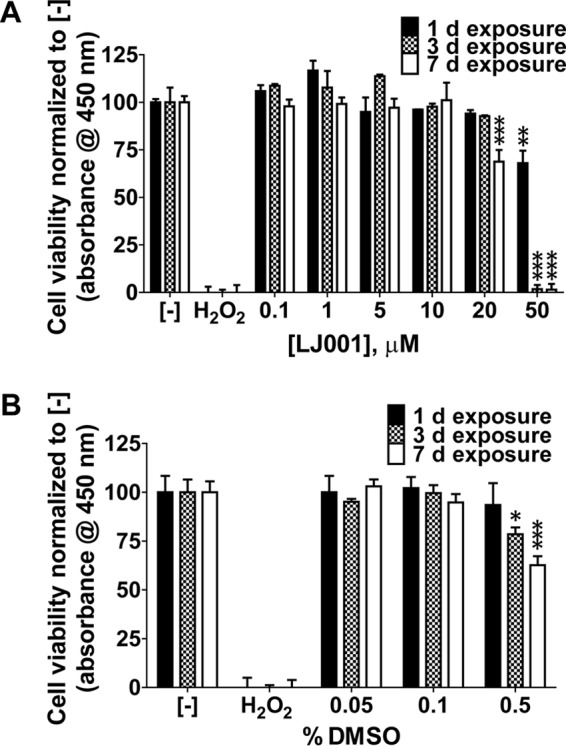
LJ001 is not cytotoxic at antiviral concentrations. EPC cells were exposed to increasing concentrations of LJ001 (A) or the vehicle control (DMSO) (B) for 1, 3, and 7 days in the presence of light at the time of addition. Formazan dye absorbance was measured at 450 nm. Positive-control wells were exposed to hydrogen peroxide (40 mM final concentration) for 1 day. The negative control (−) is no drug exposure. (A) Exposure to 0 to 50 μM LJ001 (50 μM LJ001 with 0.5% DMSO, 10 μM LJ001 with 0.1% DMSO, and 1.0 μM LJ001 with 0.01% DMSO). There was no cytotoxicity to EPC cells at up to 10 μM LJ001. Toxicity occurred when cells were exposed to 20 μM LJ001 for 7 days and 50 μM LJ001 at all time points. Data represent mean cell viabilities ± standard errors (n = 3) normalized to values for no treatment (negative control). **, P < 0.01; ***, P < 0.001. (B) Exposure to 0 to 0.5% DMSO. No cytotoxic effects were observed at concentrations of up to 0.1%. Cytotoxic effects were detected after exposure to 0.5% DMSO at 3 and 7 days. Data represent mean cell viabilities ± standard errors (n = 3) normalized to values for no treatment. *, P < 0.05; ***, P < 0.001.
FIG 2
FIG 2
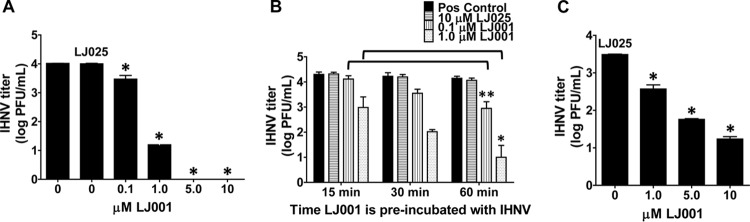
LJ001 blocks IHNV infection in vitro. (A) Concentrations of up to 10 μM LJ001 (or 10 μM LJ025) were preincubated with 1 × 10⁴ PFU/ml IHNV for 30 min during exposure to light. The IHNV titer was determined via a plaque assay. There was complete inhibition of infection with 5 and 10 μM LJ001, substantial and significant inhibition with 1.0 μM LJ001, and mild but significant inhibition with 0.1 μM LJ001 compared to the positive control (IHNV with no LJ001 treatment). The negative-control molecule LJ025 had no inhibitory effect. Mock controls had negative titers. Data represent mean IHNV titers ± standard errors (n = 3). *, P < 0.001. (B) LJ001 was preincubated with the virus for 15, 30, and 60 min. Inhibition was enhanced with an increased time of exposure of LJ001 to the virus. The difference in inhibition was significant at between 15 min and 60 min for both 1.0 μM and 0.1 μM LJ001. Mock controls had negative titers. Data represent mean IHNV titers ± standard errors (n = 4).*, P < 0.05; **, P < 0.01. (C) Up to 10 μM LJ001 (or 10 μM LJ025) was directly applied to EPC cells, followed by the addition of untreated virus at 3 × 10³ PFU/ml. Inhibition of infection is dose dependent but decreased compared to that with virus/drug preincubation. Mock controls had negative titers. Data represent mean IHNV titers ± standard errors (n = 3). *, P < 0.001.
FIG 3
FIG 3
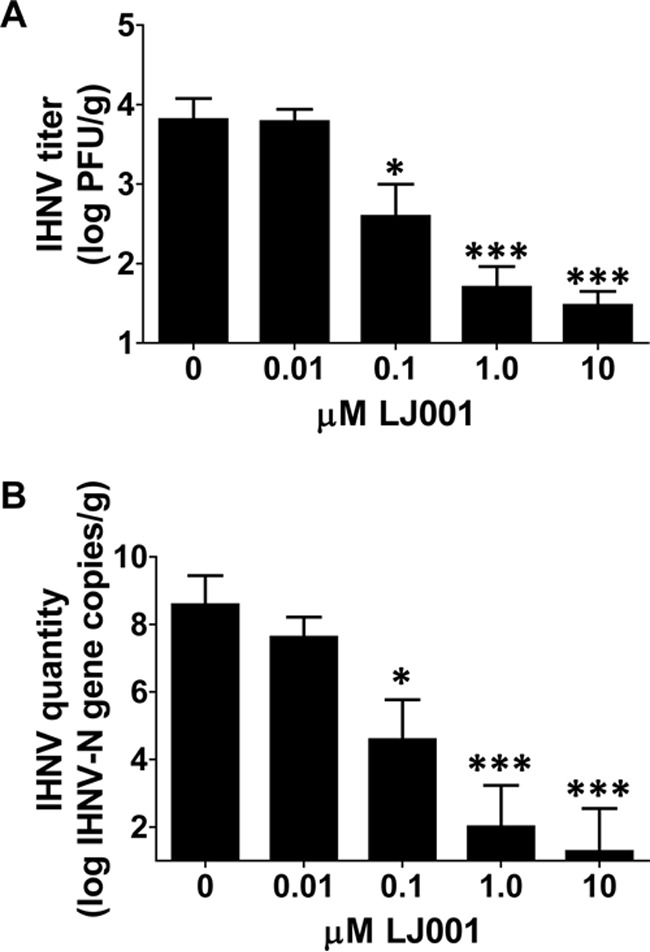
LJ001 blocks IHNV infection in vivo. Naive rainbow trout fry were immersed as a group in 1 × 10⁴ PFU/ml IHNV that was preincubated for 15 min with 0 to 10 μM LJ001 while being exposed to light. Following 12 h, fish were separated into isolation beakers, and the virus was allowed to replicate for 72 h. The homogenate supernatant from each fish was used for a plaque assay (A), and RNA was isolated and quantified by RT-rPCR (B) to determine the IHNV titer or quantity, respectively. The positive control was IHNV and the vehicle control only (0 μM LJ001 and 0.01% DMSO, final concentration). The negative control was MEM and 0.01% DMSO. (A) There was a highly significant inhibition of infection with 10 μM and 1.0 μM LJ001 and significant inhibition with 0.1 μM LJ001. Data represent mean IHNV titers ± standard errors (n = 5 fish per group). *, P < 0.05; ***, P < 0.001. (B) RT-rPCR probing for the IHNV N gene confirmed the plaque assay results. Data represent mean numbers of IHNV N gene copies ± standard errors (n = 5). *, P < 0.05; ***, P < 0.001.
FIG 4
FIG 4
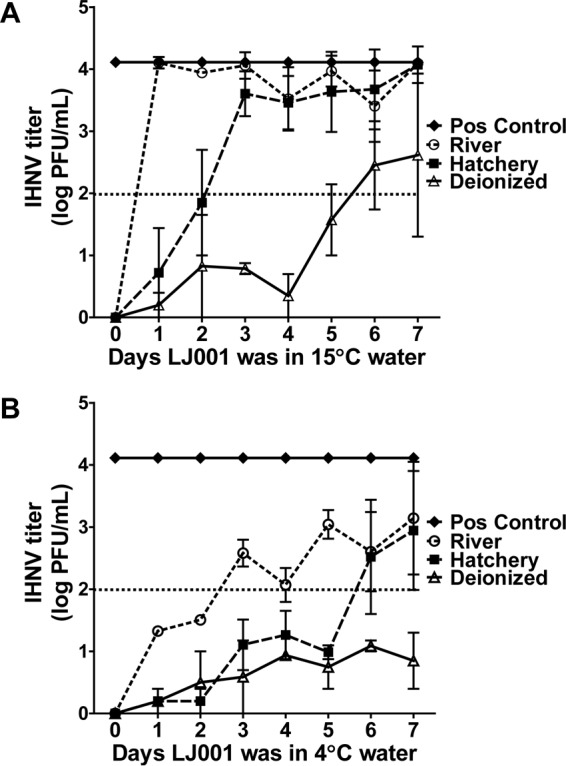
LJ001 is relatively stable in aquaculture environments. LJ001 was added to sterilized deionized, hatchery, or river water and placed at either 4°C or 15°C for 0 to 8 days (a new sample was created each day; not additive). On day 0 (final day), 1 × 10⁴ PFU/ml IHNV (final concentration) was preincubated with each treated water sample (10 μM LJ001, final concentration), followed by a plaque assay to determine the IHNV titer. There was complete inhibition of infection by LJ001 for all water and temperature conditions on day 0. The dotted line represents the inhibitory half-life titer (>50% inhibition of the positive control). (A) In 15°C water, LJ001 had an inhibitory half-life of between 1 and 2 days in hatchery water. After day 0, LJ001 in river water had no inhibitory effect. The inhibitory half-life of LJ001 in DI water at 15°C was ∼5 to 6 days. (B) When placed in 4°C water, the inhibitory half-life of LJ001 was prolonged under all water conditions. Data represent mean IHNV titers ± standard errors (n = 2).
FIG 5
FIG 5
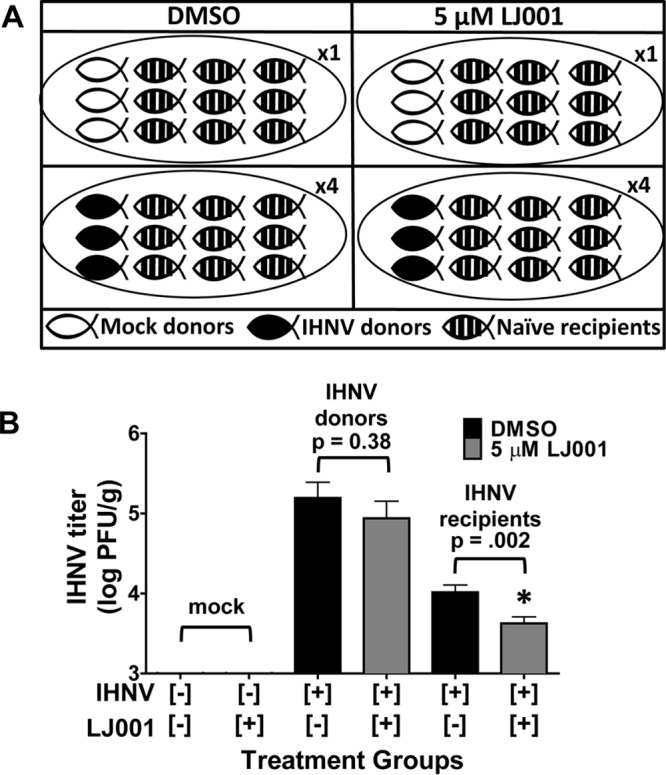
LJ001 inhibits horizontal transmission of IHNV. Rainbow trout were immersion infected with 2 × 10⁵ PFU/ml IHNV (donor fish) or MEM (mock) and remained in the flowthrough for 24 h. (A) Experimental groups. Three IHNV- or mock-infected donor fish were placed into static challenge containers, followed by the addition of LJ001 (5 μM final concentration) or 0.005% DMSO (vehicle control); after 15 min, nine naive recipient fish were added to each challenge container for cohabitation (n = 1 challenge container per mock-infected group, and n = 4 challenge containers per IHNV-infected group). Water exchanges and fresh LJ001 or DMSO dosing occurred every 24 h. (B) For donor fish that were immersion infected with IHNV, there was a nonsignificant (P = 0.38, as determined by Student's t test) decrease in viral loads for the LJ001-treated donor fish (12 fish) compared to DMSO-treated (vehicle control) donor fish (12 fish). There was a significant decrease in viral loads for LJ001-treated IHNV recipient fish (36 fish) compared to DMSO-treated (control) IHNV recipient fish (36 fish) (P = 0.002). All mock-infected fish had negative titers. Data represents mean IHNV titers ± standard errors (n = 12 for mock groups, n = 12 for IHNV donors, and n = 36 for IHNV recipients).
FIG 6
FIG 6
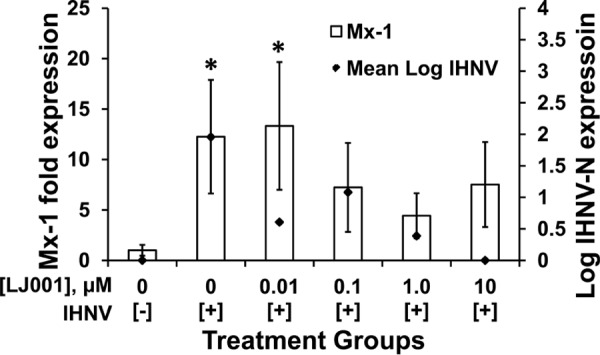
Mx-1 gene expression levels are elevated with LJ001-inactivated IHNV (10 μM). Naive rainbow trout fry (n = 5 fish per treatment group) were exposed in batch by immersion delivery of 1 × 10⁴ PFU/ml IHNV preincubated with 0 to 10 μM LJ001. Following 12 h, fish were separated into isolation beakers, and the virus was allowed to replicate for 72 h. Pectoral fins were sampled for Mx-1 gene expression and corresponding IHNV N gene expression levels. The positive control was IHNV and the vehicle control only (0.01% DMSO, final concentration). The negative control was MEM (mock) and 0.01% DMSO. Mx-1 gene expression was significantly upregulated in the positive-control and 0.01 μM LJ001 treatment groups compared to the negative control. *, P < 0.05. Data represent means ± standard errors for Mx-1 expression and mean IHNV titers.

References

    1. Food and Agriculture Organization of the United Nations. 2014. FAO Yearbook 2012, fishery and aquaculture statistics. Food and Agriculture Organization of the United Nations, Rome, Italy.
    1. Alonso M, Leong JA. 2013. Licensed DNA vaccines against infectious hematopoietic necrosis virus (IHNV). Recent Pat DNA Gene Seq 7:62–65. doi:10.2174/1872215611307010009. - DOI - PubMed
    1. Crane M, Hyatt A. 2011. Viruses of fish: an overview of significant pathogens. Viruses 3:2025–2046. doi:10.3390/v3112025. - DOI - PMC - PubMed
    1. Amend DF. 1975. Detection and transmission of infectious hematopoietic necrosis virus in rainbow trout. J Wildl Dis 11:471–478. doi:10.7589/0090-3558-11.4.471. - DOI - PubMed
    1. Woo PTK, Leatherland JF, Bruno DW. 2011. Fish diseases and disorders. CABI Publishing, Oxford, United Kingdom.

Publication types

MeSH terms

Substances

LinkOut - more resources